Heads up: some links here are affiliate links. If you buy through one we may earn a commission, at no extra cost to you. More
Brain Training for Dogs: A $67 online course (regular price $127) with 21+ brain games across seven levels, obedience lessons, trick videos and a members' forum, with a 60-day refund window.
See what's inside Brain Training for Dogs60-day money-back guarantee
What is bell potty training and when should you start?
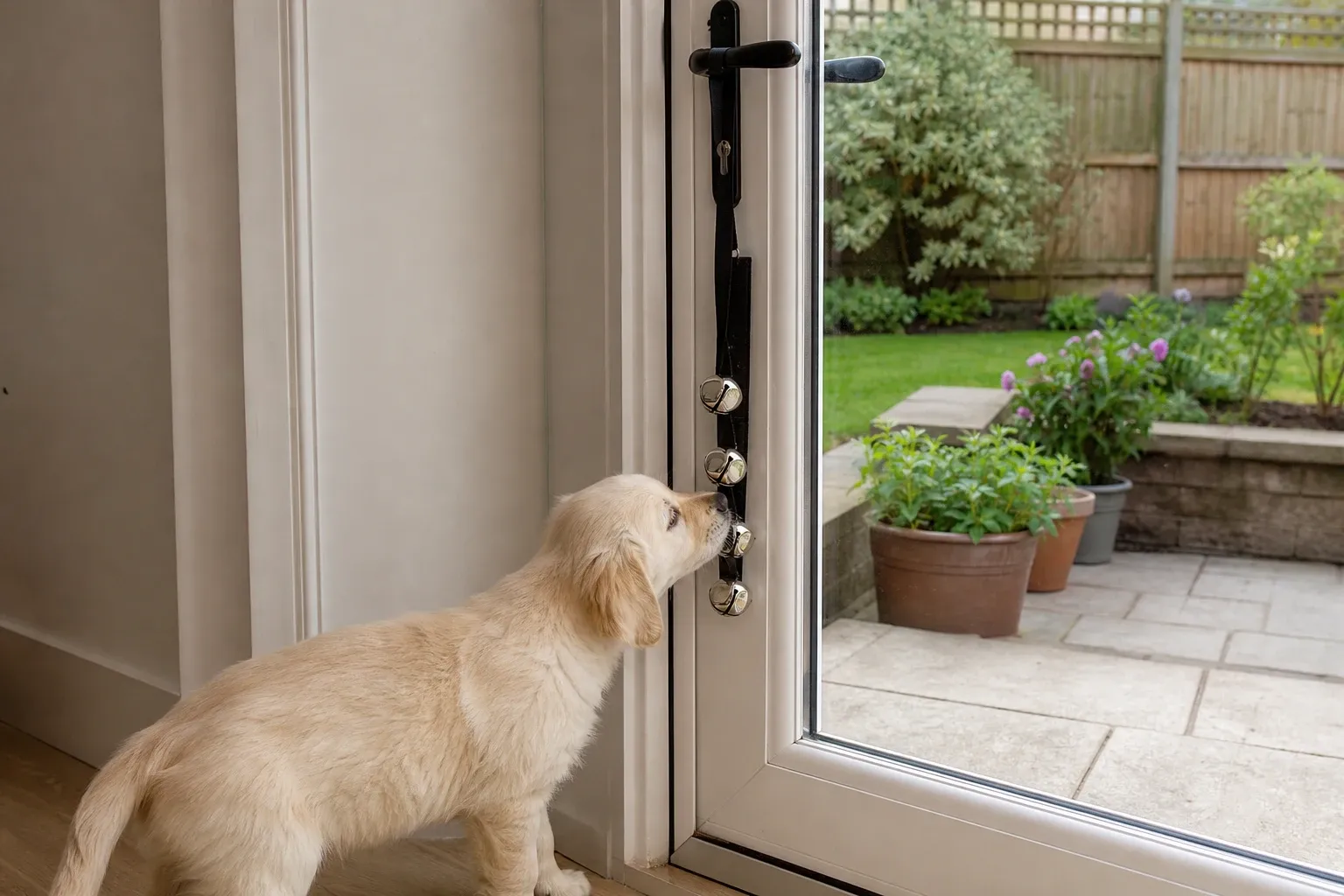
Bell potty training teaches your puppy that touching a bell by the door makes the door open for a potty break. It gives your puppy a clear way to tell you, “I need to go.”
Start once basic house training is in place. That means a regular schedule, frequent outings and one potty spot outside. If you’re still setting those up, begin with our guide to puppy potty training and add the bell a little later, or alongside it once the routine feels steady.
Young puppies have limited bladder control. A small puppy often can’t wait long, even if it knows the bell. So the bell adds to your schedule. It doesn’t replace it. You still take your puppy out on time, whether or not it rings.
This method suits puppies and adult dogs alike, and it’s especially handy in busy households where it’s easy to miss quieter signals like sniffing or circling.
Example: a puppy who already goes out after meals and naps is ready for the bell. A puppy who has no set routine yet will learn faster once the routine comes first.
What do you need? Bell types, height, and cost
You need a sturdy bell, a few small treats, a leash and a door you use for every potty trip. No special kit is required.
Choosing a bell
The best potty bell is sturdy, safe to chew near, and makes a sound your household can live with.
| Bell type | How it works | Good for | Watch out for |
|---|---|---|---|
| Hanging strand of bells | Puppy nudges a strap of jingle bells | Most puppies; cheap and simple | Loose or small bells that could come off and be swallowed |
| Push-button chime | Puppy presses a pad with nose or paw | Homes that want a softer sound; doors without a handle to hang from | Costs more; some puppies chew the pad |
| Single hanging bell | One larger bell on a cord | Bigger dogs; quieter homes | Cord length; keep it out of reach when unsupervised |
A strand of bells usually costs only a few dollars. Push-button chimes cost more. Pick one with no small parts that can detach, and check it now and then for wear.
Where to hang it
Hang the bell on the door you always use for potty trips, with the bells at your puppy’s nose height. Door placement matters: one door, one bell, one meaning.
Raise it as your puppy grows. Keep treats and the leash by that door so you’re ready the moment it rings.
Quick tip: If the jingle is too loud, wrap a little tape around the inside of each bell to soften it.
How do you bell train a puppy step by step?
You bell train a puppy by teaching a touch first, then linking that touch to the door opening and a potty break outside. Short gaps between bell, door and potty keep the link clear. Use positive reinforcement throughout, which simply means rewarding what you want so it happens more.
Step 1: Introduce the bell
The first step is letting your puppy meet the bell calmly, away from the door. Hold it low, let your puppy sniff, and give a treat. This makes the sound and object feel safe and pleasant.
Step 2: Teach a nose or paw touch
Nose targeting means your puppy bumps an object with its nose on purpose. Hold the bell an inch from your puppy’s nose. The moment the nose touches it, say “yes” and give a treat reward. Do 5 to 10 quick reps, then stop.
If your puppy already knows a hand touch, hold the bell in your palm so touching your hand means touching the bell. Keep sessions to a couple of minutes. Puppies learn best in short, happy bursts.
Step 3: Pair the touch with the door
Now hang the bell on the door. Before every potty trip, ask for the touch. As soon as the bell rings, open the door. This is why consistent timing matters: ring, then door, every single time, so your puppy sees the bell as the thing that opens it.
Step 4: Add a cue and reward outside
Once outside, use one consistent cue phrase, such as “go potty,” while your puppy is at the spot. The moment your puppy finishes, praise and give an immediate treat. Keep the outing short and a bit boring. Play can come after, or later, so the bell means potty, not a party.
Step 5: Let the puppy start the ring
The final step is waiting for your puppy to touch the bell on its own. At the door, pause and look at the bell instead of guiding. If your puppy nudges it, open the door straight away. Answer every ring, at least in these early weeks.
Teaching a puppy to start a behaviour on its own, like ringing a bell or coming when called, is often harder than teaching a cue like sit. That’s because it relies on your puppy choosing to do it without a prompt, so be patient here.
If you enjoy the touch work and want more structured games and tricks to keep your puppy’s mind busy, our Brain Training for Dogs review covers that course. It isn’t part of the bell method; it’s a separate place for game-based modules, trick videos and a members’ forum.
Worked example: one day of pairing the bell with door trips
A single day of bell practice is just your normal potty schedule with a bell touch added before each trip. Here’s how it might look with a 10 week old puppy.
| Time | What happens | Your help level |
|---|---|---|
| 6:30 am, wake up | Carry puppy to door, hold bell to nose, touch, door opens, “go potty,” treat | Full guidance |
| 7:15 am, after breakfast | Lead to door, point at bell, touch, out, cue, treat | Pointing |
| 9:00 am, after play | Same routine; puppy sniffs toward bell | Pointing |
| 11:00 am, after nap | Stand at door and wait 5 seconds; puppy bumps bell, door opens | Waiting |
| 1:00 pm, after lunch | Walk to door, wait; puppy looks at you, so you point | Pointing |
| Every 2 hours | Repeat the same pattern | Mixed |
| Bedtime | Last trip, calm and quiet, back to bed | Full guidance |
After each trip, jot down the time, whether your puppy peed or pooped, and whether it touched the bell alone. An accident log like this is gold. After a few days you’ll see your puppy’s natural timing, such as always needing to go 15 minutes after eating.
Fading your help is the key part. You move from holding the bell to pointing, then to simply waiting. If your puppy struggles, step back to the last stage that worked.
To plan the trip times themselves, see our schedule for potty training a puppy.
What if your puppy rings the bell but does not go?
A puppy that rings without going has usually learned that the bell opens the door to fun. The fix is keeping bell trips calm, short and focused on potty.
Ringing to play or go out
A puppy that rings for play needs every bell trip to stay dull. Take your puppy on leash to the spot, wait about two to three minutes, and go back in if nothing happens. No games, no chasing. Your puppy learns the bell gets a potty trip, not a romp.
Example: your puppy rings, sniffs a leaf and wants to play. Stand still, say nothing, then head inside.
Accidents without ringing
Accidents without ringing mean the schedule needs tightening for now. Take your puppy out more often and watch for sniffing, circling or wandering off.
Clean accidents with an enzymatic cleanser, a product that breaks down the smell so your puppy isn’t drawn back to the same spot. Use a baby gate to keep your puppy in the room with you. Never scold for a missed ring; it only teaches your puppy to hide when it needs to go.
Several people in the home
Bell training in a home with several people works when everyone does the same thing. Agree on one bell, one door, one cue phrase and one treat reward. Everyone answers every ring. A shared accident log on the fridge helps keep the whole household in step.
How long does it take, and when can a young puppy go outside?
Most puppies connect the bell with the door within days to a couple of weeks, and reliable ringing usually takes several weeks. Puppy age, bladder control and how consistent you are all change the timeline.
What to expect:
- First days: your puppy learns to touch the bell for treats.
- First couple of weeks: your puppy starts nudging it at the door with less help.
- Several weeks on: your puppy rings more often on its own, with occasional misses.
Can a 9 week old puppy go outside? Yes, a young puppy can use its own yard potty spot. Before walks in public places or dog areas, check with your vet about vaccinations.
You may also hear about the 7 7 7 rule, often described as 3-3-3. It’s a loose guide for a newly adopted dog settling in: about 3 days to decompress, 3 weeks to learn the routine, and 3 months to feel at home. It isn’t a bell method, but it’s a gentle reminder that rescued adult dogs may need extra time before bell training clicks.
If accidents suddenly increase, or your puppy needs to go far more often than usual, see your vet to rule out a health problem.
Where bell training fits in your puppy’s potty plan
Bell training is one tool inside your wider house training routine. It works best when the basics, regular trips, a set spot and instant rewards, are already steady.
For the full routine, start with Puppy Potty Training: A Step-by-Step Guide. Then use the Potty Training Schedule for a Puppy to set trip times that match your puppy’s age. For sit, stay and other everyday skills, our hub on dog & puppy training shows where to go next.
Once the bell habit is forming, some owners like adding structured games to fill the rest of the day. Brain Training for Dogs is a self-paced online course; the maker says it includes 21 games across 7 modules plus 7 trick videos. This assessment uses published course information; we have not worked through Brain Training for Dogs with a dog of our own.
See the current course details, price and refund terms on the creator’s site.
See what's inside Brain Training for Dogs60-day money-back guarantee
Your next step is simple: hang the bell at nose height today and start with five easy nose touches before dinner.
Owners also ask
Should I use a bell or a push button for potty training?
Either works for bell potty training. A strand of bells is cheap and easy for most puppies to nudge. A push-button chime suits homes wanting a softer sound or doors without a handle. Choose whichever your puppy can reach safely and that has no small parts it could chew off and swallow.
Can adult dogs learn to use a potty bell?
Yes, adult dogs can learn to ring a potty bell using the same steps as puppies: teach a nose touch, pair it with the door, and reward after going outside. Adults often have better bladder control, which can help. Newly adopted dogs may need time to settle into the home first.
Should I keep the potty bell up forever?
Many owners leave the potty bell up for good, since it stays a clear way for the dog to ask to go out. If you move it or take it down, your dog loses that signal. If you switch doors or homes, hang it again and practise the touch for a few days.