Heads up: some links here are affiliate links. If you buy through one we may earn a commission, at no extra cost to you. More
Brain Training for Dogs: A $67 online course (regular price $127) with 21+ brain games across seven levels, obedience lessons, trick videos and a members' forum, with a 60-day refund window.
See what's inside Brain Training for Dogs60-day money-back guarantee
What do you need before you teach a dog to stay?
To teach a dog to stay, you need a steady sit or down, a pocket of small treats, a release word and a quiet room. That’s the whole kit.
A reliable sit or down
A sit stay or down stay just means holding a position your dog already knows. If sit still needs a lure every time, spend a few more days to teach your dog how to sit first. The RSPCA suggests your dog be well practised at lying down before starting stay, and many dogs do find a down easier to hold than a sit.
Treats, a release word and a calm spot
The release word tells your dog the stay is over and they can move. Common choices are “okay,” “break” or “free.” Keep it different from your recall cue (the come command), so “come” always means run to you and the release word just means “you’re done.”
Train when your dog is calm, rested and not starving or stuffed. Use tiny, soft treats they can swallow fast. This is positive reinforcement: rewarding what you want so it happens more.
Dogs don’t follow sentences the way we do. They mostly pick up single words, your tone and your body. So choose one stay cue, say it once, and skip the dog’s name, which often means “get moving” to them.
Quick tip: Write your stay cue and release word on a sticky note for the whole household so everyone uses the same words.
How do you teach a dog to stay, step by step?
The dog stay command is built from three parts, called the three Ds: duration (how long), distance (how far you go) and distraction (what’s going on around you). Work on one at a time.
This method suits puppies and adult dogs alike, and fits busy households because each session takes about three minutes.
Step 1: Duration, from one second up
Duration comes first because your dog has to learn that staying still is what earns the treat.
- Ask for a sit.
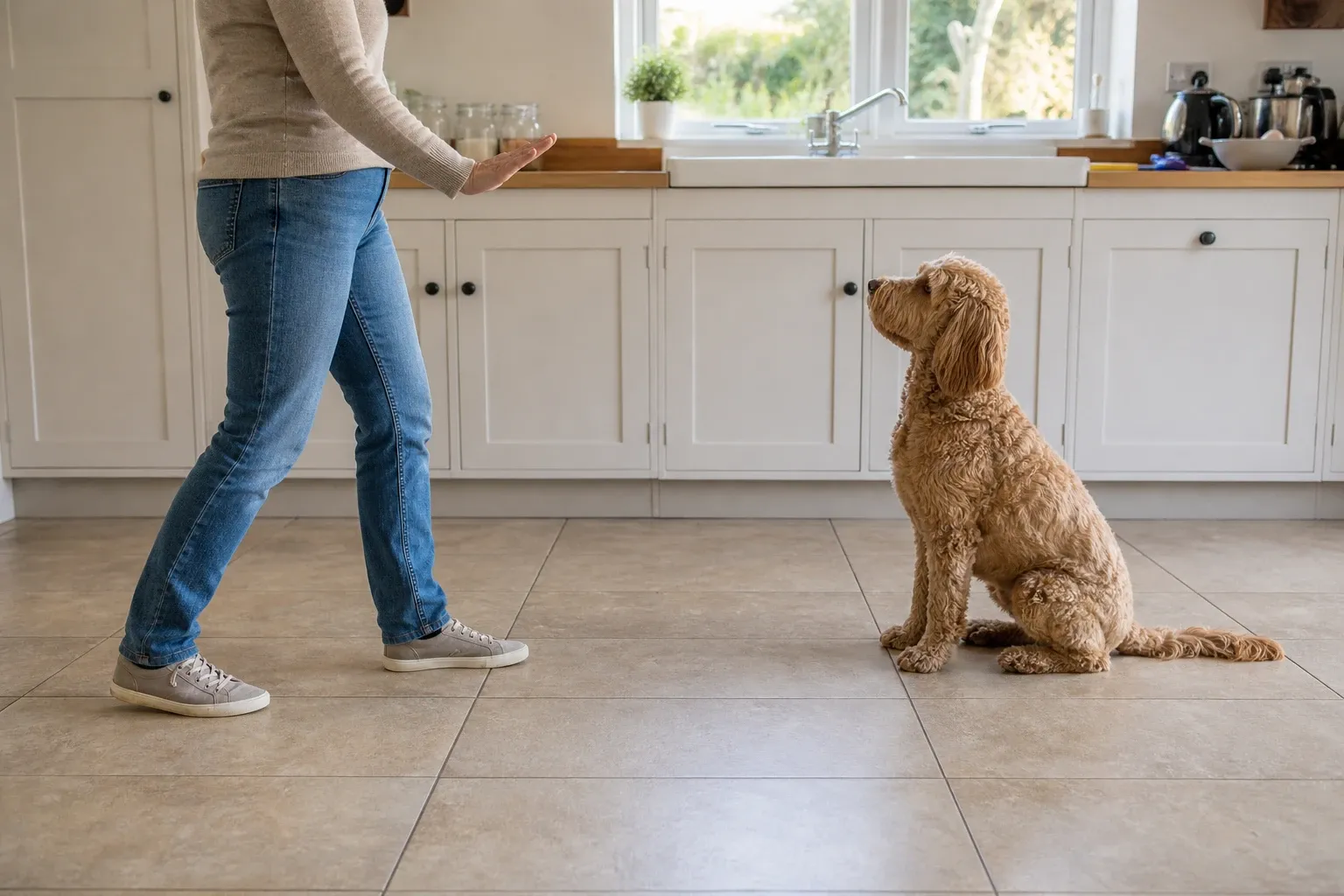
- Say “stay” once, calmly.
- Count one second in your head.
- Give a treat while your dog is still sitting.
- Say your release word in a happy voice and step back so they get up.
Worked example: today you do five reps at one second. Next session, try three seconds, then five, then ten, then 20. If your dog pops up at ten, drop back to five for a while. Reward in position, never after they’ve stood up.
Step 2: Distance, one step at a time
Distance starts with a single step, and you shorten the duration while you add it. Say stay, take one step back, step back in, treat, release. Then two steps. Then three. Always return to your dog to reward, so they learn you come back to them.
Step 3: Distraction, last and gently
Distraction is added last and in small doses, with you standing close again. Try shifting your foot, then a soft clap, then dropping a treat on the floor (pick it up yourself), then rolling a toy. Reward your dog for holding still through each one.
Step 4: Add a hand cue
A hand cue, like a flat palm facing your dog, is easiest to add once the verbal stay is solid. Show the palm just before you say “stay.” Over time your dog will respond to either.
How long does it take a dog to learn to stay?
Most dogs get the idea of a few seconds of stay within a handful of sessions, but a stay that holds through distractions usually takes weeks of short daily practice. Age, energy and past training all play a part.
A realistic timeline
| Stage | What you’re building | What to aim for before moving on |
|---|---|---|
| Early days | Duration in a quiet room | 10 to 20 seconds, almost no breaks |
| Next phase | Distance, short duration | Several steps away and back |
| Later | Mild distractions, you nearby | Holds through a clap or dropped treat |
| Ongoing | New places, longer stays | A minute or more in the garden or park |
These stages are a guide, not a deadline. Practise a few minutes at a time, two or three times a day, and stop while your dog is still keen.
What the 3-3-3 and 7-7-7 rules mean
The 3-3-3 rule is an informal idea about rescue dogs settling in: roughly three days to decompress, three weeks to learn the routine and three months to feel at home. The 7-7-7 idea for puppies is a loose checklist of new people, places and experiences. Neither is a rule for teaching stay, but both are a nice reminder to keep early training light for a dog who’s still settling.
Some owners like a structured, guided course alongside home practice. Brain Training for Dogs, a self-paced online course by Adrienne Farricelli, is one option; the maker says it offers seven game-based modules with over 21 games, trick videos and a members’ forum.
How do you teach a dog to stay next to you?
A heel-side stay teaches your dog to hold a sit at your side while you move, which is handy at doorways, curbs and car doors.
Heel-side stay
The heel-side stay starts with your dog sitting at your left side.
- Hold a treat at your dog’s nose level, say “stay” and stand still for two seconds. Treat and release.
- Take one step forward, step back beside your dog, treat, release.
- Try a step to the front, then a half circle, then a full walk around your dog.
Example: at a curb, you ask for a sit, say stay, and wait two seconds before crossing with your release word. This is great for adult dogs who already walk on a leash. Keep the leash loose so the stay comes from your dog, not from tension.
Why does my dog keep breaking the stay?
A dog who keeps breaking the stay is usually being asked for a little too much, too soon. That’s fixable.
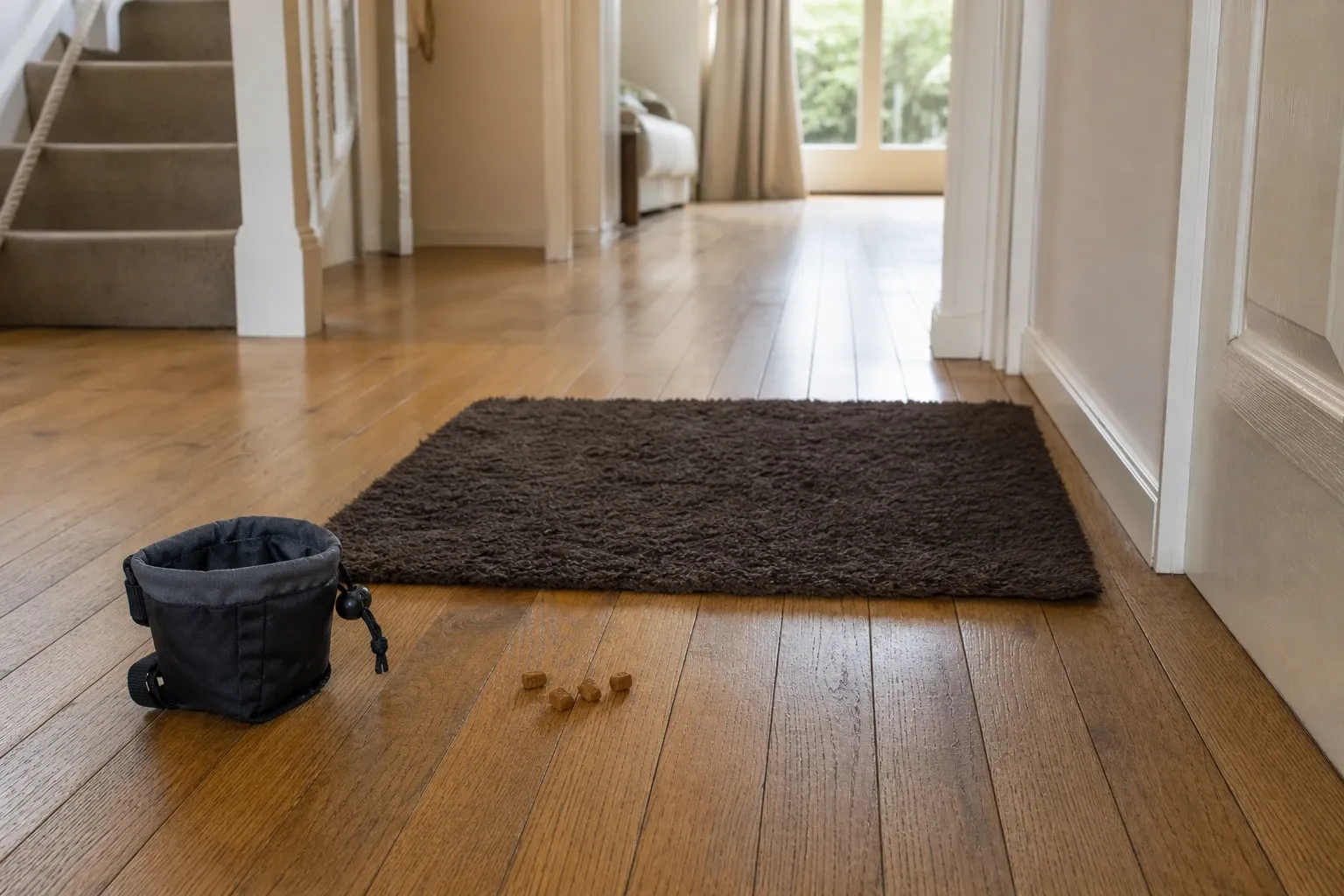
Stay often ranks among the harder cues, along with a solid recall, because it asks a dog to do nothing while the world gets interesting.
Common mistakes
- Moving up too fast, like jumping from 5 to 30 seconds
- Raising two Ds at once, such as walking away during a long stay
- Repeating “stay, stay, stay” or adding the dog’s name
- Releasing late, or forgetting to release at all
- Rewarding after the dog has already stood up
Quick fixes
- Go back to the last step your dog nailed
- Reward more often, every few seconds at first
- Keep sessions to two or three minutes
- Release before your dog breaks, so they win every time
The RSPCA advises watching for signs your dog is about to break and rewarding just before. If your dog does get up, Cornell’s guidance is to calmly lead them back and try again, since scolding won’t help. Example: your dog stands when you take a third step, so next rep, take two.
If your dog suddenly can’t hold a sit or down they managed before, or seems sore lying down, check with your vet.
Can puppies learn stay, and what is it used for?
Puppies can learn stay, starting with stays of just a second or two in a sit or down. Keep it short, bouncy and fun.
Puppy-friendly stay
A puppy stay works best right after play, when your puppy is a little tired. Ask for a down, wait one second, treat, then release with a cheerful word and a quick game. A toy reward can work too, but save it for the release, since a toy tends to make puppies leap up. Five reps is plenty.
Real-life uses
Stay is a safety skill first. It keeps your dog back from an open front door, holds them still at the vet, and lets you clip a leash on before they jump out of the car. It’s also part of the Canine Good Citizen exam, and it’s needed for therapy work and dog sports. Build toward a minute or more, slowly, over many sessions.
Where stay fits in your dog’s training basics
Stay sits alongside sit, down and come as one of the core everyday skills. Our guide to puppy training commands shows how these cues fit together and which to teach first. Once your dog holds a steady stay, pairing it with a recall is a natural next step, and this guide on how to teach my dog to come when called walks through it. For a wider starting point, see our dog & puppy training hub.
If you’d like guided, game-based lessons beyond stay, Brain Training for Dogs by Adrienne Farricelli is one option: self-paced games and obedience lessons you follow at home. Our Brain Training for Dogs review covers what’s inside and who it suits.
Check the current course details, price and refund terms on the creator’s site.
See what's inside Brain Training for Dogs60-day money-back guarantee
Your best next step is simple: tonight, ask for a sit, say stay, count one second, treat, and release.
Owners also ask
Is stay different from wait?
Many trainers use stay to mean hold still until I come back to you, and wait to mean pause briefly, then follow the next cue, like at a door. The exact words matter less than using each one consistently, and always ending both with a release word so your dog knows when to move.
Should I use treats or a toy to reward stay?
Small, soft treats usually work best for stay because you can deliver them while your dog holds still. A toy tends to get a dog excited and moving. Many owners use treats during the stay and save a quick toy game as a fun reward right after the release word.
Can an older dog learn stay?
Yes, adult and senior dogs can learn stay with the same small steps: short durations, rewards in position and a clear release word. Older dogs may prefer a down stay on a soft mat. If lying down or holding a sit seems uncomfortable, ask your vet before continuing training.