Heads up: some links here are affiliate links. If you buy through one we may earn a commission, at no extra cost to you. More
Brain Training for Dogs: A $67 online course (regular price $127) with 21+ brain games across seven levels, obedience lessons, trick videos and a members' forum, with a 60-day refund window.
See what's inside Brain Training for Dogs60-day money-back guarantee
How long can a puppy stay in a crate during the day?
A puppy can stay in a crate during the day for about one hour per month of age, plus one, and no more than about 4 to 5 hours even when grown. That’s a rule of thumb, not a promise. Some puppies need to go out sooner, especially after drinking, playing or waking up.
Think of the crate as a bedroom for naps, not a storage box for the workday. Your puppy needs awake time, play and company between crate stints.
Crate time limits by puppy age
Crate time limits grow slowly as your puppy’s bladder matures. Use this chart as a starting point and watch your own puppy.
| Puppy age | Rough daytime crate limit | What a workday needs |
|---|---|---|
| 8 to 10 weeks | 1 to 2 hours | Someone home, or a pen with a potty area |
| 3 months | About 3 hours | Two midday breaks, or a walker plus a pen |
| 4 months | About 4 hours | One or two midday potty breaks |
| 5 to 6 months | About 4 to 5 hours | One solid midday break |
| Adult (1 year+) | About 4 to 5 hours | A midday walk on full workdays |
The month-plus-one rule works because bladder control builds with age. But small breeds, very active pups and puppies still learning potty habits often need shorter stretches. If your 4-month-old soils the crate at three hours, three hours is your real limit for now.
Quick tip: Note the time of every accident for a week. The pattern shows your puppy’s true limit better than any chart.
Why adult dogs still have a ceiling
Adult dogs still need a crate time ceiling because long confinement means no movement, no sniffing and no chance to toilet. Four to five hours is a sensible daytime cap for most grown dogs.
Senior dogs and arthritis change the math. Older dogs often need to pee more often, and stiff joints get sorer when they can’t stretch. For an older dog, keep stints shorter, add a thick crate bed, and ask your veterinarian if stiffness or accidents seem new.
What does a puppy’s workday crate schedule look like?
A puppy’s workday crate schedule alternates short crate rests with potty breaks, play and meals, and it always includes a midday visit. Potty breaks go right after waking, eating and play, because those are the moments puppies most often need to go.
Sample schedule for a 9 to 5 job with a midday break
This 9 to 5 crate schedule suits puppies about 4 months and older, with a walker or family member at lunch.
- 6:30 Wake up, straight outside to potty
- 6:45 Play, short walk and sniffing
- 7:15 Breakfast, then potty again
- 7:45 Calm time out of the crate, then a short brain game
- 8:30 Into the crate with a stuffed chew
- 12:00 to 12:45 Midday break: potty, walk, play, a small meal for younger pups
- 12:45 Back in the crate with a fresh chew
- 4:30 to 5:00 You’re home: potty right away, then play
- Evening Dinner, potty, training games, family time, final potty before bed
That’s two stints of around 3.5 to 4 hours, which fits the age chart.
Sample schedule when you can only be home at lunch for 15 minutes
A 15-minute lunch visit is enough for a potty break, not for exercise. So make the morning and evening count.
For example: give a longer walk and play before work, then at lunch go straight outside, praise and treat for peeing, offer a few minutes of gentle play, and leave a new chew. Evening becomes your big exercise and social time. For puppies under 4 months, a 15-minute visit usually isn’t enough by itself; add a walker or use a pen.
Morning routine: exercise and tiring the puppy before leaving
A tired puppy settles in the crate far more easily than a wired one. Aim for a mix of body and brain work before you leave.
Try a 15 to 20 minute walk with plenty of sniffing, then five minutes of a simple game such as hiding treats in a towel. Finish with a calm potty trip. Sniffing is surprisingly tiring for dogs, a bit like a crossword is for us.
On the hardest-stage question: many owners find the period from around 4 to 9 months tough, as energy and testing rise. Steady routines help most here.
What can you do if no one is home for long?
If no one is home for a full workday, swap long crating for a dog walker, a playpen with a potty area, a dog-proofed room or daycare. Crating is one management option, not a must.
| Option | Best for | Watch out for |
|---|---|---|
| Dog walker or neighbor | Puppies 4 months+, busy households | Pick someone reliable who uses gentle handling |
| Playpen with potty area | Young puppies, long days | Some chewing of pads; supervise early on |
| Dog-proofed room | Older pups with good potty habits | Hidden cords, shoes and plants |
| Daycare | Social, healthy, vaccinated pups | Can overtire some puppies |
Hire a dog walker or ask a neighbor
A dog walker or a trusted neighbor turns one long day into two shorter ones. Ask them to follow your exact routine: potty spot, reward word, then play.
Use a puppy pen or a puppy-proofed room
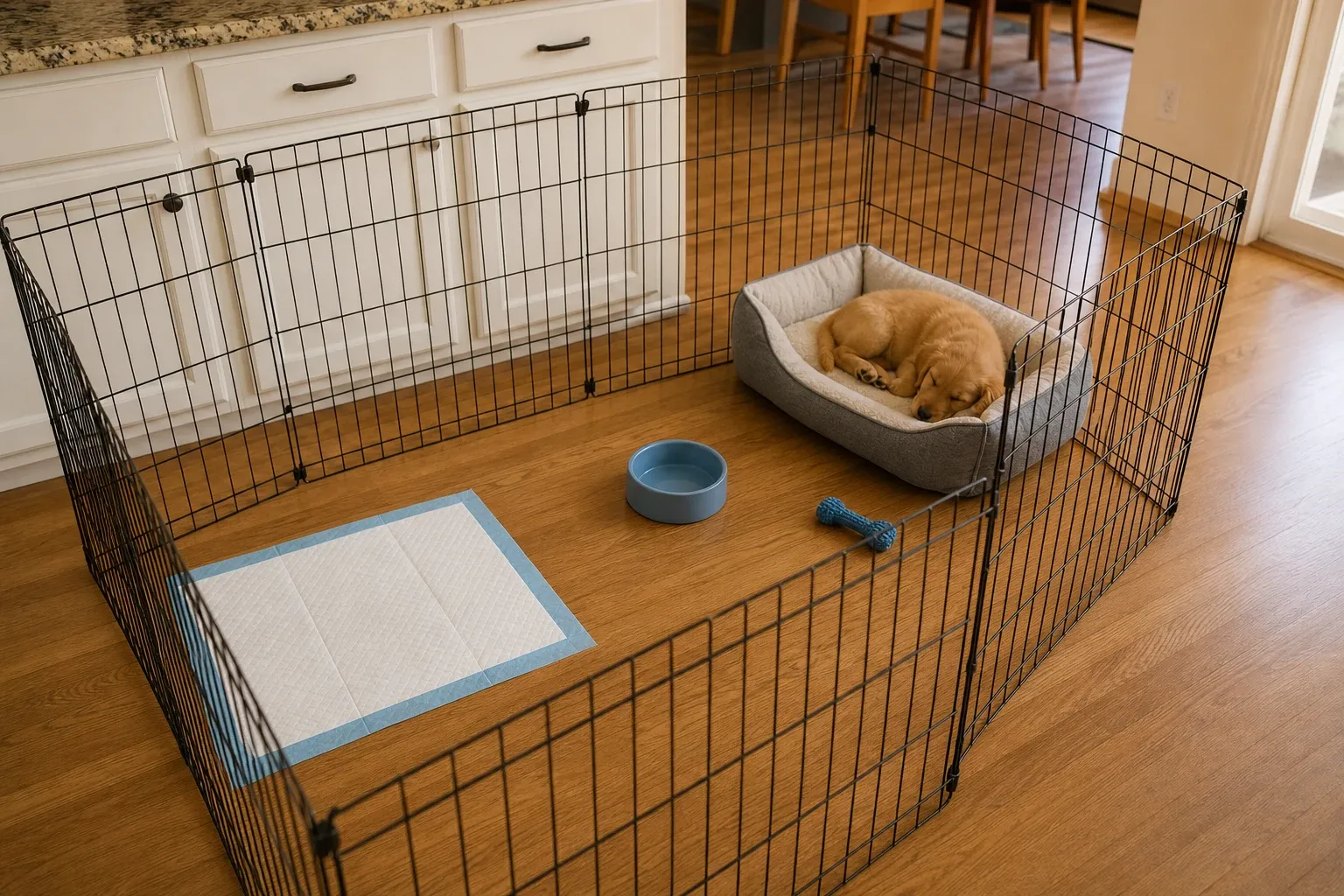
A playpen gives your puppy room to stretch, play and toilet on a pad away from the bed. Set the bed at one end, water and toys in the middle, a pad or grass tray at the other.
Open-door crate setup inside a pen
An open door crate inside a pen keeps the cozy den without locking your puppy in. Many pups choose to nap in it, which keeps the crate a happy place.
Is leaving a puppy crated for days ever acceptable?
No, leaving a puppy crated or alone for days is never acceptable, and the same goes for adult dogs left three days alone. Book a pet sitter, a trusted friend or boarding instead.
How do you crate train a puppy from scratch?
Crate training a puppy from scratch means pairing the crate with good things, then building time in small steps. Our crate puppy training guide goes deeper; here’s the short version for workdays.
Step 1: Make the crate a happy place
Make the crate a happy place with a soft crate bed, treats tossed inside and meals served there. Leave the door open and let your puppy wander in and out.
Step 2: Build up short stays
Build short stays by closing the door for about 10 minutes while you sit nearby. Give a stuffed chew, then open the door before your puppy fusses. Add a few minutes at a time over many sessions.
Step 3: Practice leaving the room, then the house
Practice leaving the room for a minute, then five, then ten, before you ever leave for a workday. Next, step outside for short errands. Never use the crate as punishment; it should always mean rest and good things.
If you’d like structured games to fill those calm evening sessions, Brain Training for Dogs is one self-paced option. It’s an online course of game-based modules and trick videos; the maker says the games help with obedience and behaviour training. It’s an add-on for mental stimulation, not a fix for anxiety.
What if my puppy cries in the crate?
Puppy crying in the crate is common in the first days and often eases as the routine becomes familiar, though how long it lasts varies from puppy to puppy.
The first night and first weeks
The first night is often the noisiest. Place the crate near your bed so your puppy can hear and smell you, and keep the first weeks calm and predictable.
Should you crate a puppy at night?
Night crating is generally fine and often helps house training, because puppies avoid soiling where they sleep. Do a late potty trip before bed, and for young pups, one quiet trip in the middle of the night. It isn’t required, though; a safe pen works too.
Signs of stress versus normal fussing
Normal fussing is brief whining that fades as your puppy settles. Real distress looks different:
- Heavy panting or drooling
- Frantic chewing or clawing at the door
- Soiling the crate after a recent potty break
- Howling that builds instead of fading
These can point to anxiety and stress, including separation anxiety, which long confinement can make worse. Scale back crate time right away and talk to your veterinarian or a qualified trainer if the distress keeps happening.
What are the 7 7 7 rule and puppy blues, and how do they affect crate time?
The 7 7 7 rule is a popular rule of thumb for socialising, often described as seven new surfaces, people, sounds and experiences by around a set age. It isn’t science, so treat it as loose inspiration, not a checklist to stress over.
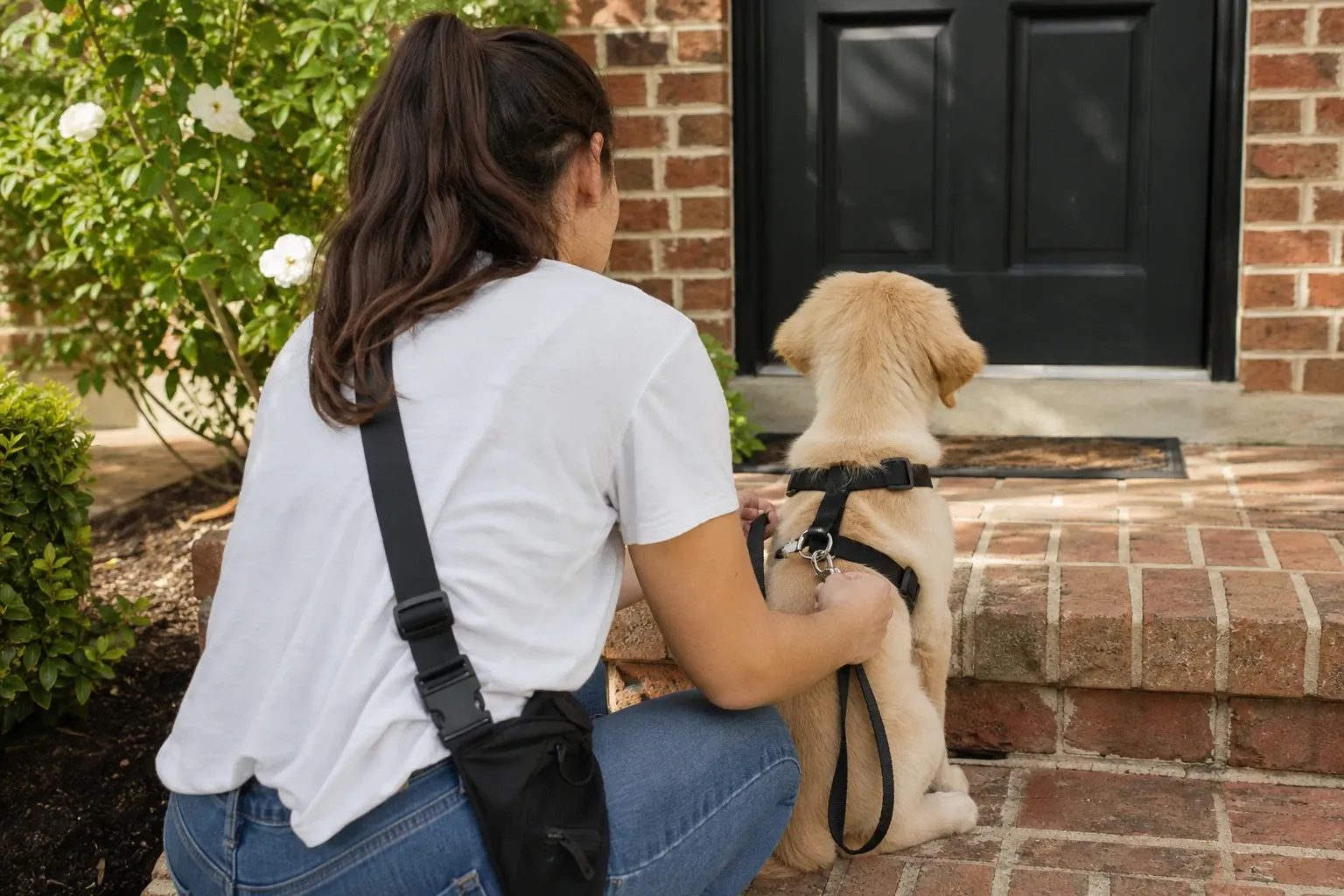
Puppy blues are the overwhelmed, tired or regretful feelings many owners get in the first weeks. Broken sleep and constant potty trips add up fast.
A clear crate and potty schedule helps both of you. For example, write the day’s plan on the fridge and ask a friend to cover one midday break a week. Sharing the load is a smart plan, not a failure.
How do you phase out the crate as your puppy grows?
Phase out the crate only once your puppy has reliable potty habits and no chewing accidents for several weeks. Rushing tends to bring setbacks.
Start with one dog-proofed room for short absences, such as a kitchen with gates and nothing chewable in reach. If that goes well, expand to more space bit by bit. Keep the crate set up with the door open; many dogs keep using it as their bed for life.
Where does daytime crating fit in your training plan?
Daytime crating is one piece of a wider crate routine. For the full step-by-step method, start with our complete guide to crate training a puppy. If your puppy is very young, see crate training a 8 week old puppy for tiny-bladder schedules. And for sit, stay, potty training and more, our dog & puppy training hub shows where to begin.
If evening brain games appeal to you, Brain Training for Dogs by Adrienne Farricelli is one option: self-paced games and obedience lessons you follow at home. Our Brain Training for Dogs review covers what’s inside and who it suits.
See what's inside Brain Training for Dogs60-day money-back guarantee
Your best next step today: time your puppy’s next few potty gaps, then build your workday schedule around the shortest one.
Owners also ask
Should I crate my puppy while I work from home?
Yes, short crate naps help a puppy who works from home with you learn to rest alone. Crate during calls or focused work for stints that fit your puppy’s age, with a chew inside. Take potty breaks between, and keep some time apart so your puppy doesn’t expect you every minute.
Can I put a puppy's water in the crate?
For short daytime crate stints, many owners skip water and offer a drink at each potty break. For longer stints or hot days, a clip-on bowl or bottle attached to the door helps avoid spills. Always make sure your puppy has had a chance to drink before going in.
Should I cover the crate?
Covering a crate with a light, breathable blanket can help some puppies settle by blocking busy views. Leave at least one side open for airflow, and remove the cover if your puppy chews it. Watch how your puppy reacts: some find it cozy, others feel more unsettled.