Heads up: some links here are affiliate links. If you buy through one we may earn a commission, at no extra cost to you. More
Brain Training for Dogs: A $67 online course (regular price $127) with 21+ brain games across seven levels, obedience lessons, trick videos and a members' forum, with a 60-day refund window.
See what's inside Brain Training for Dogs60-day money-back guarantee
What do I need before I teach my dog to sit?
To teach sit, you need small tasty treats, a quiet room and one agreed command word. That’s it. No special gear.
- Treats: soft, pea-sized and tasty, like bits of cooked chicken or soft training treats. Tiny pieces mean lots of rewards without a full belly.
- A calm training environment: a quiet room with few distractions. The kitchen after dinner, with the TV off, works well.
- One command word and one marker word: pick “sit” and a marker like “yes”. A marker is a short word that tells your dog “that exact thing earned the treat.” Make sure everyone at home uses the same words.
- A relaxed, slightly hungry dog: train before a meal, not right after a wild play session. Count treats as part of the day’s food so your dog doesn’t gain weight.
It also helps if your dog responds to its name first. Say your dog’s name once in a happy voice. The moment your dog looks at you, say “yes” and give a treat. Repeat this five or six times a day. Soon the name means “look at me, something good is coming,” which makes every other cue easier.
This setup suits puppies and adult dogs alike. For a busy household, keep a small pot of treats in one spot so anyone can run a quick session.
How do you teach a dog to sit, step by step?
The sit command is taught in four steps: lure, mark and reward, add the word, then fade the lure. Do 5 to 10 tries per session and stop after a few minutes.
Step 1: Lure the head up and back
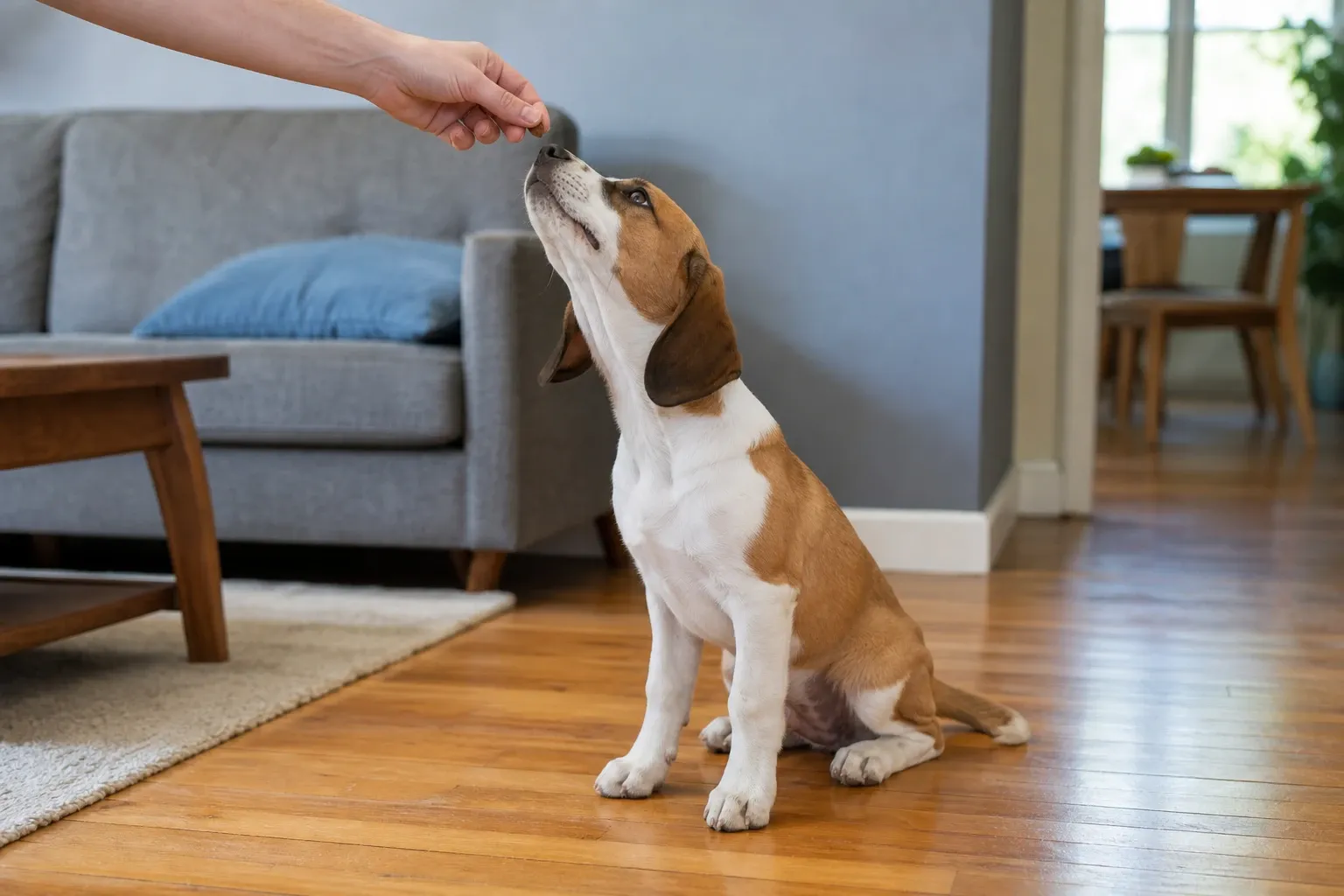
The lure works because when a dog’s nose goes up and back, its bottom naturally goes down. Hold a treat right at your dog’s nose, almost touching. Move it slowly up and back over the head, toward the tail. Keep it low, just an inch or two above the nose.
Step 2: Mark and reward the instant the bottom touches down
Timing of reward is what teaches your dog what you want. The second the bottom hits the floor, say “yes” and give the treat. Add warm praise like “good dog”. A treat that arrives two seconds late might reward standing up instead.
Step 3: Add the word “sit”
Add the command word only once your dog sits smoothly with the lure most of the time. At first, say “sit” just as the bottom lowers, so the word links to the position. After a few sessions, say “sit” once, just before you lure. Say it one time only.
Step 4: Fade the lure into a hand signal
Hand signals grow out of the lure movement. Hold the treat in one hand behind your back. Make the same upward sweep with your empty hand. When your dog sits, mark and reward from the other hand. Over time, make the sweep smaller until it’s a simple lift of the palm.
Quick tip: If your dog stops sitting when the treat leaves your luring hand, go back to the lure for a few tries, then try the empty hand again.
What if my dog bounces, backs up or loses interest?
Most sit problems come from the lure being too high, too fast or not tasty enough. Small changes usually fix them. Whatever the problem, reward any small bend in the back legs at first, then ask for a little more each time.
My dog keeps standing up or jumping for the treat
Jumping usually means the lure is too high. Keep the treat touching the nose and move it more slowly. Reward sooner, even for a half-sit. This is very common with bouncy puppies.
My dog backs away as I lure
Backing up means your dog is following the treat with its feet instead of its head. Practise with your dog’s back end near a wall or sofa so there’s nowhere to go but down. You can also use a shorter, tighter arc over the head.
My dog gets bored or ignores the treat
Boredom often means the treat isn’t worth it or the session is too long. Try a better treat, train before meals and keep sessions to a couple of minutes. Stop while your dog still wants more, so next time starts on a keen note.
People often say the hardest cues to teach are a reliable recall or a long stay. Sit is one of the easier ones, which is why it’s a good first cue for building confidence for both of you.
What are the common mistakes when teaching sit?
The most common sit training mistakes are repeating the word, rewarding late and pushing the dog down. Each one is easy to fix.
| Mistake | Why it causes trouble | What to do instead |
|---|---|---|
| Saying “sit, sit, SIT” | Your dog learns the word means nothing until the third try | Say it once, then lure if needed |
| Late rewards | The treat rewards whatever happened last | Mark with “yes” the instant the bottom lands |
| Pushing the bottom down | Can feel unpleasant and doesn’t teach the dog to choose to sit | Let the lure do the work |
| Luring too high | Your dog jumps instead of sitting | Keep the treat at nose level |
| Dropping treats too early | The sit falls apart | Fade treats slowly once the sit is solid |
| Only practising in one room | The sit doesn’t work elsewhere | Practise in new places, step by step |
| A harsh or shouting voice | Can make your dog worried or slow | Use a calm, happy tone |
Dogs seem to perk up at short, cheerful words they’ve linked to good things, like “yes”, “good” and their name. Use those words during sit training and they’ll carry a happy meaning.
How long does it take, and is it too late for an older dog?
Most dogs start sitting to the lure within a few short sessions. A sit that holds up with distractions often takes days to weeks of practice, and it’s never too late to start.
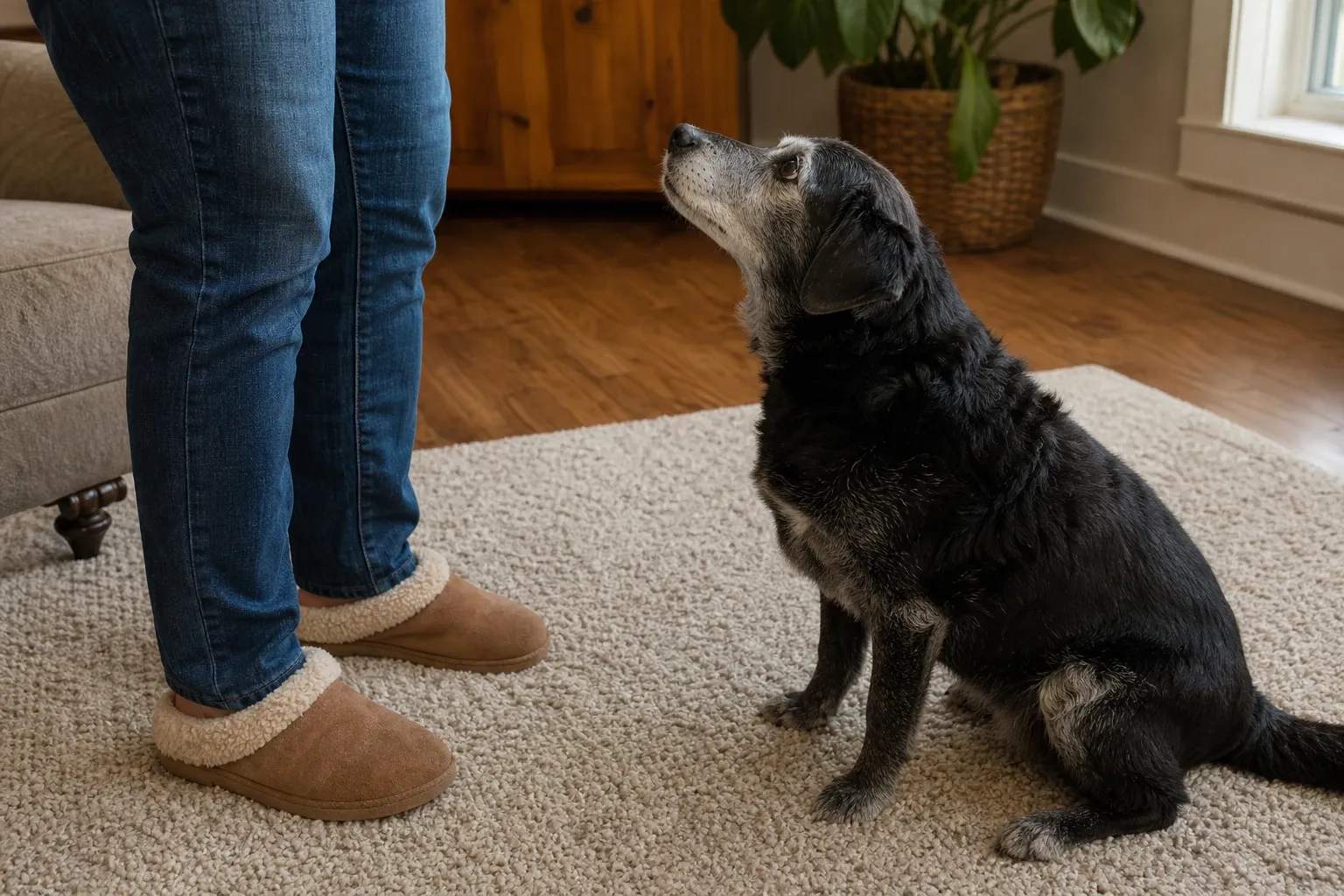
Puppy vs adult dog
A puppy has a short attention span, so think one or two minutes, several times a day. An adult dog can often focus longer but may have old habits, like jumping up for food, that need extra patience. Senior dogs or dogs with stiff joints do better on a soft rug with fewer reps. If sitting seems painful, check with your vet.
A realistic timeline
Every dog learns at its own pace, so there’s no set timeline. Consistency and repetition matter more than long sessions. Five short sessions spread across a day usually go further than one long one.
If you’ve just adopted a dog, you may hear of the 7-7-7 rule. It’s a common rule of thumb, not a scientific finding, suggesting a new dog needs about 7 days to decompress, 7 weeks to learn routines and 7 months to feel fully at home. In those early days, keep sit training gentle, short and fun, as a way to bond.
How do I make sit reliable in other rooms and outdoors?
A reliable sit comes from practising in new places, adding distractions slowly and reducing treats a little at a time. Dogs don’t automatically carry a cue from the kitchen to the park.
- Generalise step by step. Move from one room to another, then the garden, then a quiet street. Each new place is a bit like starting again, so make it easy.
- Add distractions slowly. Try a sit while someone walks past, then with a toy on the floor.
- Gradually reduce treats. Once the sit is solid, reward every second or third sit, mixed with praise. Use life rewards too: sit before the door opens, before the ball is thrown or before dinner goes down.
- Build a little duration. Wait one second longer before the treat. This is the first step toward stay.
For example, ask for a sit before clipping on the lead for a walk. The walk itself is the reward.
If your dog seems stuck, worried or stressed during training, a qualified trainer can help you in person.
Where does sit fit with your dog’s other basics?
Sit is usually the first cue in a set of everyday basics that build on each other. Once your dog sits on cue, down and stay come next. Our guide to puppy training commands shows a simple order to teach them in.
A steady sit is the starting point when you teach your dog how to stay. It also helps with recall, because many owners ask for a sit when the dog arrives. See how to teach your dog to come when called for that next step, or start from our dog & puppy training hub.
If you’d like a structured set of games and tricks to try after sit, Brain Training for Dogs by Adrienne Farricelli is a self-paced online course. The maker says it includes 21 games across seven modules plus seven trick videos.
Check the current Brain Training for Dogs course, price and refund terms on the creator’s site.
See what's inside Brain Training for Dogs60-day money-back guarantee
Your best next step is simple: grab five tiny treats, find a quiet spot and try the lure today for two minutes.
Owners also ask
Should I use a clicker to teach my dog to sit?
A clicker is optional. It makes a short, clear sound that marks the exact moment your dog does the right thing, just like saying “yes”. Some owners find it sharpens their timing. If you’d rather keep things simple, a consistent marker word works well for teaching sit.
Can I teach a dog to sit without treats?
Yes, though treats usually make learning faster and clearer. You can use a favourite toy, a game of tug or praise as the reward, as long as your dog truly wants it. Some owners also capture sits by rewarding the dog whenever it sits on its own.
How many times a day should I practise sit?
Two to five short sessions a day suits most dogs, with 5 to 10 tries in each. Puppies do best with very brief sessions of a minute or two. Spreading practice through the day, such as before meals and walks, builds the habit without tiring your dog.