Heads up: some links here are affiliate links. If you buy through one we may earn a commission, at no extra cost to you. More
Brain Training for Dogs: A $67 online course (regular price $127) with 21+ brain games across seven levels, obedience lessons, trick videos and a members' forum, with a 60-day refund window.
See what's inside Brain Training for Dogs60-day money-back guarantee
Is 8 weeks too early to crate train a puppy?
No, 8 weeks is not too early to crate train a puppy: it’s an ideal time to start, because your 8-week-old puppy has no habits to undo yet. Begin on day one with short, cheerful sessions.
A crate is a safe, den-like space. It keeps your puppy out of trouble when you can’t watch, protects cables and shoes from little teeth, and helps house training, because most puppies don’t like to soil the spot where they sleep.
Six and seven weeks are different. Puppies normally stay with their mother and littermates until about 8 weeks, where they learn a lot about play and gentle biting. If your puppy came home earlier, you can still use a crate. Just keep stretches very short and lean on close supervision.
The crate is a tool for part of the day, not a place to park a puppy. Think of it like a cot for a toddler: great for naps and safety, not for spending the whole afternoon.
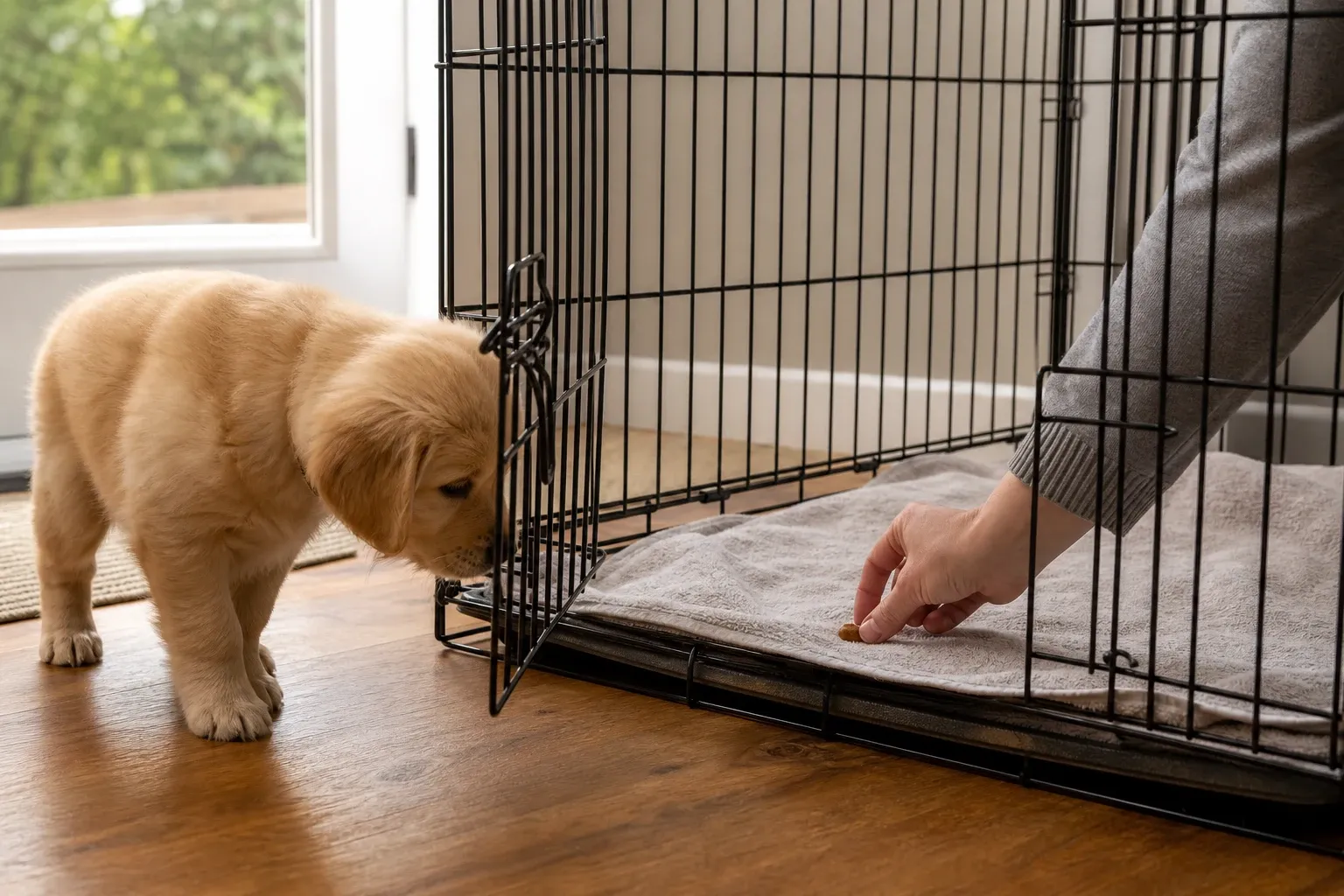
For example, on day one you might toss a treat into the open crate, praise your puppy for stepping in, and let them walk straight back out. That’s a full, successful session.
This tip suits every new puppy, from tiny breeds to big pups.
Crate training by puppy age: a chart of realistic crate times
Realistic crate times grow slowly with age, and the chart below gives a starting point for each stage from 6 weeks to 7 months. Treat every number as a ceiling, not a goal.
The common bladder rule is your puppy’s age in months plus one hour. So a 2-month-old can usually hold it for up to about 3 hours when resting. Awake, active puppies need to go far more often.
| Age | Daytime crate stretch | Night stretch between breaks | Potty breaks (awake) | What to practise |
|---|---|---|---|---|
| 6 to 7 weeks | 5 to 30 minutes, mostly naps | 2 to 3 hours | Every 30 to 60 minutes | Treat tosses, door open, sleeping near you |
| 8 to 10 weeks | 30 minutes to 1.5 hours | 2 to 3 hours | Every 1 to 2 hours, plus after naps, meals, play | Crate cue, meals in crate, short door-closed naps |
| 3 to 4 months | 1.5 to 3 hours | 4 to 5 hours | Every 2 to 3 hours | Settling with a chew, you leaving the room |
| 5 to 7 months | 3 to 4 hours | Often 6 to 8 hours | Every 3 to 4 hours | Calm settling after exercise, short absences from home |
6 to 7 weeks
Crate training a 6-week-old or 7-week-old puppy should be gentle and very brief. Use the crate mainly for naps with the door open, keep it next to you, and expect night breaks every 2 to 3 hours. Best for pups who came home early.
8 to 10 weeks
Crate training a 9-week-old or 10-week-old puppy builds on short naps of up to about an hour and a half. Take your puppy out the moment they wake. Most need one or two quiet trips outside overnight.
3 to 4 months
Crate training a 3-month-old or 4-month-old puppy can include longer daytime naps and nights of four or five hours. Bladder control is improving, but teething can bring extra chewing, so keep a safe chew in the crate.
5 to 7 months
Crate training a 5-, 6- or 7-month-old puppy usually means a few hours by day and most of the night. Exercise first matters more now, because a bored adolescent finds it harder to rest.
Small and toy-size pups have tiny bladders, so give them more frequent breaks than the chart shows. Read the chart as a ladder: add 10 to 15 minutes only after several dry, calm sessions in a row.
How do you set up the crate and make it a happy place?
A happy crate is the right size, sits where the family is, and is linked with food, chews and calm. Get these three right and most puppies settle faster.
Choosing the right crate size
The right crate size lets your puppy stand, turn around and lie down stretched out, with little spare room. Too much space invites a toilet corner. A crate with a divider lets you buy for the adult size and move the panel as your puppy grows. Breed differences matter here too, and our guide to crate training a lab puppy and other breeds covers sizes in detail.
Where to put the crate
The best crate spot is a busy room by day and near your bed at night. Puppies are social, and being alone in a far room can feel scary. Some families use two crates to avoid carrying one around.
Feeding meals in the crate and the crate cue
Feeding in the crate is one of the easiest ways to build a good feeling about it. Start with the bowl just inside the door, then move it further back over several meals. Add soft bedding, a safe chew and treats.
Pick a simple crate command such as “crate” or “bed”. Say it once, toss a treat inside, and praise when your puppy goes in. Soon the word alone gets them moving.
Never use the crate as punishment. It should always feel like a good place to be.
This setup works for puppies of any age and for busy households who need a reliable safe spot.
What does a first-week routine look like at 8 weeks?
A first-week crate schedule at 8 weeks is a simple loop: potty, play, meal, potty, nap in the crate, repeat. Young puppies sleep around 18 to 20 hours a day, so naps are where the crate earns its keep.
A sample daytime schedule
Here’s one day you can copy and adjust:
- 7:00 Wake, straight outside for potty
- 7:15 Breakfast in the crate, then potty
- 7:45 Play and short training, then potty
- 8:30 Nap in the crate with a chew
- 10:00 Wake, potty, play, potty, nap
- 12:00 Lunch in the crate, potty, play, nap
- Repeat through the afternoon and evening
- 22:30 Last potty, calm time, bed
The key rule for house training is a potty trip straight after waking, eating, play and every crate release. Our daytime crate training guide has more sample days.
Short practice sessions and building time gradually
Short, door-closed sessions of 5 to 10 minutes with a long-lasting chew are the best way to start. Sit nearby, then open the door before your puppy fusses. Add a few minutes at a time.
Many owners ask which puppy stage is hardest. The first weeks are tiring because of night breaks, and adolescence, often around 6 to 12 months, brings testing and forgetfulness. Both pass with patient routines.
Should a puppy sleep in a crate at night, and how long can they cry the first night?
Yes, nighttime crating is fine for an 8-week-old puppy and helps with safety and potty training. Keep the crate beside your bed so your puppy can hear and smell you.
Bedtime routine
A good bedtime routine is the same every night: last potty, ten minutes of calm cuddles or a chew, then into the crate with the cue and a treat. Lights low, voices soft.
Night potty breaks
Night potty breaks at 8 weeks usually happen once or twice. Carry your puppy out, wait quietly, praise softly, and go straight back to the crate. No play, no bright lights. Make it boring. As dry nights add up, set your alarm 15 minutes later.
How long to let a puppy cry in the crate
On the first night home, a few minutes of fussing is normal, but long crying needs a response. Learn the difference:
- Need to potty: sudden whining after sleep, sniffing, circling. Take them out.
- Protest: whining right after the door closes. Wait for a short pause, then calmly reassure.
- Rising distress: crying that builds or goes on for long stretches. Take them out, check needs, and move the crate closer.
Avoid opening the door in the middle of loud demands, but don’t leave a frightened puppy to cry it out for hours.
The 7-7-7 rule is a loose settling-in idea some people use: give a new puppy about 7 days to decompress, 7 weeks to learn your routine and 7 months to feel fully at home. It isn’t science, just a reminder to be patient. See our plan for crate training a puppy at night for more detail.
Can I keep my puppy in a crate while I’m at work?
No, a young puppy can’t stay in a crate for a full workday. Use the age-based bladder limit, and arrange a midday break.
Maximum hours by age
Maximum daytime crate hours, in one stretch, roughly follow the chart:
- 8 to 10 weeks: up to about 1.5 hours
- 3 to 4 months: up to about 3 hours
- 5 to 7 months: up to about 4 hours
For an eight-hour day, you’ll need someone to visit. A pet sitter, dog walker, friendly neighbour or a trip home at lunch all work.
Alternatives: playpen, baby gate and puppy pads
A playpen with a bed at one end and puppy pads at the other gives your pup room to move and somewhere to toilet. A gated, puppy-proofed kitchen does the same. Remove cords, plants and anything chewable.
For example, you might crate for the morning nap while you get ready, then switch to the playpen for the hours you’re out, with a sitter dropping by at noon.
Watch for separation anxiety signs: frantic barking, drooling, chewing the bars or trying to escape whenever you leave. These mean slow down and talk to your vet or a qualified behaviour professional. A course or crate plan can’t fix real panic on its own.
This section is best for working households and anyone out of the house for more than a few hours.
What if my puppy whines, barks or has an accident in the crate?
Whining, barking or accidents in the crate usually mean a need hasn’t been met or progress went too fast. Check the basics before anything else.
Whining and barking troubleshooting
Run through this checklist:
- Does your puppy need a potty break?
- Have they had enough play and exercise?
- Are they hungry or thirsty?
- Is the crate too hot, cold, bare or far from you?
- Did you add time too quickly?
Then go back a step: shorter sessions, crate closer to you, and a calmer routine before the door closes. A stuffed chew often helps a puppy settle.
Cleaning up and resetting after a soiled crate
A soiled crate needs a calm clean-up and a reset, never scolding. Follow these steps:
- Take your puppy outside first.
- Wash bedding and wipe the crate with an enzymatic cleaner, which breaks down the smell so the spot doesn’t invite a repeat.
- Use a plain mat or no bedding for a while, as soft beds can soak up accidents.
- Shorten your crate stretches and add a potty break.
- Check the crate size and use the divider if there’s room for a toilet corner.
If your puppy soils the crate often, cries in real distress, or suddenly starts having accidents after doing well, check with your vet first, then a trainer.
Crate training an older puppy: 3 to 7 months or a new arrival
Older puppies can learn crate training well, though some need a slower, more positive start, especially if the crate is new or was used badly before.
Starting with a 4 to 7 month old puppy
Starting with a 4- to 7-month-old puppy means going back to basics: open door, treat tosses, meals in the crate, then short door-closed sessions. Don’t skip steps just because your puppy is bigger.
Pair crate time with exercise and brain games so rest comes naturally. A sniff walk and a five-minute food puzzle before a nap work well, like letting a child run around at the park before quiet time.
Expect setbacks during teething and adolescence. A pup who was settled at 4 months may test the crate at 6 months. Shorten sessions for a while and keep it positive.
Once the crate routine feels steady, some owners like a structured plan for what comes next. Brain Training for Dogs is a self-paced online course by Adrienne Farricelli; the maker says it has 7 modules with over 21 games for obedience and behaviour, plus 7 trick videos and a bonus behaviour course. This assessment uses published course information; we have not worked through Brain Training for Dogs with a dog of our own. It isn’t a substitute for a vet or behaviour professional.
How long does a 5-month-old take to adjust?
A 5-month-old usually takes a few days to a few weeks to adjust to a new home, and some take longer. The 7-7-7 rule is a gentle guide: first days for decompressing, the next weeks for routine.
This section is best for rescues, rehomed pups and owners starting the crate a little later.
Where this fits in your crate training plan
Crate training by age is one piece of the bigger picture in our step-by-step crate puppy training guide, which walks through each stage from first introduction to an open-door crate. If your nights are the hard part, our night plan goes deeper, and the daytime guide helps with work schedules. When you’re ready to add sit, stay and recall, head to our dog & puppy training starting point.
If a structured, game-based plan for basics and mental stimulation sounds useful once the crate is settled, you can look at the course details. Check the current Brain Training for Dogs course, price and refund terms on the creator’s site.
See what's inside Brain Training for Dogs60-day money-back guarantee
Whatever your puppy’s age, keep tonight simple: a last potty, a calm few minutes, the crate beside your bed, and a quiet trip outside if they wake.
Owners also ask
Should I put water in my puppy's crate?
For short daytime naps, most puppies don’t need water in the crate. For longer stretches, a clip-on bowl or bottle helps on warm days. Many owners remove water an hour or two before bedtime to cut night breaks, but always offer plenty of water during the day.
Should I cover my puppy's crate with a blanket?
A light, breathable cover over part of the crate can help some puppies feel cosy and settle at night. Leave the front or one side open for airflow, and remove it if your puppy pulls the fabric through the bars and chews it. Watch for overheating in warm rooms.
When can a puppy sleep outside the crate at night?
Many puppies are ready to sleep loose when they’ve had several weeks of dry nights and no chewing of household items, often somewhere between 6 months and a year. Start with the crate door open in a puppy-safe room, and go back to closing it if accidents or chewing return.