Heads up: some links here are affiliate links. If you buy through one we may earn a commission, at no extra cost to you. More
Brain Training for Dogs: A $67 online course (regular price $127) with 21+ brain games across seven levels, obedience lessons, trick videos and a members' forum, with a 60-day refund window.
See what's inside Brain Training for Dogs60-day money-back guarantee
Start here
These guides take each part of home training a step further.
- Dog and puppy training at home: where to begin with rewards, routines and the first cues.
- Dog puzzle toys, from DIY to store-bought: puzzle types, difficulty levels and how to make your own.
- Easy tricks to teach your dog: short, fun tricks that double as brain work.
- Online dog training courses compared: how the main self-paced courses differ, so you can decide if you want one.
- Our Brain Training for Dogs review: who that game-based course suits and who should skip it.
Which brain game should you start with?
Five quick questions suggest a first game for your dog. It's a starting point, not an assessment.
Gentle sniffing games
Start with a treat hunt using easy, visible spots, or a snuffle mat on the floor. Sniffing is calm, low-impact work, and you can make it harder a little at a time once your dog is relaxed and keen. Keep sessions short and end while your dog still wants more.
A structured, game-based course could suit you
If you’d rather follow set levels than choose games yourself, a course gives you an order to work through. Read our Brain Training for Dogs review to see who it suits, and compare the main options in online dog training courses compared. The free games on this page are plenty to start with either way.
See what's inside Brain Training for Dogs60-day money-back guarantee
Short find-it games
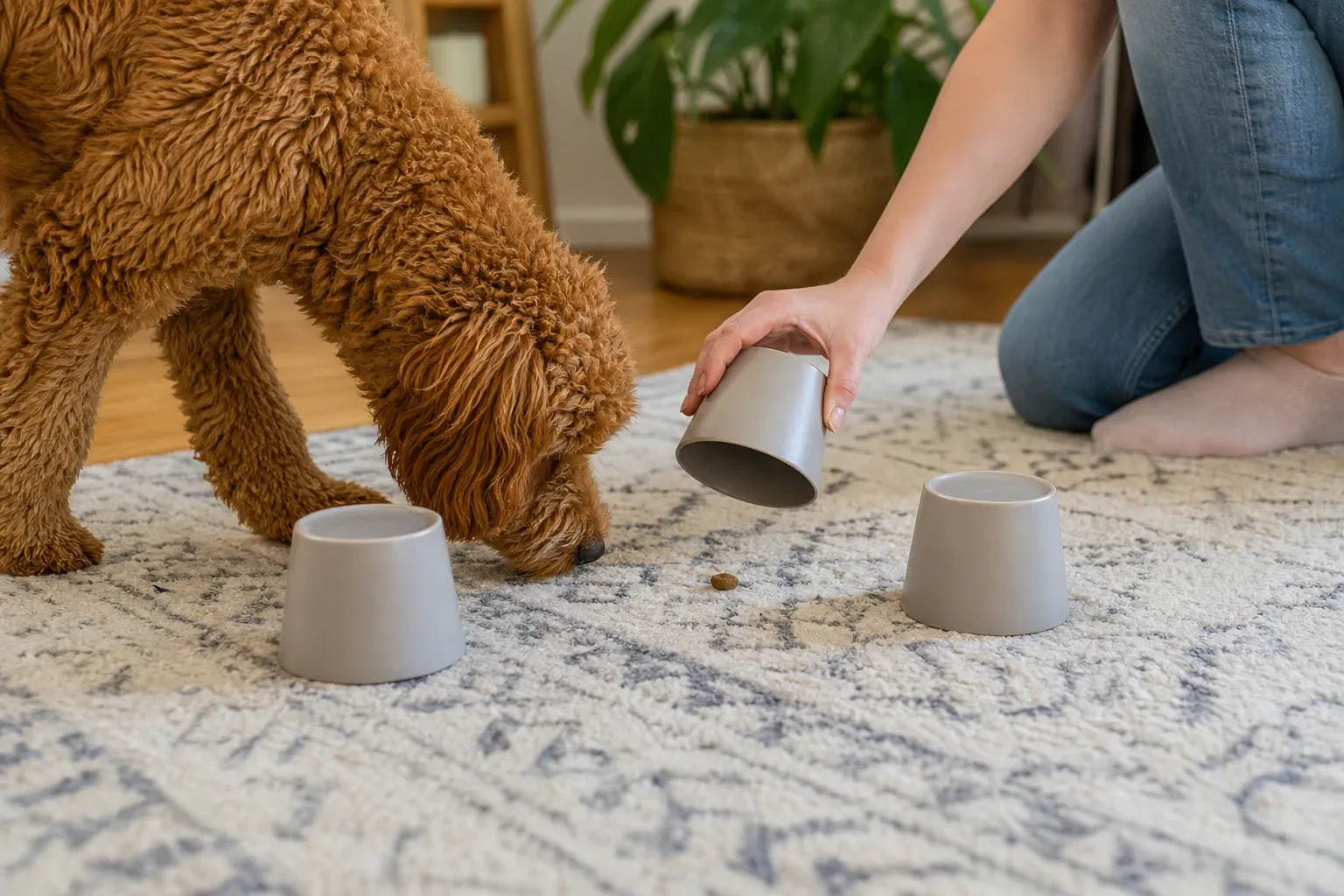
Hide a treat under one of two cups while your puppy watches, then let them find it. Two or three minutes is plenty at this age. Pair games with the first cues in our puppy commands guide, and see puppy biting and nipping if play gets mouthy.
Toy hide-and-seek
Hide a favourite toy somewhere easy, ask your dog to find it, and celebrate with a quick game of tug or fetch. Our dog puzzle toys guide has more games that don’t need treats.
Food puzzles and an indoor obstacle course
A muffin-tin puzzle or rolled-towel game makes a good warm-up, then try a simple obstacle course with cushions and a low box to step over. Our dog puzzle toys guide shows how to make puzzles harder as your dog gets the hang of them.
Treat hunt, shell game and one easy trick
Try a treat hunt around one room, the cup shell game, and a simple trick from our easy dog tricks guide. Rotate them through the week so each one stays fresh.
What are good brain games for dogs to play at home?
Good brain games for dogs are short activities built around sniffing, searching and simple problem-solving, like a treat hunt, the shell game or a muffin tin puzzle. They work your dog’s nose and focus more than their legs.
DIY brain games for dogs mostly use things you already own: towels, cardboard boxes, cups and kibble. That keeps them cheap or free. On this page, the games are graded by effort (how much you do) and space (how much room you need). You can grab a low-effort game on a tired weeknight and save the bigger ones for weekends.
Why does sniffing count for so much? Scent detection is how dogs make sense of the world. A walk past one hedge can hold a lot of smells to sort through.
Here’s an example. Scatter ten pieces of kibble across a rug and say “find it”. Your dog has to stop, sniff, check each spot and decide where to look next. To you it’s ten minutes. To your dog it’s a puzzle with a snack at every turn, and many dogs flop down for a nap afterwards.
Why does mental stimulation matter for dogs?
Mental stimulation, meaning activities that make your dog think, sniff and choose, gives your dog a healthy outlet for energy that would otherwise go somewhere you won’t like.
Boredom often shows up as chewing, barking, digging at cushions or other destructive behavior. A dog with nothing to do will find a job, and it may be your shoes. Regular enrichment (adding new, interesting things to your dog’s day) gives them a better job.
Brain games can help a dog settle into a calmer routine. They are not a treatment for anxiety, though. If your dog panics when left alone, shakes at noises, or their behaviour suddenly changes, talk to your vet first. Pain and health problems can sit behind those changes.
Games are also handy when exercise is limited. On a stormy day, a gentle hide-and-seek round in the hallway can take the edge off.
Quick tip: Play a game right before you leave the house or start a work call. A dog that has just done some sniffing often finds it easier to rest.
Which brain games fit your effort and space?
The best brain game for you is the one you’ll actually play, so match it to the energy and room you have today. The table grades each game so you can choose at a glance.
| Game | Materials | Cost | Setup time | Space | Best for |
|---|---|---|---|---|---|
| Treat hunt | Kibble or small treats | Free | 1 min | Small | Puppies, seniors, beginners |
| Shell game | 3 cups, treats | Free | 1 min | Tiny | Food-keen dogs, quick sessions |
| Snuffle mat | Mat or old fleece strips | Low | 2 min (once made) | Tiny | Fast eaters, nervous dogs |
| Muffin tin puzzle | Muffin tin, tennis balls | Low | 2 min | Small | Adult dogs, rainy days |
| Towel roll | Old towel, kibble | Free | 2 min | Small | Puppies, seniors |
| Box and toilet paper roll games | Cardboard box, tubes, paper | Free | 3 min | Small | Dogs who love to shred (supervised) |
| DIY obstacle course | Cushions, chairs, broom | Free | 10 min | Large | Young, active adult dogs |
| Hide and seek | You, treats | Free | None | Medium to large | Households with two people |
| Trick training | Treats or a toy | Free | None | Tiny | All ages |
Low effort, tiny space: treat hunt, shell game, snuffle mat
These three games need almost no setup and fit into a corner of the kitchen.
Treat hunt (materials: kibble)
- Ask your dog to sit or have someone hold them.
- Drop a few pieces of kibble where they can see.
- Say “find it” and let them go.
- Once they get it, hide pieces behind chair legs or under the edge of a rug.
Shell game (materials: three plastic cups, treats)
- Put a treat under one cup while your dog watches.
- Let them nudge or paw the cup, then lift it and let them eat.
- Add a second cup, then a third. Slide them slowly once your dog gets the idea.
Snuffle mat (materials: a store-bought mat or fleece strips tied through a rubber sink mat)
- Sprinkle kibble deep into the fabric.
- Put the mat down and let your dog root around.
- Pick it up when the food is gone.
Example: a puppy who gulps dinner can eat half of it from a snuffle mat, which slows the meal down and turns it into a sniffing game.
Medium effort: muffin tin puzzle, towel roll, cardboard box and toilet paper roll games
Medium games take a few minutes to set up and give your dog a bit more to solve.
Muffin tin puzzle (materials: muffin tin, tennis balls, kibble)
- Put kibble in a few cups of the tin.
- Cover every cup with a tennis ball.
- Let your dog lift or nose the balls away to find the food.
Towel roll (materials: old towel, kibble)
- Lay the towel flat and scatter kibble along it.
- Roll it up loosely.
- Let your dog unroll it with nose and paws.
Cardboard box and toilet paper roll games (materials: a cardboard box, empty tubes, scrap paper)
- Fold the ends of a toilet paper roll over a few treats.
- Drop several tubes into a box with scrunched paper.
- Let your dog dig, then gather up the scraps when they’re done.
Optional extras: an empty bottle with holes cut in it (caps and labels removed) can work as a rolling dispenser, and a knotted treat rope with kibble tucked into the knots adds a tug-and-search challenge. A stuffed Kong or other puzzle feeder works well too.
High effort: DIY obstacle course, hide and seek, trick training
High-effort games ask more of you, but they build a strong bond and work your dog’s body as well as their brain.
DIY obstacle course (materials: cushions, a broom across two low boxes, a chair to weave around)
- Lure your dog over each piece with a treat, one at a time.
- Link two pieces, then three.
- Keep jumps at ankle height for adults and skip them for puppies.
Hide and seek (materials: treats, a helper)
- Have someone hold your dog while you hide behind a door.
- Call your dog’s name once.
- Celebrate with treats when they find you.
Trick training (materials: treats) Teach one small trick, like touching your hand with their nose. Reward each try that gets closer.
Games without treats
Dogs on a diet, or dogs who prefer toys, can play every game here with swaps. Use part of their daily kibble, hide a favourite toy instead of food, or pay them with praise and a quick game of tug.
As for a dog simulator game: those are video games for people, where you play as a dog. They’re not brain games for your dog. Your dog’s version is a towel, a box and a good sniff.
How long should brain games last each day?
Brain games work best as roughly 15 minutes a day of focused play, split into short sessions. That’s a handy target, not a strict rule.
What is 15 minutes of mental stimulation?
Fifteen minutes of mental stimulation means about a quarter hour where your dog is actively sniffing, searching or learning. That doesn’t include lying near a toy they’ve lost interest in. Three five-minute rounds count just as well as one long one. Busy households often fit one game before work, one after, and one at dinner using the meal.
Sessions of 5 to 10 minutes
Short sessions of 5 to 10 minutes keep games fun and stop frustration from building. End while your dog is still keen, so they look forward to the next round.
Stop early if you see:
- Walking away or lying down and ignoring the game
- Barking, pawing hard or chewing the puzzle out of frustration
- Sniffing the floor aimlessly rather than searching
If that happens, make the game easier and give your dog an easy win. For example, if your dog stares at three cups and gives up, go back to one cup for a few rounds.
What do the 7-7-7, 10-10-10 and 3-3-3 rules mean?
The 7-7-7, 10-10-10 and 3-3-3 rules are rough rules of thumb people use for puppy and rescue-dog routines. They aren’t fixed timetables, and their meanings vary from one writer to the next.
- 7-7-7 rule for puppies: one common version says that by around 7 weeks old, or in the first weeks home, a puppy should have met about 7 kinds of surfaces, 7 sounds, 7 types of toys, 7 places, 7 people, 7 small challenges and 7 food containers. Some people use the same idea for adult dogs as a list of new things to try.
- 10-10-10 rule: this has no single meaning. Some use it for potty training, and others as a day plan, such as 10 minutes of sniffing, 10 of play and 10 of training.
- 3-3-3 rule: a guide for rescue dogs. In the first 3 days, a dog may feel overwhelmed. Over 3 weeks, they start learning your routine. By about 3 months, many begin to feel at home. It’s often searched along with anxiety, but it describes settling in, not a treatment.
Games fit each stage. During a rescue dog’s first days, choose gentle sniff games like a scattered treat hunt with no pressure. For a puppy, a snuffle mat and a towel roll tick off new textures for a 7-7-7 list.
Every dog is different. Some settle in a week, and others need much longer.
How do you choose games for puppies, seniors and nervous dogs?
The right brain game depends on your dog’s age, body and confidence. Start easy and build up.
- Puppies: keep it to a couple of minutes, make every round an easy win, and skip anything with small parts they could swallow. A treat hunt on a rug is a great first game.
- Senior dogs: choose low-impact sniffing games and skip jumps and slippery floors. A snuffle mat or muffin tin puzzle works without strain. If your older dog seems stiff or sore, check with your vet.
- Nervous dogs: pick quiet, predictable games in a familiar room, and let them leave whenever they want. Avoid sudden noises like crinkly boxes at first.
- Bad weather swaps: a backyard scatter hunt becomes a hallway hunt, and a park search becomes hide and seek between rooms.
Example: a shy rescue dog might start with kibble sprinkled on a towel while you sit calmly nearby, not hovering over them.
Safety checklist for supervised brain games
Safe brain games always mean supervision: stay with your dog and clear away anything they could chew up and swallow.
- Watch the whole game, especially with boxes, tubes and bottles.
- Pick up loose cardboard and plastic pieces as soon as the game ends.
- Use treats sized for your dog, and take them out of the day’s meal so calories stay steady.
- Remove bottle caps, rings and labels before using any empty bottle.
- Wash fabric toys and snuffle mats often, and throw away worn or torn ones.
- Feed and play with multiple dogs separately to avoid squabbles over food.
- Stop the game if your dog starts chewing and swallowing materials, and offer a safe chew instead.
If you think your dog has swallowed something they shouldn’t, call your vet right away.
Where can you go next if you want a structured plan?
A step-by-step course with game-based lessons can add structure if you like a plan to follow. Free DIY games, though, are plenty to get started.
Brain Training for Dogs is one self-paced online course built around games. The maker says it includes 7 modules (Preschool through to Einstein) covering over 21 games, 7 trick training videos, more than 100 articles, a bonus behaviour course, a members’ forum, and the option to send questions to the trainer. The maker describes the games as aimed at obedience and behaviour training. It’s a video course you work through yourself, so it can’t watch your dog in real time.
Our Brain Training for Dogs review covers the price, the refund terms and who it suits.
This assessment uses published course information; we have not worked through Brain Training for Dogs with a dog of our own. It’s not the right fit for aggression, biting or severe anxiety. For those, start with your vet and a qualified behaviour professional.
If a ready-made plan of games appeals to you, check the current Brain Training for Dogs course, price and refund terms on the creator’s site.
See what's inside Brain Training for Dogs60-day money-back guarantee
Every guide on this site
Training basics
Crate training
- Crate training basics
- Crate training at night
- Crate time during the day
- Crate training by age
- Crates by breed and size
Potty training
- Potty training basics
- Potty training schedule
- Potty training by age
- Pee pad training
- Bell training
- Potty training by size and breed
Cues and manners
Games and tricks
Online courses
Owners also ask
Can brain games tire a dog out more than a walk?
Brain games can leave many dogs ready to rest, because sniffing and problem-solving take focus. They work best alongside walks, not instead of them. Dogs still need physical exercise suited to their age and health. Use games to round out the day, especially on rainy days or when walks have to be short.
Do I need treats for brain games?
You don’t need special treats for brain games. Part of your dog’s daily kibble works well, and it keeps calories steady. Dogs who aren’t food-keen can search for a favourite toy instead, or be rewarded with praise and a short game of tug once they find what you hid.
How often should I change the games?
Rotate brain games every few days so they stay interesting. Keep a favourite that your dog finds easy, and add one slightly harder game each week. Once your dog solves a puzzle without stopping to think, make it trickier by hiding food deeper or adding another cup or cover.
What if my dog gives up or gets frustrated?
If your dog gives up, the game is probably too hard for now. Make it easier straight away, for example by using one cup instead of three or leaving food partly visible. Let them win a few times, then end the session while they’re still happy and keen.
Are store-bought puzzle feeders better than DIY?
Store-bought puzzle feeders aren’t automatically better than DIY games. They’re sturdier, easier to clean and often come with set difficulty levels. DIY versions cost little or nothing and are easy to change. Many owners use both: home-made games for variety and one durable feeder for daily meals.
Can I leave my dog alone with a brain game?
It’s safest to stay with your dog during brain games, especially ones made from cardboard, paper tubes or bottles that can be chewed and swallowed. If you want something for alone time, ask your vet which sturdy chew or feeder suits your dog’s size and chewing style.