Heads up: some links here are affiliate links. If you buy through one we may earn a commission, at no extra cost to you. More
Brain Training for Dogs: A $67 online course (regular price $127) with 21+ brain games across seven levels, obedience lessons, trick videos and a members' forum, with a 60-day refund window.
See what's inside Brain Training for Dogs60-day money-back guarantee
What are dog puzzle toys and why do dogs enjoy them?
Dog puzzle toys are toys where your dog earns food by solving a simple task, such as sliding a panel, lifting a lid or sniffing through fabric. Instead of a bowl that empties in seconds, mealtime becomes a small job of sniffing, pawing and thinking.
That job is a big part of the appeal. Dogs are natural foragers, and working out where the food is gives them something to do with their nose and brain. People call this mental stimulation, which simply means giving your dog’s mind a workout, not just their legs.
Here’s a simple example. Put a treat on the floor and your dog eats it. Put the same treat under a plastic cup and suddenly it’s a game: sniff, nudge, tip, win.
Puzzle toys suit most dogs:
- Puppies who need short, calm activities between naps
- Adult dogs who finish meals too fast
- High-energy dogs who need more than walks
- Indoor dogs and busy households on rainy days or short-walk days
They’re a helpful extra, not a replacement for walks, play and time with you.
Which types of dog puzzle toys are there?
Dog puzzle toys fall into five main types, and each asks your dog to do something different: roll, slide, lift, sniff or lick. Whatever the type, supervise your dog and put the toy away when the food is gone.
Treat-dispensing and rolling toys
A treat-dispensing toy releases food as your dog rolls, nudges or chews it. A stuffable rubber Kong is the classic example, alongside balls and wobblers with a hole that drops kibble as they move. These suit dogs who like to push things around and are a good first puzzle for most adults. They can be noisy on hard floors.
Sliding and lifting puzzles (Nina Ottosson style)
Slider and lift-the-cup boards hide treats under panels, cones or lids your dog moves with a nose or paw. Swedish designer Nina Ottosson made this style popular, and many brands now sell similar boards graded by level. They suit thoughtful dogs and owners who want clear steps to move through. Watch for chewers who’d rather eat the pegs than lift them.
Snuffle mats and lick mats
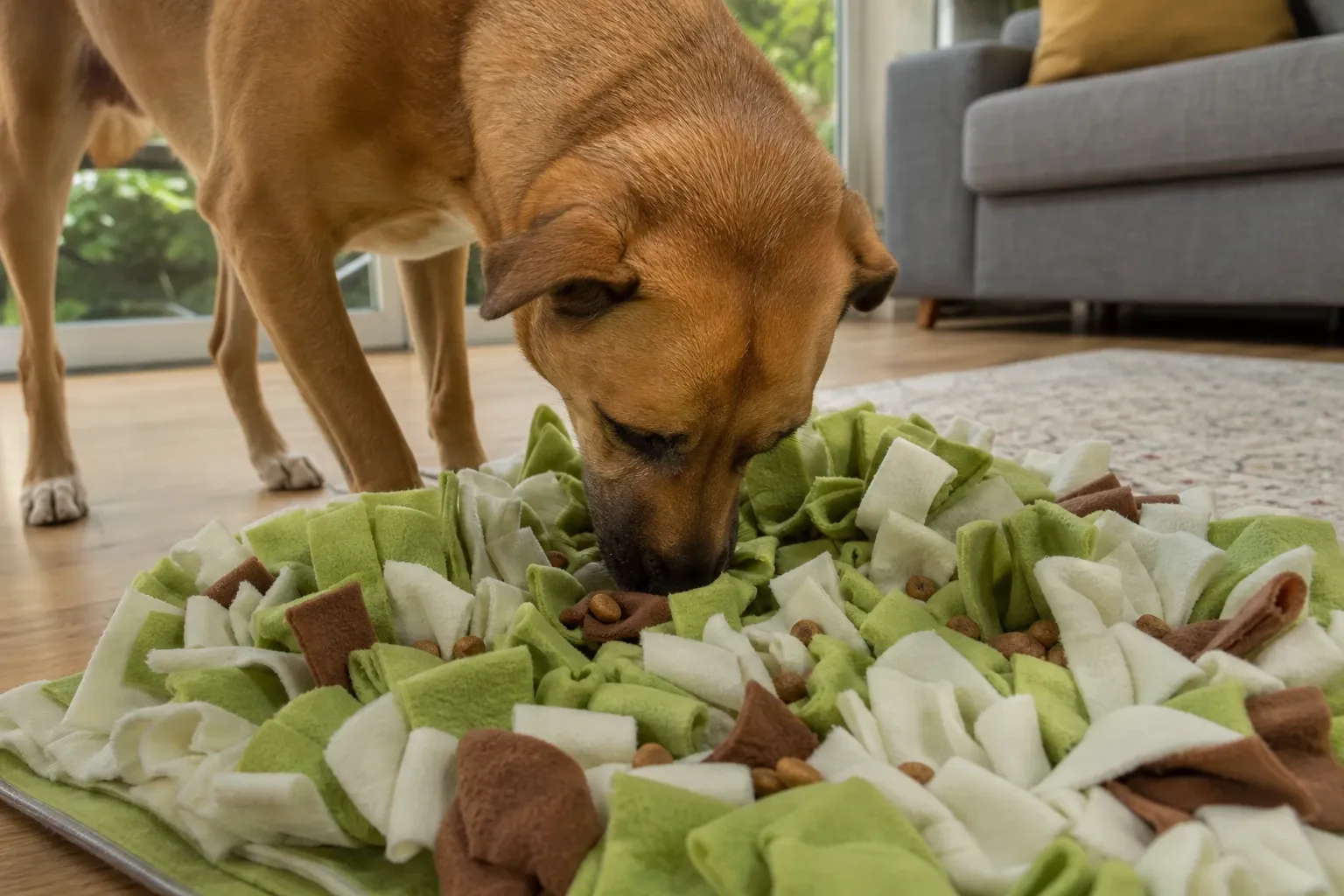
A snuffle mat is a fabric mat with strips where you scatter dry food for your dog to sniff out. A lick mat is a textured rubber mat you spread with soft food for slow licking. Snuffle mats suit nose-driven dogs and puppies; lick mats suit dogs who need help settling, such as during grooming. Both can be chewed, so stay close.
Interactive and hide-the-treat toys
Interactive toys hide treats inside pockets or plush shells, such as a soft log with zip-free compartments or a ball with squeaky toys stuffed inside. Your dog pulls things out to find the reward. These suit gentle players. Dogs who shred fabric may swallow stuffing, so pick sturdier types for them.
Large dog puzzle toys
Large dogs need puzzle toys big and sturdy enough that no part fits fully in their mouth. Check that rolling toys are larger than your dog’s throat, that boards have non-slip bases, and that pegs or cones can’t be pulled off and swallowed. Strong chewers do better with thick rubber than thin plastic.
Quick tip: If a toy cracks, splits or loses a piece, throw it away.
How do puzzle toy difficulty levels work?
Puzzle toy difficulty levels describe how many steps your dog must take to reach the food, from one simple move to a short sequence. Many boxed puzzles print a level on the packaging.
Level 1: beginner
A level-one puzzle needs one simple move, often with treats partly visible or in open spots. Think a wide snuffle mat or a treat ball with a large hole. This is where every dog should start, including puppies and dogs new to puzzles.
Level 2: intermediate
A level-two puzzle adds a second step or covers the treat spots. Your dog might slide a panel and then lift a lid, or find food hidden fully out of sight. For example, the treat sits under a cone inside a closed slider track.
Level 3 and up: advanced
Advanced puzzles combine moves in sequence, such as lifting a block before a drawer will slide open. They suit experienced solvers who stay calm when stuck.
The moving-up rule is simple: move up a level when your dog solves the current one quickly and calmly three sessions in a row. If they get frustrated, go back a level.
Puzzle toy types compared at a glance
Puzzle toy types differ mainly in what your dog does, how hard they start, and how closely you’ll need to watch. Choose by type and level rather than by brand.
| Type | What the dog does | Starting level | Best for | Mess or noise | Supervision need | DIY match |
|---|---|---|---|---|---|---|
| Rolling treat toy | Nudges, rolls | Level 1 to 2 | Active adults | Noisy on hard floors | Medium | Plastic bottle, lid off, holes cut (watch closely) |
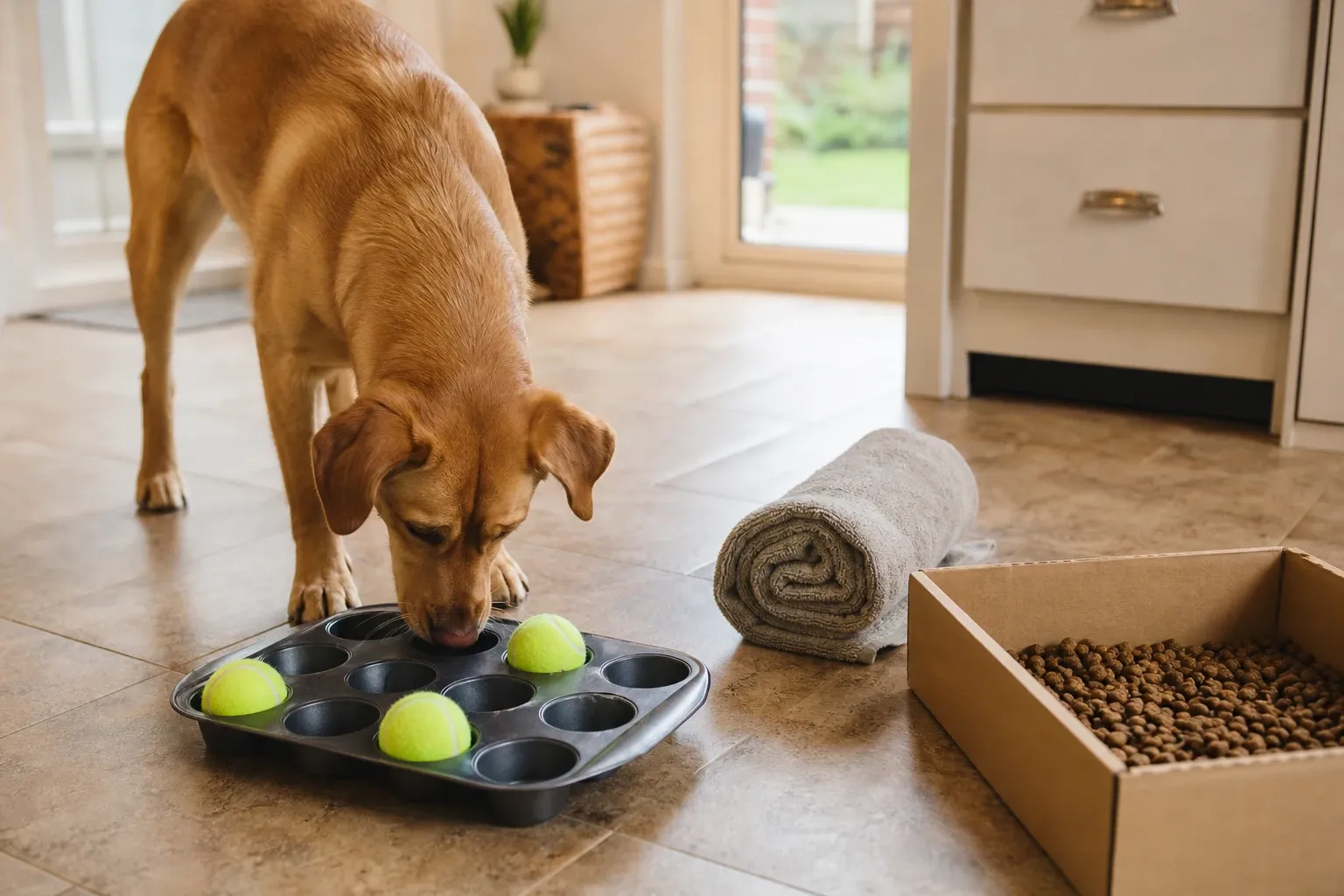
| Slider board | Slides panels | Level 2 | Thoughtful dogs | Quiet | High for chewers | Muffin tin with balls |
| Lift-the-cup puzzle | Lifts cones or lids | Level 1 to 3 | Paw users | Quiet | High | Cup shuffle game |
| Snuffle mat | Sniffs, forages | Level 1 | Puppies, nose-led dogs | Crumbs | Medium | Rolled towel |
| Lick mat | Licks slowly | Level 1 | Settling, grooming time | Sticky | Medium | Frozen lick bowl |
| Cardboard DIY | Tears, sniffs | Level 1 to 2 | Most dogs | Very messy | High | Box or tube puzzle |
How do you introduce a puzzle toy to your dog?
Introduce a puzzle toy by making the first round so easy your dog can’t fail, then adding challenge slowly. Early wins keep them keen to try again.
- Pick tasty, smelly treats. Small soft pieces are easier to find than plain kibble.
- Set it on the easiest setting. Leave lids off or treats in sight.
- Show the treat going in. Let your dog watch you load it.
- Help once if needed. Lift a lid halfway, then let your dog finish.
- Keep it short. A few minutes is plenty. End on a win.
- Pick it up afterwards. Put the toy away so it stays special and safe.
Watch for frustration: walking away, chewing the toy, whining, or barking at it. That’s your cue to make it easier, not to wait it out.
To avoid extra calories, use part of your dog’s daily meal instead of extra treats. For example, a busy owner might serve half of breakfast in a snuffle mat before leaving for work.
What DIY dog puzzle toys can you make at home?
DIY dog puzzle toys can be made from a muffin tin, a towel, a box or a few cups. Use only safe materials, supervise every time, and bin anything that gets chewed apart or swallowed.
Muffin tin and tennis ball puzzle
The muffin tin puzzle hides treats in tin cups under tennis balls. Start with treats in open cups (level 1), then cover half, then all of them (level 2). Use balls too big to swallow for your dog’s size.
Cardboard box or towel roll
A rolled towel with kibble tucked in the folds is a gentle level-one snuffle game for puppies. A box filled with scrunched paper and treats is messier fun for adults. Remove tape, staples and plastic first.
Cup shuffle game
The cup shuffle game hides a treat under one of three upturned cups. Begin with one cup, then add more, then slowly slide them around (level 2 to 3). It doubles as a lovely way to sit and play together.
Frozen lick bowl
A frozen lick bowl is a shallow bowl smeared with plain yogurt or wet dog food and frozen. Skip foods unsafe for dogs, such as grapes, onions, chocolate and anything sweetened with xylitol. Check with your vet if your dog has food sensitivities.
Where do puzzle toys fit in a wider brain-games routine?
Puzzle toys are one tool in a brain-games routine, alongside scent games, short training sessions and trick learning. A puzzle needs no teaching from you, which makes it handy on busy days. Guided games, where you and your dog work together, build skills and your bond.
A mixed week might look like this: a snuffle mat breakfast twice, a find-it scent game, and a five-minute trick session on another day. Our guide to brain games for dogs you can play at home has ideas beyond toys, and you can add simple moves from our list of easy dog tricks to teach. For the bigger picture, start with dog & puppy training basics at home.
If you’d like a structured plan of games, Brain Training for Dogs by Adrienne Farricelli is one option: self-paced games and obedience lessons you follow at home. Our Brain Training for Dogs review covers what’s inside and who it suits.
See the current course contents, price and refund terms on the creator’s site.
See what's inside Brain Training for Dogs60-day money-back guarantee
If your dog suddenly loses interest in food or play, or seems sore when pawing, check with your vet before adding new puzzles.
Owners also ask
How often should my dog use a puzzle toy?
Most dogs enjoy a puzzle toy once or twice a day, often as part of a meal. Keep each session to a few minutes, rotate between two or three toys so none gets boring, and put the toy away afterwards so it stays interesting and doesn’t become something to chew.
Can puzzle toys tire out a dog?
Puzzle toys give a dog’s mind something to work on, and many owners find a sniffing or solving session helps their dog settle afterwards. They don’t replace walks or play, though. Pair a short puzzle with daily exercise and time together for a well-rounded routine.
How do I clean dog puzzle toys?
Wash dog puzzle toys after each wet or sticky use with warm soapy water, then rinse well and dry fully. Snuffle mats can usually go in a washing machine on a gentle cycle; check the label. Throw away cardboard DIY toys after use and replace any cracked plastic or rubber.