Heads up: some links here are affiliate links. If you buy through one we may earn a commission, at no extra cost to you. More
Brain Training for Dogs: A $67 online course (regular price $127) with 21+ brain games across seven levels, obedience lessons, trick videos and a members' forum, with a 60-day refund window.
See what's inside Brain Training for Dogs60-day money-back guarantee
Why does my dog jump on people?
Dogs jump on people because it works: jumping gets them close to faces and almost always gets attention. Even a push, a shout or a stern “off” counts as attention to an excited dog, so the habit gets paid again and again.
Most jumping comes from excitement and a greeting habit. Dogs greet each other face to face, and our faces are up high. Overstimulation (being so wound up that thinking gets hard) makes it worse, which is why jumping peaks at the door, after time alone, or when a guest makes a fuss.
It’s most common in a puppy and in a large breed dog with lots of bounce. That matters, because jumping can cause real injury: scratches, bruises, and knocked-over children or older adults.
Jumping on its own is normal social behaviour, not a sign of a disorder. People sometimes ask about “ADHD in dogs”, but an excitable greeter is usually just an excitable greeter. If your dog also can’t settle at all, even in quiet moments at home, a trainer’s view can help.
For example, a young Labrador who jumps on everyone at the door but naps happily in the evening is showing a habit you can retrain, not a problem with the dog.
How do I stop my dog jumping on people, step by step?
Stopping a dog jumping up on people takes four steps: stop rewarding the jump, reward paws on the floor, teach a greeting sit, and give your dog something else to do. This is positive reinforcement, which simply means rewarding the behaviour you want so it happens more. It suits puppies and adult dogs alike.
Step 1: Stop rewarding the jump
Ignoring jumping means turning away, folding your arms and staying quiet until your dog lands. Skip eye contact, talking and pushing, since attention as reward is what keeps jumping going. If your dog keeps at it, step out through a door for a few seconds, then come back calmly.
Step 2: Reward four paws on the floor
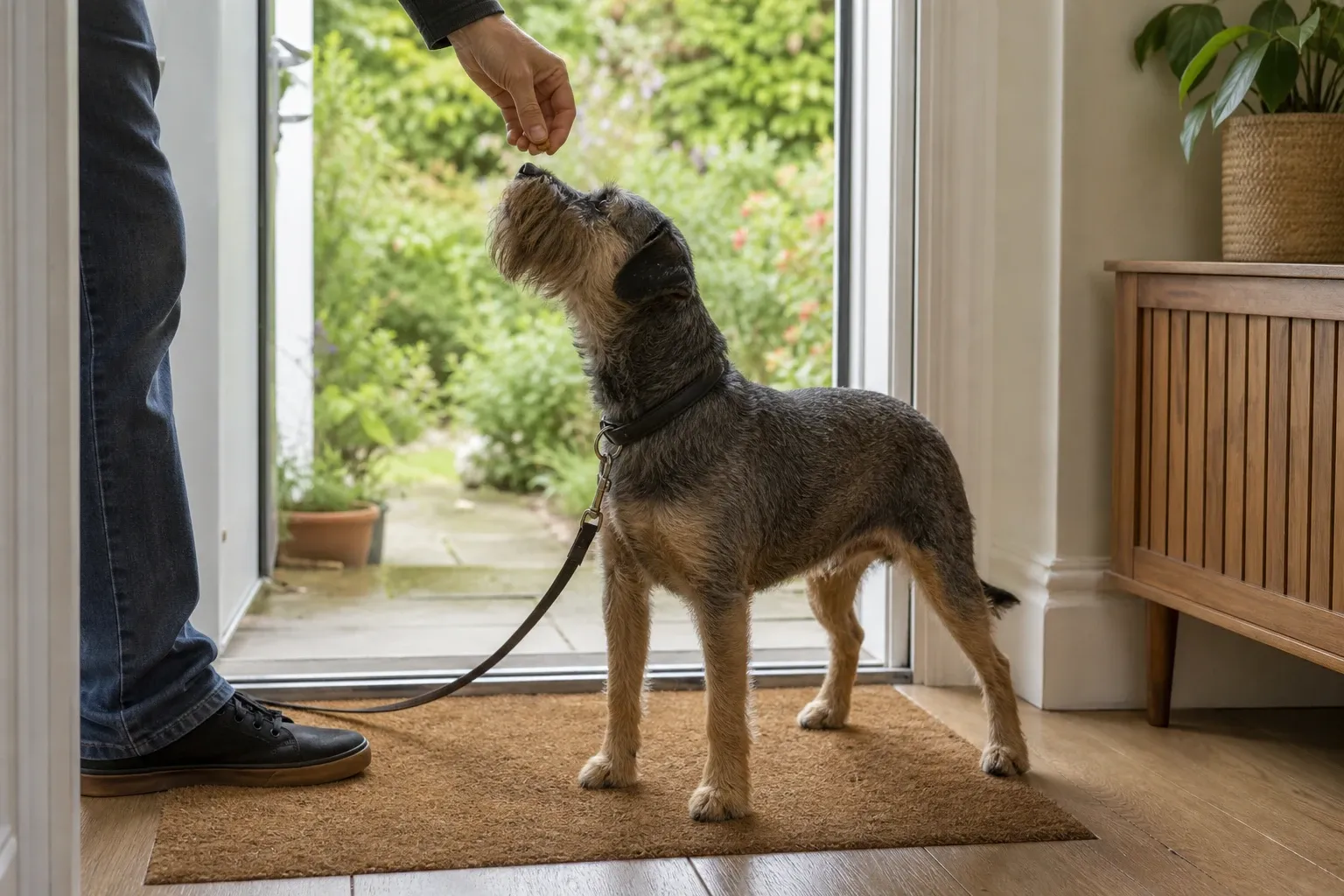
The moment all four paws touch the floor, mark it with a quick “yes” and drop treats low, near your dog’s front feet. Feeding low keeps your dog’s head and body down. Add soft praise and a slow stroke on the chest. If your dog bounces back up, go back to Step 1.
Step 3: Teach a sit for greetings
The sit command gives your dog a clear job that can’t happen while jumping. Teach it first in a calm room with no visitors, then ask for it just before you say hello. If your dog doesn’t know sit yet, start with our guide to teach your dog how to sit.
Step 4: Use a touch cue or redirect to a toy
The touch command, where your dog bumps your open palm with their nose, is a handy redirect for dogs too excited to sit. Hold your hand low, say “touch”, and reward the nose bump. Scattering a few treats on the floor or offering a toy works too. This kind of distraction and redirection gives energy somewhere to go.
Quick tip: Expect jumping to get a little worse for a few days once it stops paying off. That burst is normal, and it fades if everyone stays consistent.
What can I use to stop my dog jumping up?
The best tools for jumping are simple management: gates, a leash, a house line, a crate or a pen. Management means setting things up so your dog can’t practise jumping while learning something better. Every jump your dog doesn’t get to rehearse is one less step backwards.
Gates, leashes and house lines
A baby gate across the hallway keeps your dog from rushing the door. A leash or harness held by a helper lets you keep your dog’s paws down during greetings. A light house line (a thin leash your dog trails indoors while supervised) lets you guide them away without grabbing the collar. A front-clip harness gives gentle steering on walks.
Crates and pens
A crate or puppy pen is a calm spot for busy moments, like a party or a delivery. Give a chew or a stuffed toy so it feels like a nice break, not a punishment. This works best for dogs already comfortable in their crate.
Do anti-jump devices work?
Anti-jump gadgets such as shock collars, spray collars and spiked harnesses are best avoided. They can add stress and fear around people, and they don’t teach your dog what to do instead. A gate and a pocket of treats do the job more kindly.
For example, a busy household might gate the kitchen at dinner when guests arrive, then bring the dog out on leash once the excitement settles.
How do I practice greetings with guests and strangers?
Practising greetings works best when you plan them, so your dog meets people while calm, on leash or behind a gate, and gets paid for staying down. This plan suits any dog, and it’s especially useful for busy households with frequent visitors.
Before the doorbell
Exercise helps calm come easier. A sniffy walk or a game of fetch, followed by a chew, takes the edge off before guests arrive. Put the leash on or close the gate before you open the door.
Setting up a practice greeting with a helper
A friend who agrees to follow one rule is the best training partner you can get. Try this:
- Your dog is on leash, a few steps back from the door.
- Your helper comes in and ignores your dog completely.
- When all four paws are down or your dog sits, your helper says a quiet hello and offers a treat low.
- If your dog jumps, your helper turns and walks out. Wait a few seconds, then repeat.
- Do three to five short reps, then end on a calm one.
With real guests, give them the same one simple rule: “Only say hi when paws are down.”
On walks
Walk greetings should be short. Ask for a sit before a stranger comes close, and say “not today” if your dog is too wound up. Good leash skills help too, and our guide to train loose leash walking covers that.
How long does it take, and what is a realistic timeline?
Most dogs learn calm greetings gradually over several weeks of short daily practice, though every dog moves at their own pace. Consistency matters more than speed. If one family member still pets the dog for jumping, the habit keeps getting paid.
| Stage | Focus | What to expect |
|---|---|---|
| Week 1 to 2 | Management and rewarding four paws at home | A short burst of extra jumping, then more moments of landing on their own |
| Week 3 to 4 | Greeting sit, helper practice, walks | Better with family; guests still need the leash or gate |
| Beyond a month | New places, new people, more distractions | Fewer slips, but excitement can still tip things over |
Week 1 to 2
The first weeks are about stopping rehearsal and paying paws on the floor. Keep sessions to five minutes, a few times a day.
Week 3 to 4
Weeks three and four add the greeting sit and helper visits. Raise the challenge only when your dog is getting it right most of the time.
Beyond a month
After a month, practise in new places such as a friend’s house or a café patio. Impulse control (holding back when excited) keeps building with practice.
Some dogs need extra time. Newly adopted dogs often follow the 3-3-3 rule: roughly 3 days to decompress, 3 weeks to learn the routine and 3 months to feel at home. Many owners find adolescence, often around 6 to 18 months, the toughest stretch with a puppy.
What mistakes keep a dog jumping?
The most common mistake is giving attention to the jump, even negative attention. Kneeing, pushing or repeating “off” still pays off for many dogs.
Watch for these too:
- Wild homecomings. Big, excited hellos teach your dog that arrivals are party time. Come in calmly and greet once paws are down.
- Rewarding only sometimes. If jumping pays off now and then, your dog keeps trying.
- Asking too much, too soon. A dog already bouncing off the walls can’t sit. Back away and ask once they’ve settled a bit.
- Expecting a long stay at the door. Stay is often called one of the hardest cues, because it asks for impulse control while exciting things happen. Build it in tiny steps.
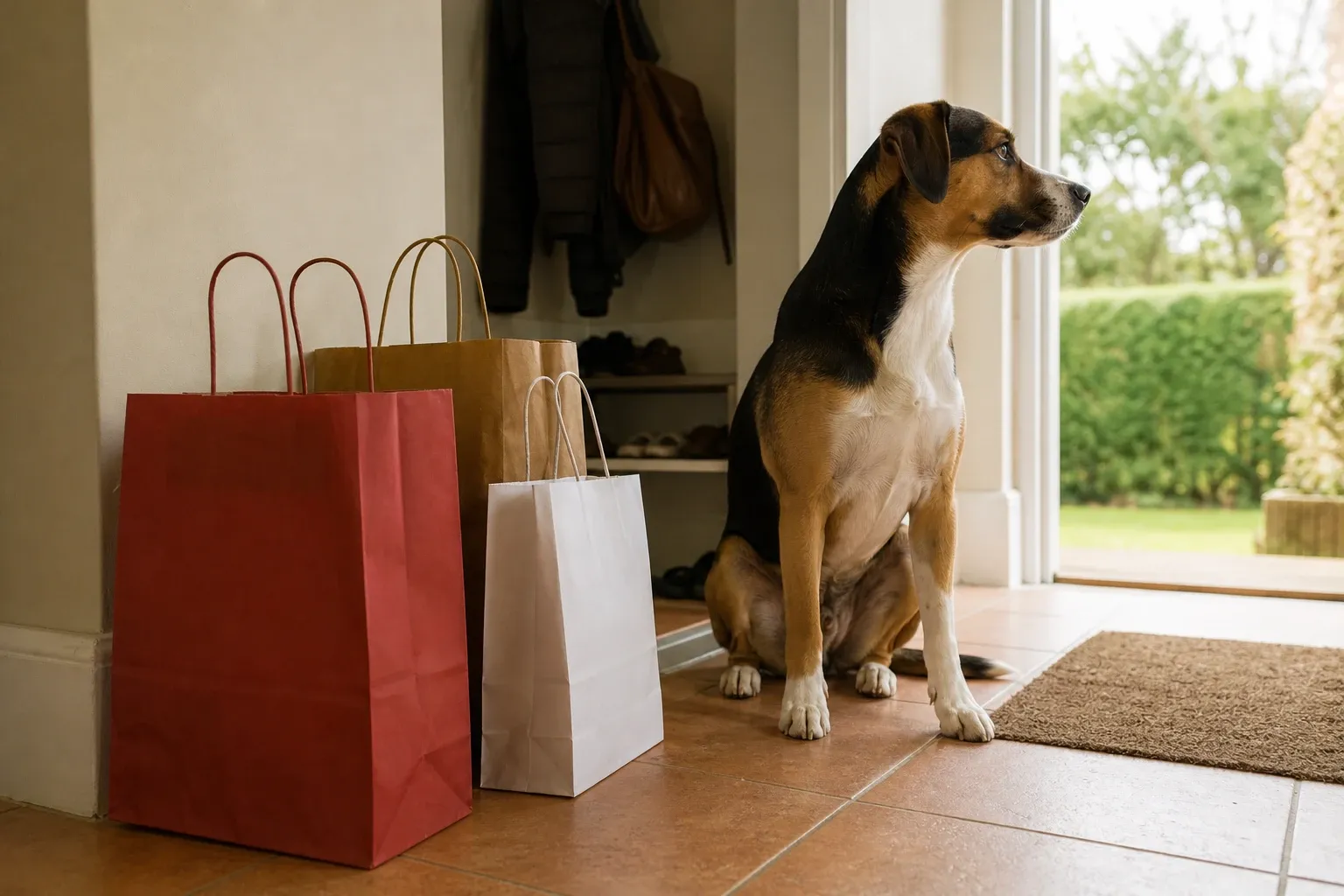
For example, if your dog jumps when you walk in with shopping, put the bags down, wait for four paws, then say hello.
When should I ask a dog trainer for help?
Ask a dog training professional for help when jumping comes with other worrying behaviour, when someone could be hurt, or when practice isn’t changing things. A self-paced course or a guide like this one can’t watch your dog in person.
Reach out if:
- Jumping comes with hard mouthing, grabbing clothes, growling or signs of fear.
- You have a very large dog and a toddler or frail relative at home.
- You’ve practised consistently for several weeks and see no change.
Look for a trainer who uses reward-based methods and can explain their plan clearly. If your dog’s behaviour changes suddenly or they seem to be in pain, see your vet first.
Where does this fit in your dog’s training?
Calm greetings build on everyday basics like sit, touch and paying attention to you. If you’re working out what to teach next, our dog & puppy training starting guide lays out the order that helps most. The core cues are covered in our puppy training commands guide too.
Some owners like a structured course to keep practice going. Brain Training for Dogs is one self-paced online option. The maker says it uses game-based lessons for basic cues and impulse control, and includes a bonus course that covers jumping. This assessment uses published course information; we have not worked through Brain Training for Dogs with a dog of our own.
Check the current Brain Training for Dogs course, price and refund terms on the creator’s site.
See what's inside Brain Training for Dogs60-day money-back guarantee
Whatever you choose, start today with one small step: keep a few treats by the front door and pay your dog the next time all four paws stay on the floor.
Owners also ask
Should I knee my dog or push it off when it jumps?
No. Kneeing or pushing can hurt your dog and can make them uneasy around people. It also gives attention, which many dogs find rewarding. Turning away quietly and rewarding your dog when all four paws touch the floor teaches what to do instead, without fear or pain.
Why does my dog only jump on some people?
Dogs often jump on people who have rewarded it before, such as a relative who always fusses. They may also jump on people who move fast, talk excitedly or bend over them. Ask those people to follow one rule: greet the dog only when its paws are on the floor.
Is it okay to let my dog jump on me but not guests?
Most dogs find it hard to tell when jumping is allowed, so mixed rules usually mean more jumping on guests. If you enjoy hugs, teach a clear invite cue, such as patting your chest, and reward staying down at all other times. Everyone else then keeps the no-jumping rule.