Heads up: some links here are affiliate links. If you buy through one we may earn a commission, at no extra cost to you. More
Brain Training for Dogs: A $67 online course (regular price $127) with 21+ brain games across seven levels, obedience lessons, trick videos and a members' forum, with a 60-day refund window.
See what's inside Brain Training for Dogs60-day money-back guarantee
How do I get my dog to walk on a leash without pulling?
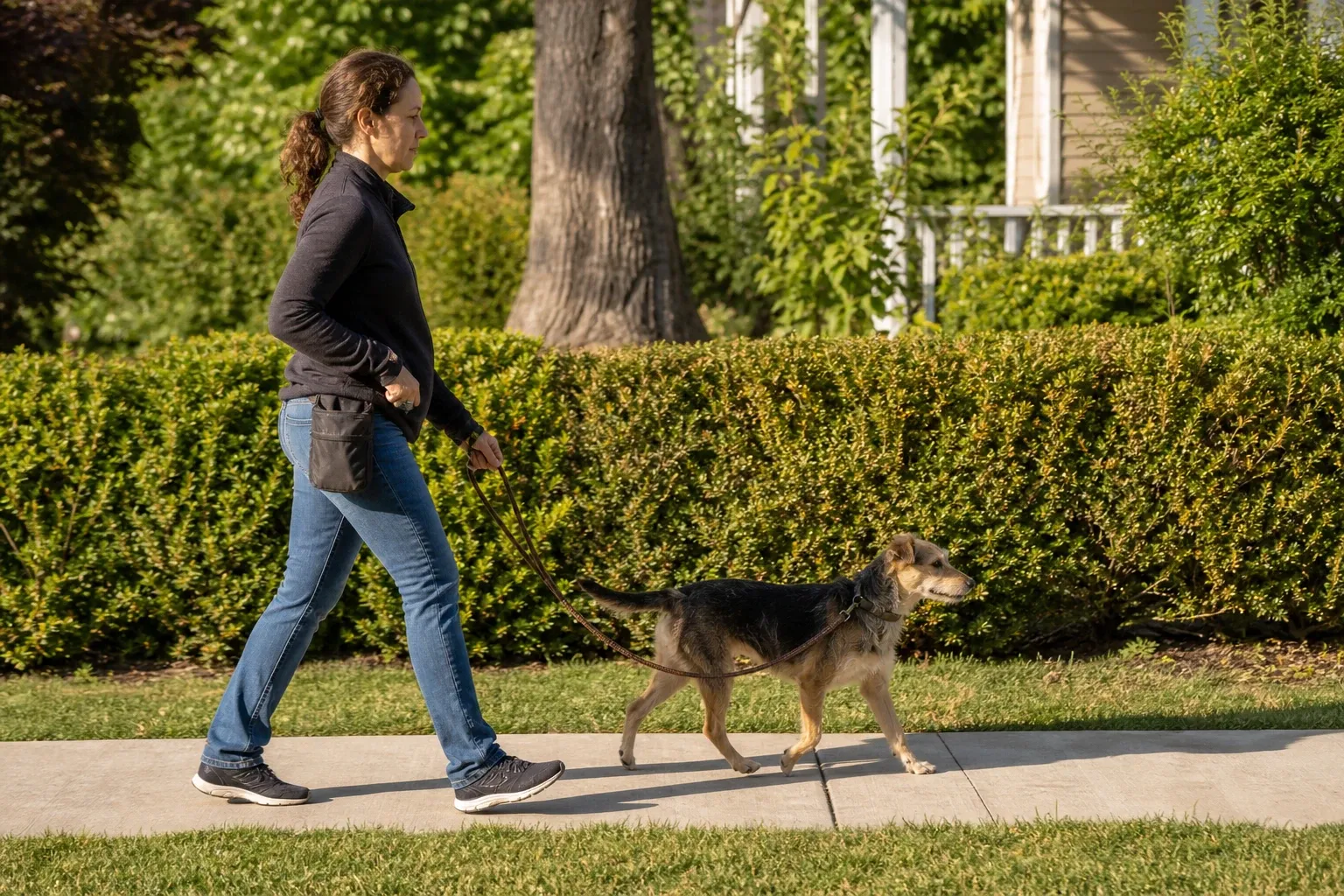
Loose leash walking comes down to one rule: a slack leash moves you forward, and a tight leash means you stop. Your dog learns that staying near you is the only way the walk keeps going.
Pair that rule with rewards. Each time your dog is close to your leg with the leash hanging in a soft J shape, mark it with a quick “yes” and hand over a small treat right at your side. Paying at your leg teaches your dog that this spot is where good things happen.
This is a learned skill, not a battle over who’s in charge. Pulling isn’t your dog trying to dominate you. As the AKC puts it, puppies aren’t born knowing what a leash is, so leash walking has to be taught and then kept up.
For example, if your dog drifts back to your side after sniffing a post, say “yes” and reward right there. That’s the behaviour you want more of. This approach suits puppies and adult dogs alike.
Why does my dog pull on the leash?
Dogs pull mostly because it works. They walk faster than we do, and every time pulling gets them to the tree, the dog or the park, the pulling is rewarded. Trainers call that reinforcement: anything that gets a dog what it wants becomes more likely to happen again.
Excitement and spare energy add fuel. A young dog who’s been home all day will bounce out of the door like a fizzy drink shaken up.
There’s also the opposition reflex. When something pulls on a dog, the dog tends to lean the other way. So if you tug back, your dog often pulls harder. It’s a bit like someone tugging your sleeve: you pull away without thinking.
That’s why tugging back rarely helps. It feeds the reflex, and if your dog still reaches the thing it wanted, the pulling has paid off anyway. Standing still breaks that loop without any force.
What gear do I need for leash training?
Good leash training gear is simple: a comfortable harness or flat collar, a standard 4 to 6 foot leash and a pouch of small, soft treats. You don’t need special tools, and you don’t need aversive collars such as prong, choke or shock collars.
Harness or collar
A front-clip harness is a good choice for strong pullers, because the leash attaches at the chest and gently turns your dog toward you when they pull. The AKC notes that for large puppies, a front-clip harness makes it easier to redirect pulling, while a well-fitted flat collar also works. A back-clip harness is comfy but can make pulling easier, a bit like a sled harness.
Leash length and type
A 4 to 6 foot J-shaped leash is the best training leash, because it’s long enough to hang slack in a soft J and short enough to stay in control. Skip the retractable leash while training. It’s always a little tight, so your dog never feels what “slack” means.
Quick tip: Keep treats pea-sized and soft, like chopped chicken or cheese, so your dog can eat fast and keep walking.
How do you train loose leash walking step by step?
You train loose leash walking in five stages, moving to the next only when your dog passes the current one. Keep each session to 3 to 5 minutes, once or twice a day.
Step 1: Teach your dog to stay near you indoors
Staying near you indoors is the first step, built with the follow me game: walk around a room, and reward your dog at your side each time they catch up. Change speed and direction often so they keep watching you.
Step 2: Add the leash and walk a few steps
Adding the leash comes next, in the same quiet room. Walk three or four steps, mark and reward while the leash is slack, and repeat. Reward checking in, too, whenever your dog glances up at you.
Step 3: Stop and wait when the leash tightens
Stop and wait is the core move: the second the leash goes tight, freeze. When your dog steps back or looks at you and the leash loosens, mark, reward at your side and walk on.
Step 4: Move to the yard, then the quiet street
The yard and a quiet street are the next places to practise, with better treats because outdoors is more exciting. The pattern game helps here: count “1, 2, 3” aloud and drop a treat by your foot on “3”, so your dog knows what’s coming.
Step 5: Add distractions gradually
Distractions get added one at a time: a distant dog, a jogger, a busy corner. Back off to an easier spot if your dog can’t focus.
How you deliver treats matters too:
| Reward style | Best for | What it teaches |
|---|---|---|
| By hand at your leg | Building heel position | “Stay right here” |
| Dropped by your foot | Pattern game, calm practice | Focus near you, a short sniff |
| Tossed behind you | Resetting after a pull | Turns your dog back to you |
| Tossed ahead | Rarely, as a release | Can encourage forging ahead |
For most dogs, hand delivery at your side does the heavy lifting. Use tosses on purpose, not by habit.
As for stopping pulling in 5 minutes: there’s no true quick fix. You can often see a small change in one short session if you pay well for position and stop every time the leash tightens.
Can my dog sniff on walks while learning?
Yes, sniffing is welcome on walks and makes a brilliant reward. Give it a release cue such as “go sniff”, let your dog explore, then call them back to your side and carry on training.
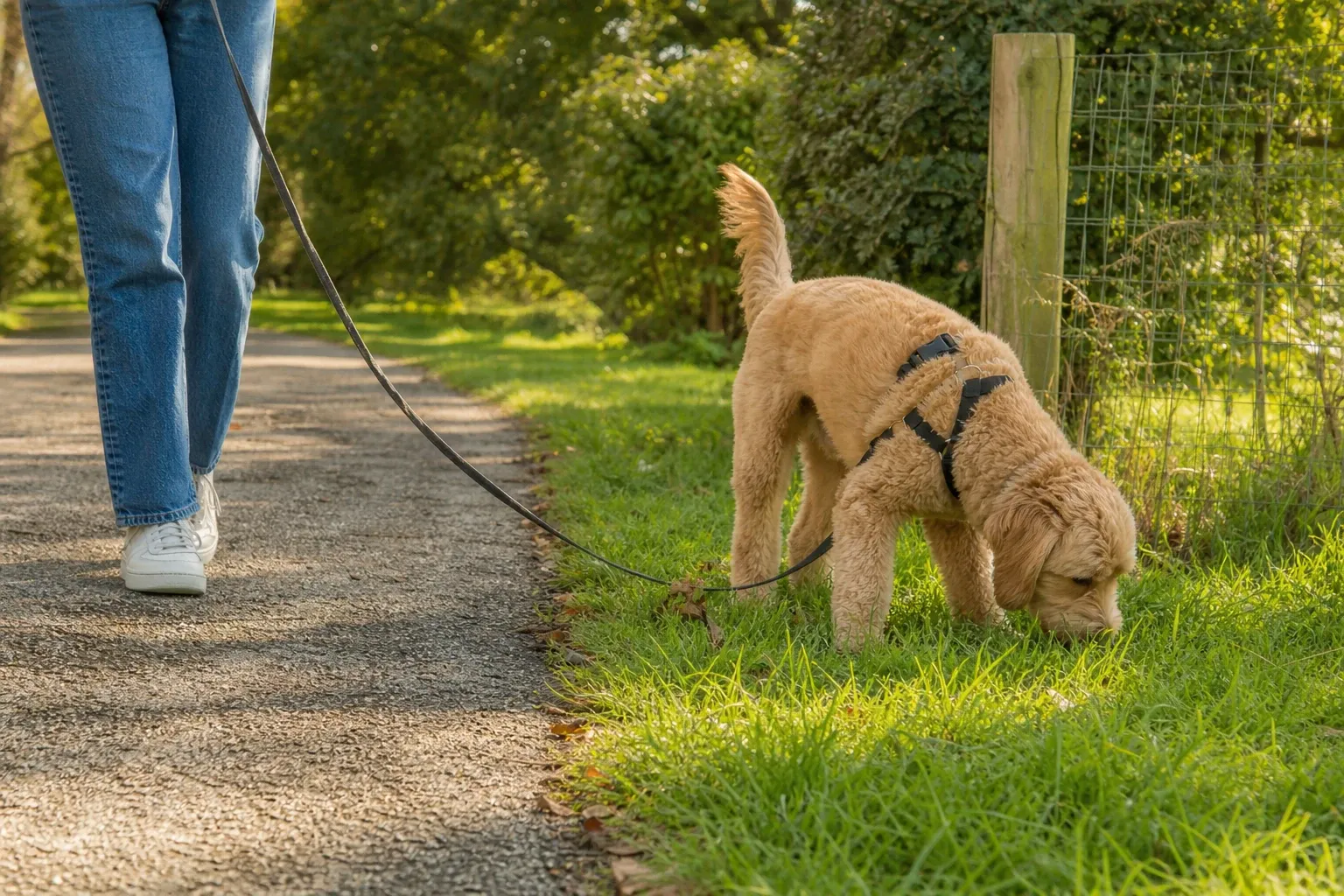
Split each walk into short training stretches and relaxed sniff breaks. The AKC describes how sniffy walks help meet a puppy’s enrichment needs, so you’re not giving anything up.
As for “hello” in dog language: polite dogs greet with loose, curvy bodies, a slow approach and a sniff, often from the side. A dog charging straight in on a tight leash isn’t saying hello calmly, so let greetings happen only when the leash is slack.
Exercise and mental stimulation before a walk can take the edge off. Five minutes of a sniffing game in the garden or a puzzle toy helps a busy household’s dog start the walk calmer. This works especially well for young, high-energy dogs.
What do the 7-7-7, 3-3-3 and 123 rules mean for leash training?
The 7-7-7, 3-3-3 and 123 rules are general rules of thumb, not set leash methods. They come from talk about settling in a new dog, socialising puppies and short training, and their exact meanings vary from person to person.
Here’s how to borrow the ideas for leash work:
- 3-3-3 thinking: practise over about three weeks, adding one new place each week.
- Short repeats: three tries, then a break, so sessions stay fun.
- The 123 idea: count aloud before a treat, just like the pattern game.
People often ask which command is hardest to teach. Loose leash walking is high on many lists, along with a reliable recall, because both have to hold up around real-world distractions.
A realistic timeline:
| Dog | Early sign | Typical milestone |
|---|---|---|
| Puppy | Follows you indoors | Quiet-street walks in a few weeks of practice |
| Adult with a pulling habit | Pauses when you stop | Steadier walks over weeks to months |
Every dog differs, so let your dog’s progress set the pace.
What if my dog still pulls? Troubleshooting common situations
Most leftover pulling comes from distractions that are too close, too much energy or rewards that aren’t strong enough. Small changes usually get you moving again.
Pulling toward other dogs or triggers
Distance from triggers is the key fix: move away until your dog can take a treat and look at you, then close the gap a little at a time. If your dog won’t eat, you’re too close.
Pulling at the start of the walk
Start-of-walk pulling eases when you practise at the door. Clip on the leash, stop and wait for calm, then step out. Go back in if needed and try again.
Progress plateaus or the dog ignores treats
A plateau often means the treats aren’t worth enough. Try better treats, shorter sessions and walking when your dog is a little hungry or calmer after play.
When to call a professional trainer
A professional is the right call if your dog lunges, barks hard, freezes or seems scared on walks. A course or guide can’t assess that, and the AKC notes that asking a trainer for help is never a sign of failure. See your vet if pain could be part of it.
For calm pullers who just need more structure, Brain Training for Dogs is a self-paced online course by Adrienne Farricelli. The maker says it has 7 modules with over 21 games, trick videos, a bonus behaviour course and a members’ forum. This assessment uses published course information; we have not worked through Brain Training for Dogs with a dog of our own. Read our Brain Training for Dogs review for who it suits.
Check the current Brain Training for Dogs course, price and refund terms on the creator’s site.
See what's inside Brain Training for Dogs60-day money-back guarantee
Where loose leash walking fits in your dog’s training
Loose leash walking works best alongside the basics you teach at home. A dog who already knows to look at you, sit and wait finds walking politely much easier. Our guide to dog and puppy training at home shows where to begin. Brush up on the core puppy training commands, and once walks feel calmer, practise teaching your dog to come when called on a long line in a safe space.
Owners also ask
Should my dog walk on my left side?
Your dog can walk on either side for everyday loose leash walking. The left side is a tradition from obedience competitions, not a rule. Pick one side and stick with it while learning, so your dog knows where rewards appear and doesn’t weave across your path and trip you.
Can an older dog learn to walk on a loose leash?
Yes, older dogs can learn loose leash walking with rewards. An adult dog with a long pulling habit may need more repetitions, because pulling has worked for years. Keep sessions short, use tasty treats and be patient. If stiffness or pain seems to slow your dog down, check with your vet.
How many treats should I use on a walk?
Early on, use lots of treats, often one every few steps while the leash is slack. As your dog improves, reward less often and swap in sniff breaks and praise. Use tiny pieces and trim your dog’s meals a little on heavy training days so the extra food doesn’t add up.