Heads up: some links here are affiliate links. If you buy through one we may earn a commission, at no extra cost to you. More
Brain Training for Dogs: A $67 online course (regular price $127) with 21+ brain games across seven levels, obedience lessons, trick videos and a members' forum, with a 60-day refund window.
See what's inside Brain Training for Dogs60-day money-back guarantee
When should you start crate training a puppy?
Crate training can start the day your puppy comes home. Short, happy sessions suit even very young puppies, and older dogs can learn it too.
Many dogs like a snug, quiet spot to rest. People call this the den instinct. You don’t need to lean on the theory, though. Watch your puppy curl up under a chair or in a corner and you’ll see the idea in action. A crate just gives that cosy spot a door.
One rule matters more than any other. The crate is for rest and safety, never punishment. If the crate means “you’re in trouble”, your puppy will learn to dread it.
Starting at 8 weeks
An 8-week-old puppy is ready for crate training in tiny steps. Think seconds, not hours. A puppy this age naps a lot, so use those sleepy moments to let them drift off in the crate with the door open.
Best for: new puppy homes. Example: after a play session, toss a treat into the crate, and if your puppy flops down inside, let them nap there.
You may hear about the 7 7 7 rule. It’s a loose idea from online puppy circles, often described as giving a puppy many new experiences in their first weeks. It isn’t a scientific standard. Use it as a gentle nudge to try varied, positive experiences, not a checklist your puppy must pass.
Starting with an older puppy or adult dog
Older puppies and adult dogs can learn to like a crate, though it often takes more patience. A dog with no crate history, or a bad one, may need extra days at the “door open” stage.
Best for: rescue dogs and adolescent puppies. Example: leave the crate open in the living room for a week with a chew inside, and let your dog discover it on their own.
What size crate and what setup does a puppy need?
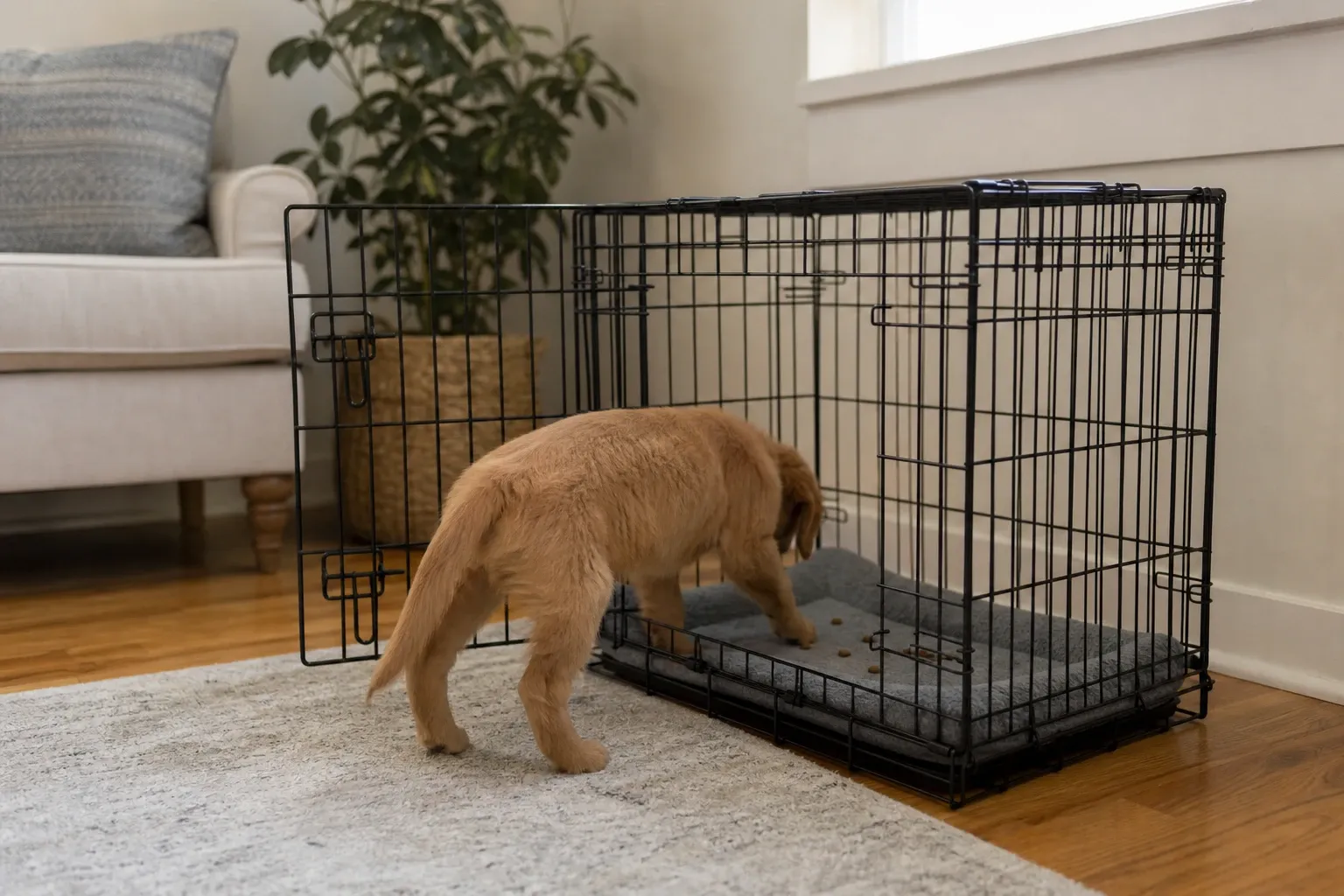
A puppy crate should let your puppy stand up, turn around and lie stretched out, with little extra room. Too much space can invite a toilet corner.
If you buy a crate for your puppy’s adult size, use a divider panel. Move it back as your puppy grows. It’s like buying school shoes a size up and stuffing the toes until they fit.
Wire, plastic and soft-sided crates
Each crate type suits a different home. Here’s how they compare:
- Wire crate: airy and easy to see through. Many come with a divider. Good for home use and growing puppies.
- Plastic crate: more enclosed and den-like. Often used as a travel crate and for airline or car trips.
- Soft-sided crate: light and foldable. Best for calm, already crate-trained dogs, since chewers and scratchers can break out.
Size by adult size (comparison table)
Crate size is easiest to pick from your puppy’s expected adult weight. These are rough guides; always check your dog’s length and height too.
| Expected adult weight | Rough crate length | Crate type that often suits |
|---|---|---|
| Up to 10 kg (about 22 lb) | 45–60 cm (18–24 in) | Plastic or wire |
| 10–20 kg (22–44 lb) | 75 cm (30 in) | Wire with divider or plastic |
| 20–32 kg (44–70 lb) | 90 cm (36 in) | Wire with divider |
| 32–41 kg (70–90 lb) | 105 cm (42 in) | Wire with divider |
| Over 41 kg (90 lb+) | 120 cm (48 in) or larger | Heavy-duty wire |
Measure your dog from nose to base of tail and add a few centimetres. For more detail, see crate training by breed and size.
Where to put the crate
Put the crate where your family spends time during the day, and near your bed at night. Puppies settle faster when they can see or hear you. Some owners keep two crates, or carry a light one between rooms.
Inside, add soft blanket bedding and a safe chew toy, such as a Kong toy stuffed with part of a meal. If your puppy shreds bedding, take it out for now and use a plain mat or nothing.
Quick tip: Keep the crate away from radiators, direct sun and draughty doors.
What are the steps to crate train a puppy?
Crate training a puppy works in five steps, each built on rewards. You’ll use positive reinforcement, which simply means giving something your puppy likes (a treat, praise, a toy) right after a behaviour you want.
Never push or pull your puppy in. Move to the next step only when your puppy is relaxed at the current one.
Step 1: Make the crate a good place
The first step is letting your puppy explore the crate with the crate door open. Toss treats just inside, then further back. Praise any choice to step in.
Example: drop three treats in the crate while your puppy watches, then walk away and let them find them.
Step 2: Feed meals inside
Feeding in the crate builds a strong, happy link. Place the bowl near the front at first, then further in over a few meals. Keep the door open until your puppy eats calmly with all four paws inside.
Step 3: Add the door and a cue
Closing the door comes next, for just a few seconds while your puppy eats or chews. Add a cue word such as “bed” as they walk in. Reward calm, not fuss.
Example: say “bed”, toss a treat in, close the door for five seconds, open it, done.
Step 4: Build up time and leave the room
Time in the crate grows bit by bit: 10 seconds, 30 seconds, a minute, then five. Next, step out of sight briefly and come back.
Only open the door when your puppy is quiet. If you open it during barking, you teach barking. Wait for even a two-second pause. Mix in crate time while you’re home, so the crate doesn’t always mean you’re leaving.
Step 5: Crate for the night
Night crating works best once your puppy naps happily in the crate by day. Keep the crate by your bed so you can hear when they need a toilet trip. Our guide to crate training a puppy at night covers the bedtime crate routine in detail.
What does a first week of crate training look like day by day?
A first week of crate training moves from open-door treats to short closed-door naps and a settled night. Here’s a sample plan for an 8- to 10-week-old puppy. Shift the times to fit your home.
- Day 1: Crate open in the living room. Treats tossed in 5–6 times through the day. Dinner by the crate door. At bedtime, crate beside your bed; take your puppy out to potty when they wake.
- Day 2: All meals inside the crate, door open. One nap in the crate after play. Potty break straight after every nap.
- Day 3: Close the door for 10–30 seconds during meals. Add your cue word. Toilet trips after meals, naps and play.
- Day 4: Stuffed Kong in the crate, door closed for 3–5 minutes while you sit nearby. One short nap with the door closed.
- Day 5: Step out of the room for a minute, then come back calmly. Repeat a few times. Keep your bedtime routine the same: potty, quiet cuddle, crate, lights low.
- Day 6: Closed-door naps of 20–45 minutes while you’re home. One short absence of 5–10 minutes.
- Day 7: A relaxed routine: meals inside, two or three crate naps, short absences, night in the crate with toilet breaks.
If your puppy cries, pants or scrabbles, go back a day or two. Shorter steps aren’t failure; they’re how puppies learn. For daytime routines with work hours, see crate training a puppy during the day.
Once the crate is settled, some owners want a structured plan for what comes next. Brain Training for Dogs is a self-paced online course by Adrienne Farricelli; the maker says its game-based modules cover obedience and behaviour training.
How long can a puppy stay in a crate?
A puppy can stay in a crate for roughly their age in months plus one hour, as an upper limit. During the learning weeks, keep daytime crate spells shorter than that.
Is one hour okay?
One hour in a crate is fine for most puppies who are settled, have been out to potty and have had some play. Very young or newly arrived puppies may need shorter spells at first.
Example: a 10-week-old who’s just been to the garden and had a game can usually nap an hour with a chew.
Age-based guide
This crate time limit is a ceiling, not a target:
- 8–10 weeks: up to about 1 hour by day
- 3 months: up to about 3–4 hours
- 4 months: up to about 4–5 hours
- 6 months and older: no more than about 5–6 hours by day, even for adults
Nights can be longer because puppies sleep, but young puppies still need one or two toilet breaks.
When crate time is too long or unsuitable
A crate isn’t right for long daily confinement or as a fix for a bored dog. Puppies need play, walks, company and brain games every day.
Stop and get help if you see persistent panic, heavy drooling, injuries from trying to escape, or repeated soiling. These can point to anxiety or a health issue. Talk to your vet first, then a qualified, reward-based trainer. Never crate a dog in a hot car, a hot room or with a collar that could catch on the wire.
Why does a crate help at night and with potty training?
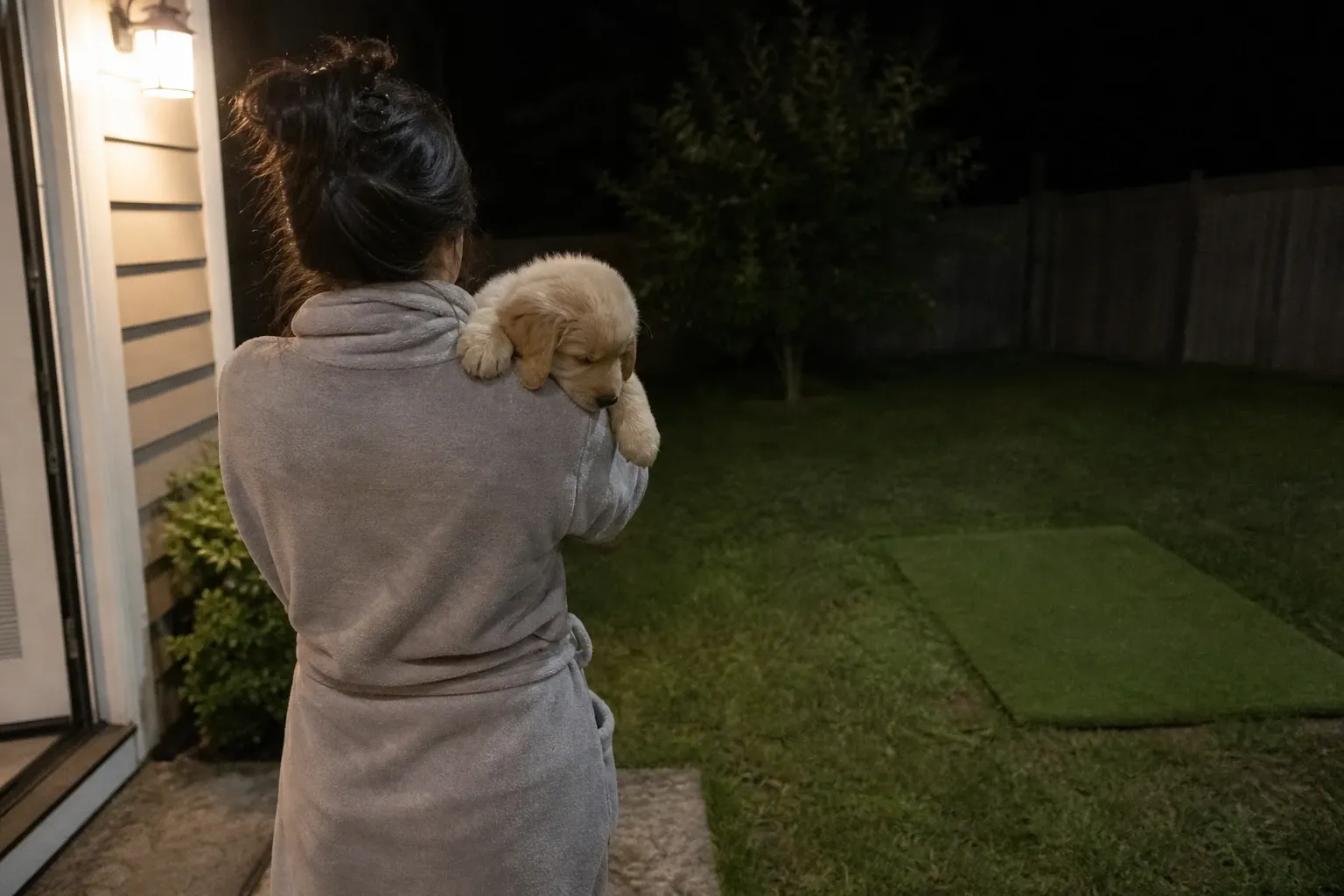
A crate helps at night and with potty training because most puppies avoid soiling where they sleep. That gives you a clear, predictable moment to take them outside.
Used well, crate training offers real everyday benefits:
- Safer sleep, away from cables and shoes
- Fewer chewing accidents while you can’t watch
- A settled routine that helps puppies wind down
- An easier potty schedule, with trips out after waking
- Calmer travel and vet visits, since a familiar travel crate feels like home
Young puppies will still need night breaks. Keep them boring: out, potty, praise, straight back to bed. For more, see our puppy potty training guide.
The cruelty concern is fair to raise. A crate becomes unkind when it’s used for punishment, for too many hours, or with a frightened dog. Used for short rests, with rewards and an open-door habit, it’s a resting space your puppy chooses.
What if your puppy is still pooping in the crate?
A puppy pooping in the crate usually needs a smaller space, shorter crate spells or a tighter toilet schedule. Work through these checks:
- Crate size: Too much room lets a puppy use one end as a toilet. Add a divider.
- Time: Cut crate spells shorter than you think they need.
- Meal timing: Avoid feeding late in the evening. Leave a couple of hours before bed.
- Schedule: Take your puppy out after waking, eating, play and every hour or two by day.
- Cleaning: Use an enzyme cleaner, which breaks down the smell so your puppy isn’t drawn back.
- Bedding: Remove absorbent blanket bedding for a while, since puppies may soil it like a pad.
- Rewards: Give a great treat the moment your puppy goes outside.
Example: a 12-week-old soiling at 5 a.m. might need a 4 a.m. trip for a week, then a slow shift later.
If accidents carry on, or your puppy has loose stools or strains, see your vet to rule out health problems.
What are the hardest puppy stages for crate training?
The hardest puppy stages for crate training are usually the first weeks at home, teething around 4 to 6 months, and adolescence after that. Each brings its own bumps.
- First weeks: Everything is new, so crying at night is common. Keep the crate close and steps small.
- Teething (about 4–6 months): Puppies chew everything. Offer safe chews and take out bedding they shred.
- Adolescence (about 6–18 months): Puppies test limits and may protest the crate again. Go back to rewarding calm entries.
Example: a 5-month-old who suddenly whines in the crate may need more play beforehand and a frozen Kong to settle with.
Keep the routine steady and exercise suited to your puppy’s age. Use the 7 7 7 idea only as a loose guide; every puppy moves at their own pace.
This assessment uses published course information; we have not worked through Brain Training for Dogs with a dog of our own.
How does crate training fit into puppy training at home?
Crate training is one piece of a bigger home plan that also covers potty training, simple cues and calm play. A puppy who rests well in a crate often finds learning sit and stay easier, because good rest helps with focus.
If you’re putting that whole plan together, start with our guide to dog & puppy training. It shows what to teach first and how the pieces link up, from house manners to games.
If you’d like a structured, game-based course for the training that follows, Brain Training for Dogs by Adrienne Farricelli is one option: self-paced games and obedience lessons you follow at home. Our Brain Training for Dogs review covers what’s inside and who it suits.
See what's inside Brain Training for Dogs60-day money-back guarantee
Crate training checklist
A crate training checklist keeps gear, setup and daily habits in one place so nothing slips. Print it or keep it on your fridge.
If your puppy shows panic, injury or repeated soiling despite small steps, pause the crate plan and speak to your vet before carrying on.
More guides in Crate training
Owners also ask
Should I cover a puppy's crate?
Covering a crate can help some puppies settle, because it blocks busy sights. Use a light, breathable cloth over three sides and leave the front open for air. Remove it if your puppy pulls it in to chew, and never cover a crate in a warm room.
Should I ignore a puppy whining in the crate?
It depends on why they whine. A young puppy may need the toilet, so take them out calmly, then straight back. If needs are met, wait for a brief quiet pause before you open the door, so you reward calm rather than noise.
Can I put water in my puppy's crate?
For short daytime naps, most puppies don’t need water in the crate. For longer stretches, a clip-on bowl or bottle helps avoid spills. Lift water a little before bedtime to help night toilet habits, but never limit water on hot days.