Heads up: some links here are affiliate links. If you buy through one we may earn a commission, at no extra cost to you. More
Brain Training for Dogs: A $67 online course (regular price $127) with 21+ brain games across seven levels, obedience lessons, trick videos and a members' forum, with a 60-day refund window.
See what's inside Brain Training for Dogs60-day money-back guarantee
Start here
These guides pair well with this list of easy dog tricks.
- Dog and puppy training at home: the basics to set up first, from potty training to leash walking.
- Brain games for dogs: play-based ways to add mental stimulation on days you’re not teaching tricks.
- Our Brain Training for Dogs review: who the online course suits and what it includes.
What are the easiest tricks to teach a dog first?
The easiest dog tricks to teach first are sit, touch and chin rest, because they use moves your dog already makes and need only one simple step.
The ranking below looks at three things. How natural is the move? How many steps does it take? And does it need another skill first? Sit comes first because it’s the starting position for many later tricks, including shake, sit pretty and roll over.
| Rank | Trick | Level | First step | Cue word | Best for |
|---|---|---|---|---|---|
| 1 | Sit | 1 | Move a treat up and back over the nose | “Sit” | Puppies and adults |
| 2 | Touch (nose target) | 1 | Hold your palm an inch from the nose | “Touch” | Puppies and adults |
| 3 | Chin rest | 1 | Reward the chin landing on your open hand | “Chin” | Adults, older and calm dogs |
| 4 | Shake paw | 2 | Wait for a paw to lift toward a closed fist with a treat | “Shake” | Puppies and adults |
| 5 | Spin | 2 | Lure a small half circle with a treat | “Spin” | Puppies and adults |
| 6 | Kiss | 2 | Touch a spot on your cheek, reward a lick | “Kiss” | Gentle adults |
| 7 | Bow | 2 | Reward a natural stretch | “Bow” | Puppies and adults |
| 8 | Roll over | 3 | From down, lure the head toward the shoulder | “Roll over” | Young, fit adults |
| 9 | Sit pretty | 3 | From sit, lift a treat just above the nose | “Beg” or “Pretty” | Adults with strong backs |
| 10 | Speak | 3 | Reward a single bark you already see | “Speak” | Adults with quiet manners |
For first commands rather than tricks, a useful core set is sit, come, heel, stay, down, leave it and place.
How do you teach a dog a trick, step by step?
You teach any dog trick the same way: get the behaviour, mark it, reward it, add the cue word once it’s reliable, then practise somewhere new.
This is positive reinforcement, which simply means adding something your dog likes, so the behaviour happens more often. Use tiny, soft treats about the size of a pea, plus warm praise. Small treats keep sessions moving and your dog’s tummy happy.
- Get the move, using a lure or by waiting for it.
- Mark the moment it happens.
- Reward within a second or two.
- Repeat five to ten times, then stop.
- Add the cue word when your dog does it smoothly.
- Practise in a new room, then with mild distractions.
Consistency matters more than length. Three short sessions a day beat one long one, and everyone at home should use the same cue word.
Lure, capture or shape: pick your method
Luring, capturing and shaping are the three ways to get a trick started. Luring means guiding your dog with a treat, like for spin. Capturing means rewarding a move your dog does anyway, like a bow when stretching. Shaping means rewarding small steps toward a final goal, like roll over built in stages.
For example, if your dog stretches every morning, keep treats nearby and reward each stretch. That’s capturing.
Add the cue word at the right time
The cue word goes in once your dog is already doing the move reliably, not before. If you say “spin” while your dog is confused, the word gets linked to confusion.
Say the cue just before you’d normally give the lure. Over many reps, your dog starts moving on the word alone.
Mark and reward: clicker or marker word
A marker is a sound that means “yes, that exact thing”, and it can be a clicker or a cheerful word like “yes”. The fancy name is marker training. A clicker is very precise; a word is always with you. Both work.
Pick one, mark, then treat every time. Our guide on clicker training a puppy covers this in more depth.
How do you start each easy trick? The first step for 10 tricks
Each easy trick starts with one small, rewardable step, and below you’ll find that step, what your dog should do, and the mistake that slows most people down.
Level 1: sit, touch, chin rest
Level 1 tricks use natural moves and suit puppies, adult dogs and seniors alike.
- Sit: move a treat slowly up and back over the nose. The bottom lowers as the head tips up. Mistake: holding the treat too high, so your dog jumps.
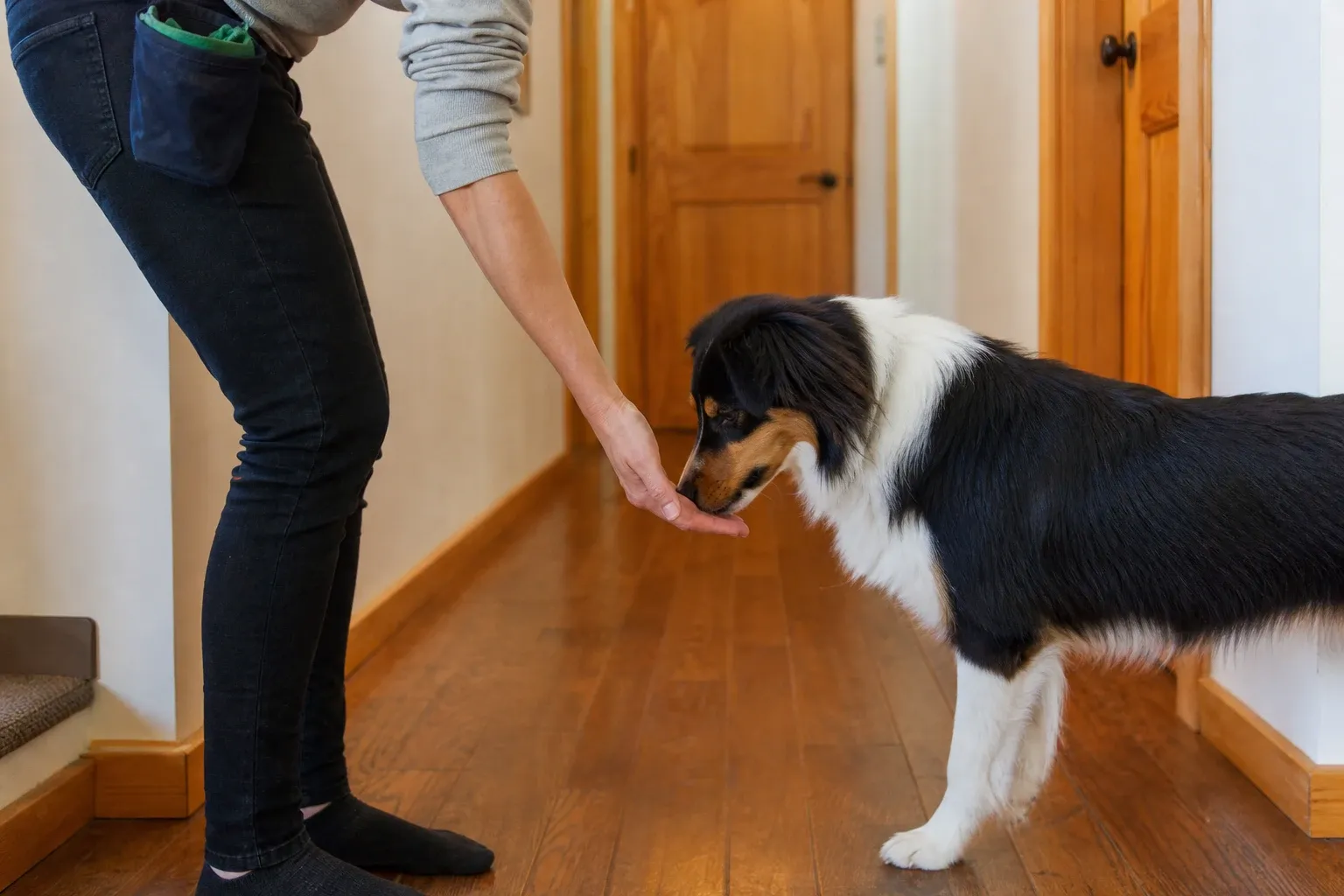
- Touch: hold a flat palm an inch from the nose. Mark the instant the nose bumps it. Mistake: pushing your hand into your dog’s face.
- Chin rest: hold your hand under the chin while your dog is calm. Reward any chin contact. Mistake: rushing; this one suits relaxed dogs.
Level 2: shake paw, spin, kiss, bow
Level 2 tricks add a little coordination and work well once sit is solid.
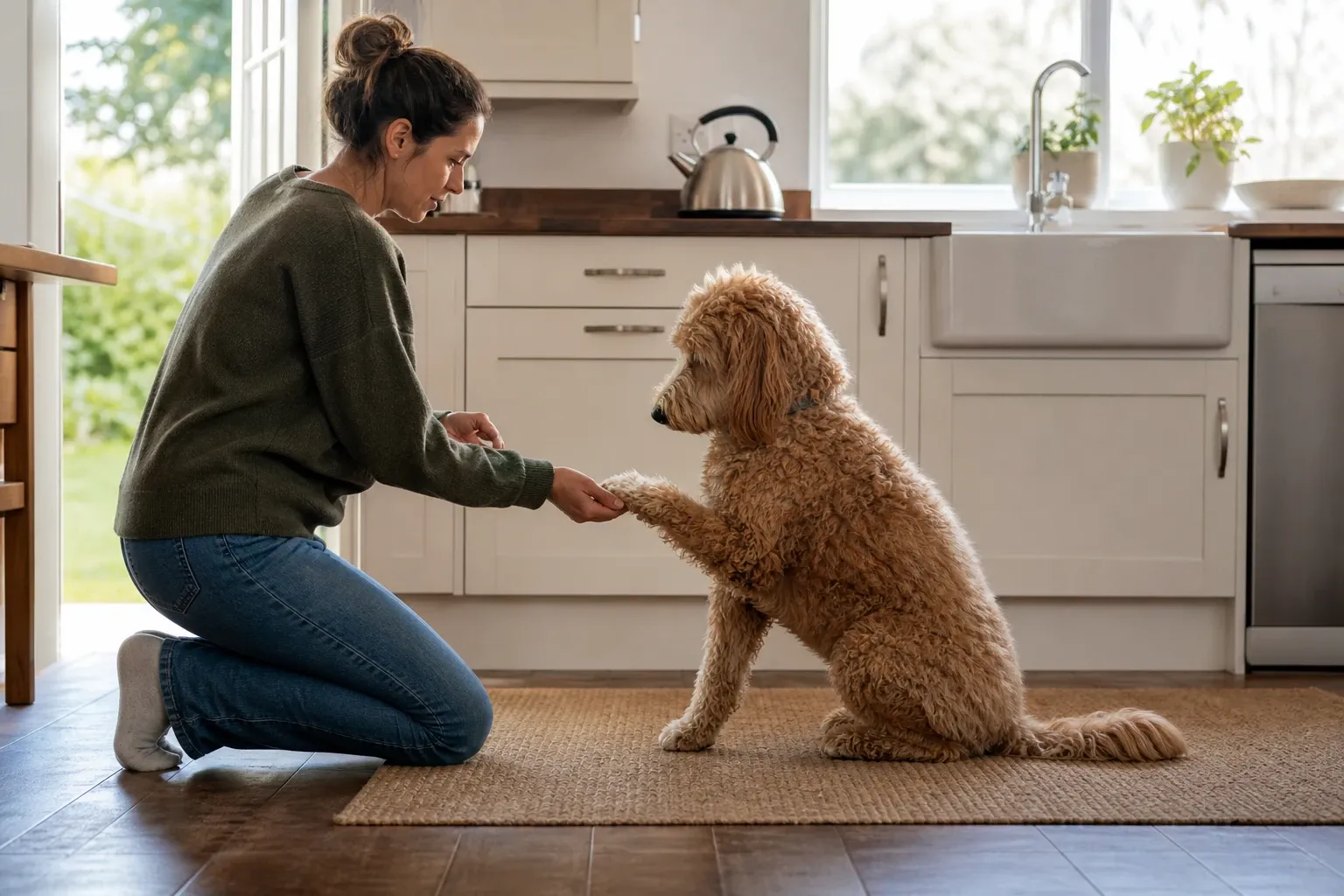
- Shake paws: close a treat in your fist low near a paw. Mark any paw lift. Mistake: grabbing the paw. Many dogs naturally like using their paws, so wait for it.
- Spin: lure a half circle at nose height. Mistake: moving the treat too fast.
- Kiss (lick face): tap your cheek and reward a lick. Skip this with mouthy puppies or if it makes anyone uneasy.
- Bow: catch a morning stretch and reward it, an approach that works because most dogs bow naturally when they stretch. Mistake: missing the moment; keep treats handy.
Level 3: roll over, sit pretty, speak
Level 3 tricks have more steps and suit fit adult dogs more than young puppies or stiff seniors.
- Roll over: from down, lure the head toward the shoulder so your dog flops on a hip. Reward that, then build. Mistake: trying the full roll in one go. Use a soft surface.
- Sit pretty: from sit, lift the treat just above the nose so the front paws leave the floor briefly. Mistake: holding too long. Skip it if your dog has back or joint trouble, and ask your vet if unsure.
- Speak (bark on command): reward a single bark you already see, like at the doorbell, then pair it with “quiet”. Mistake: rewarding a barking spree.
For showy food tricks like balancing a treat on nose, teach the leave it command first so your dog waits politely. Stay, come recall and fetch make great follow-ups, and our guide to teaching stay walks you through the first one.
Wondering about lists of 100 commands? Most are variations on these ten. Learn a handful well before chasing a long list.
What age can puppies start learning tricks, and what comes first?
Puppies can start learning simple tricks as soon as they come home, often around eight weeks, with sessions of just a minute or two.
A sensible order is: name, sit, touch, down, come, leave it, then the fun tricks. Puppy socialization, which means calm, positive meetings with new people, sounds and places, matters just as much at this age. A puppy kindergarten class adds both in one go.
A few rules you might hear:
- The 7-7-7 rule: a common idea that a puppy should meet many new surfaces, people, sounds and places in its early weeks. Treat it as a reminder to offer variety, not a strict count.
- The 3-3-3 rule: for adopted dogs, roughly three days to decompress, three weeks to learn the routine, three months to feel at home. Go easy on tricks in the first days.
- The hardest month: many owners find the teenage stretch, roughly six to twelve months, the most testing, as focus wobbles. Keep sessions shorter, not stricter.
For example, an eight-week-old might learn touch in three one-minute sessions a day, with naps in between.
How long and how often should you practise tricks?
Trick sessions work best at three to five minutes, two or three times a day, ending on a success.
The 90/10 rule is a handy guideline: aim for your dog to succeed about nine times out of ten. If they’re getting it wrong often, the step is too big. It also helps with treats: keep most treats for training and keep extras small.
Tricks give mental stimulation, a fancy term for exercise for the brain, and they’re a lovely way to bond. Trick training provides mental stimulation and physical activity, plus extra time together.
Stop for the day when your dog starts wandering off, sniffing a lot, or making mistakes they didn’t make earlier.
Quick tip: Ask for a trick your dog knows well as the last rep, so every session ends on a win.
This suits busy households well: one session while the kettle boils still counts.
What should you do when a trick isn’t working?
When a trick isn’t working, make the step smaller, use a tastier treat, shorten the session or move somewhere quieter.
Watch for signs your dog is tired or stressed: yawning, lip licking, turning away, a tucked tail or slow responses. That’s a signal to stop, not push. If a dog suddenly can’t or won’t do a move it used to enjoy, such as sitting or rolling, check with your vet in case of pain.
Mother dogs teach pups through play, short calm interruptions and lots of repetition. You can copy the patience and repetition, while skipping any correction: simply calmly stop and try an easier step.
In dog language, “I love you” often looks like soft eyes, slow blinks and a relaxed body leaning in. The kiss trick is a taught behaviour, so it’s fun, but it isn’t the same as those natural signals.
For example, if roll over stalls, go back to rewarding just the hip flop for a few days.
Printable checklist: your first 10 tricks
This printable checklist tracks your first ten tricks from first step to reliable on cue.
Work down the list in order. Tick the “8 out of 10” box when your dog gets it right eight times in ten tries, then try it in a new room and with a mild distraction.
If you’d like video lessons and a set order of games to follow after this list, an online course is one option.
Check the current Brain Training for Dogs course, price and refund terms on the creator’s site.
See what's inside Brain Training for Dogs60-day money-back guarantee
Is an online course worth it for teaching tricks?
An online course is worth it for owners who like video demos and a set order of lessons; if free guides work for you, you can skip it.
Brain Training for Dogs by Adrienne Farricelli is a self-paced course. The maker says it includes 7 modules with over 21 games, 7 trick videos and a bonus behaviour course, plus a forum and members’ area. The trick videos, by the maker’s description, cover moves like take a bow, play dead and roll over.
Our Brain Training for Dogs review covers the price, the refund terms and who it suits.
A course is a format, not a shortcut. It won’t watch your dog, and for fear, aggression or sudden changes, a vet or qualified behaviour professional is the right next step.
Every guide on this site
Training basics
Crate training
- Crate training basics
- Crate training at night
- Crate time during the day
- Crate training by age
- Crates by breed and size
Potty training
- Potty training basics
- Potty training schedule
- Potty training by age
- Pee pad training
- Bell training
- Potty training by size and breed
Cues and manners
Games and tricks
Online courses
Owners also ask
Can older dogs learn tricks?
Yes, older dogs can learn new tricks. Pick low-impact moves like touch, chin rest and shake paw, use soft treats, and keep sessions short. Skip tricks that strain joints, such as sit pretty or roll over, if your dog is stiff, and ask your vet if you’re unsure.
Do I need a clicker to teach tricks?
No, a clicker is optional. A short, cheerful marker word like “yes” works well and is always with you. A clicker is a bit more precise for fast moves. Whichever you choose, use it the same way every time and follow it with a treat.
What is the hardest trick to teach a dog?
Multi-step tricks are usually hardest, such as tidying toys into a box, pulling a blanket over themselves, or chaining several moves. Among starter tricks, roll over, sit pretty and speak take the most patience because each needs several small stages or depends on timing.
How many tricks can a dog learn at once?
Most dogs do best working on one or two new tricks at a time, while practising ones they already know. Once a trick is reliable most of the time, start the next. Mixing too many new tricks at once can confuse your dog.
What treats work best for trick training?
Small, soft, smelly treats work best, about pea-sized, so your dog can eat them fast and stay focused. Try tiny pieces of plain cooked chicken or soft training treats. Count training treats into your dog’s daily food so meals stay balanced.