Heads up: some links here are affiliate links. If you buy through one we may earn a commission, at no extra cost to you. More
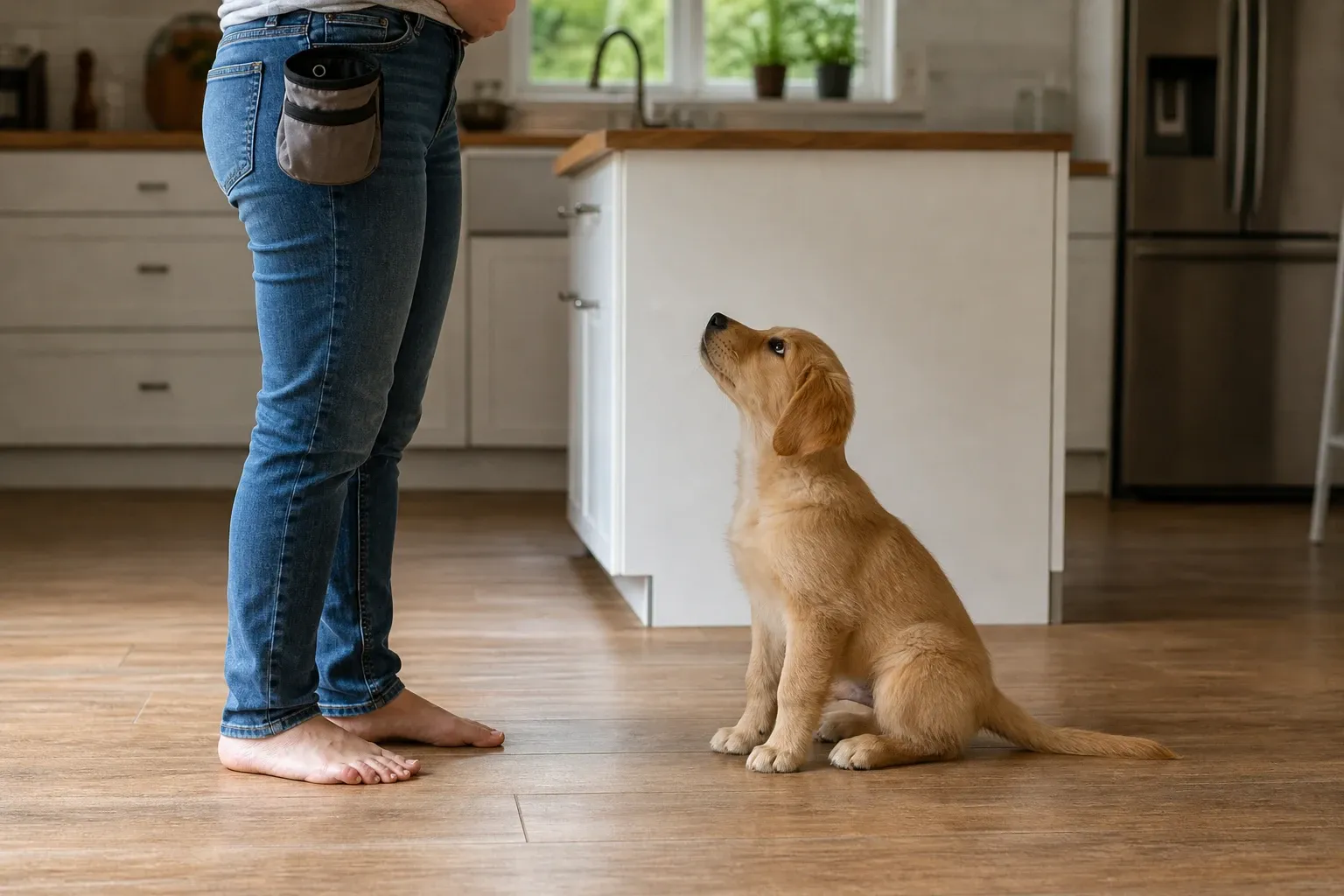
Brain Training for Dogs: A $67 online course (regular price $127) with 21+ brain games across seven levels, obedience lessons, trick videos and a members' forum, with a 60-day refund window.
See what's inside Brain Training for Dogs60-day money-back guarantee
Which puppy commands should you teach first?
The best first puppy commands are name response, sit, down, come, leave it, stay, and walking beside you, taught in roughly that order.
- Name response: your puppy looks at you when you say their name.
- Sit: an easy early win.
- Down: builds on sit.
- Come: a safety cue, so start it early.
- Leave it: another safety cue, for dropped food and dodgy finds.
- Stay: later, because it takes self-control.
- Walking beside you: the start of loose-leash manners.
This order works because easy wins build your puppy’s confidence and yours. Safety cues come early, and stay waits until your puppy can hold still for a few seconds.
A quick word on words. A “command” sounds like an order you enforce. A “cue” is just a word or hand signal that tells your puppy a reward is on offer for a certain action. Same idea, friendlier mindset.
What’s the hardest one? For most owners it’s a reliable come when there’s something exciting nearby, like another dog or a squirrel. Stay with distractions is a close second.
Example: In week one, you might only practise name response and sit. That’s plenty.
How do reward-based sessions work for puppies?
Reward-based training, also called positive reinforcement, means you add something your puppy likes right after they do what you want, so they do it more often.
Here’s the plainest example. Your puppy sits. You say “yes!” and hand over a treat. Next time, sitting looks like a great idea to them.
This is force-free dog training: no yanking, shouting or scary tools. Most teaching follows four steps:
- Lure: guide your puppy into position with a treat held at their nose.
- Mark: say “yes” (or click) the moment they get it right.
- Reward: give the treat straight away.
- Add the cue word: once your puppy does the action easily, say the word just before.
How long should a session be?
A puppy training session should last 2 to 5 minutes, repeated several times a day. Young puppies tire fast, like toddlers.
Stop while your puppy is still keen. Five sits before breakfast and five before dinner beats one long, frustrating lesson.
What counts as a good reward and good timing?
A good reward is a pea-sized treat your puppy loves, given within about one second of the right action. Late rewards teach the wrong thing.
If your puppy sits, then stands, and then gets the treat, you’ve rewarded standing. Soft, smelly treats work well, and you can use part of their daily food so meals don’t grow.
Quick tip: Keep a small pot of treats in each room so you can reward good moments as they happen.
How do you teach sit, down, leave it and stay?
Sit, down, leave it and stay are each taught with a treat lure, a marker word, and small steps your puppy can win at. For more detail, see how to teach your dog how to sit.
Sit
Sit is taught by moving a treat up and back over your puppy’s head until their bottom drops.
- Hold a treat at your puppy’s nose.
- Move it slowly up and back.
- The moment their bottom touches the floor, say “yes” and give the treat.
- After several easy wins, say “sit” just before you lure.
Down
Down is taught from a sit by lowering a treat straight to the floor between your puppy’s paws.
- Ask for a sit.
- Lower the treat slowly to the floor, then draw it a little away.
- Mark and reward when elbows touch the ground.
- Add “down” once it’s smooth.
Leave it
Leave it is taught by rewarding your puppy for backing off a treat in your closed hand.
- Show a treat, then close your fist around it.
- Let your puppy sniff and lick. Say nothing.
- The second they pull away, say “yes” and reward from your other hand.
- Add “leave it” once they back off quickly.
Stay
Stay is built slowly in three stages: duration first, then distance, then distraction. Change only one at a time.
- Ask for a sit, wait one second, mark and reward.
- Slowly build to five, then ten seconds.
- Then add one step back, and return to reward.
- Later, add small distractions like a dropped glove.
Our guide to teach dog how to stay breaks this down further.
Common mistakes with all four cues:
- Repeating the cue (“sit, sit, SIT”) teaches your puppy the third one counts.
- Rewarding late.
- Moving on too fast. If your puppy fails twice, make it easier.
What is the best way to teach a puppy to come when called?
The best way to teach a puppy to come is to use a special word, a high-value treat, and lots of easy, close-range wins before you add distance.
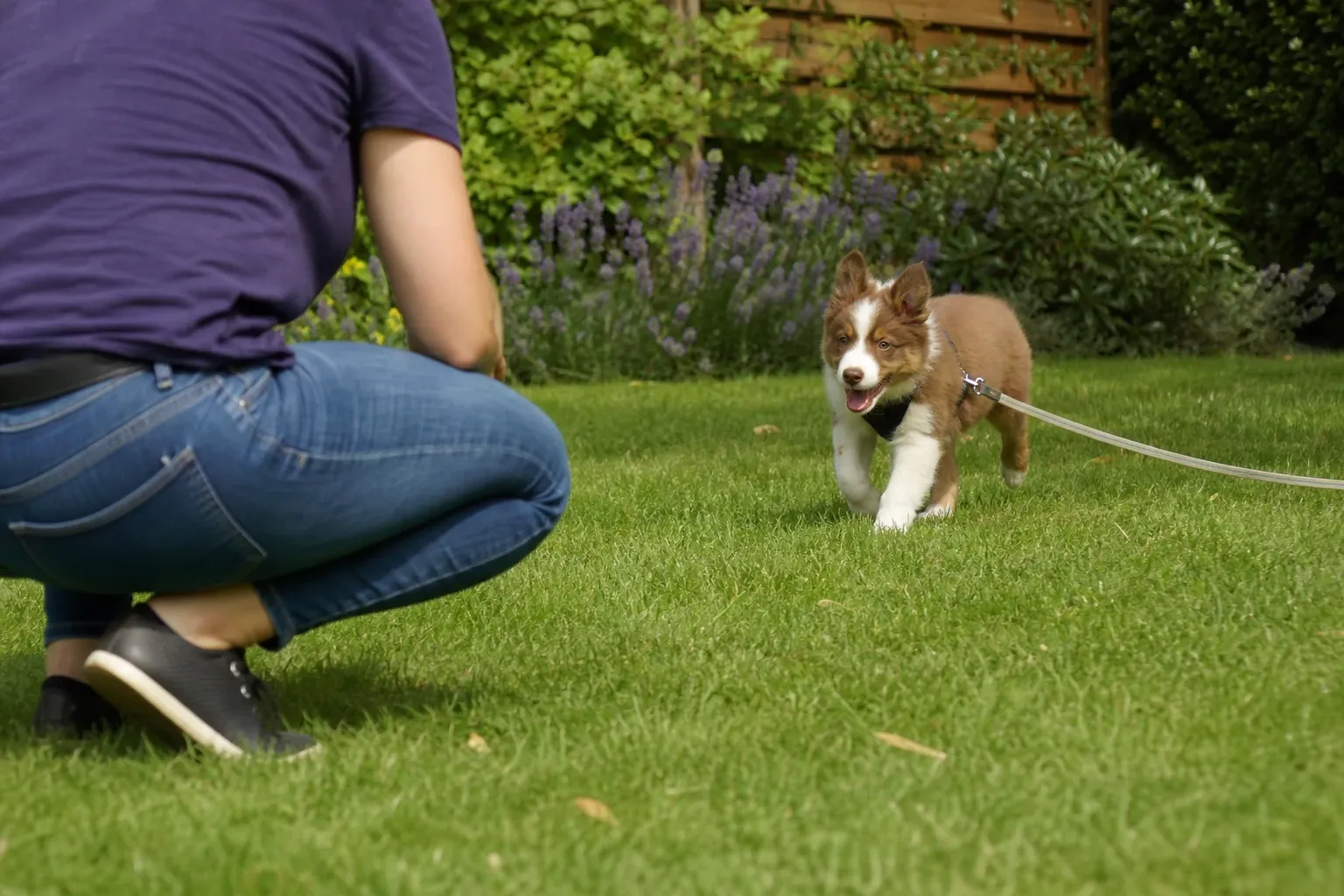
- Pick a word you don’t use every day, like “here” or “pup-pup”.
- Choose a treat your puppy adores, like a bit of chicken.
- Indoors, stand about 1 metre away. Say the word once, in a happy voice.
- When your puppy reaches you, mark and give the treat, plus praise.
- Reward every single success at first.
- Slowly add distance, then other rooms.
- Move to the garden, then to quiet outdoor spaces on a long line (a light lead several metres long) so your puppy can’t practise running off.
The golden rule: never call your puppy to end the fun or to scold them. If “come” means bath time or a telling-off, they’ll learn to avoid it. Go and get them instead. Our full guide on how to teach my dog to come when called has more games.
Example: Call your puppy, treat, then let them go back to sniffing. Coming to you costs them nothing.
What do the 7 7 7, 3-3-3 and 90/10 rules mean for puppies?
The 7 7 7, 3-3-3 and 90/10 rules are informal rules of thumb shared among dog owners, not scientific guidelines, so treat them as loose reminders.
| Rule | What people mean by it | How to use it gently |
|---|---|---|
| 7 7 7 | A popular guideline for showing a puppy varied surfaces, people and places in the early weeks, often as “seven of each” | Treat it as a variety list, not a target. Go at your puppy’s pace |
| 3-3-3 | A rescue dog’s settling-in time: about 3 days to decompress, 3 weeks to learn routines, 3 months to feel at home | Expect your dog to change as they relax. Every dog’s timing differs |
| 90/10 | A loose idea that most correct responses get rewarded and corrections stay minimal | We use rewards and management only, such as gates and leads, with no corrections |
For 7 7 7, gentle means short, happy outings with treats. If your puppy backs away or freezes, give more distance and try again another day. Socialization, meaning calm, positive experiences with new things, is about quality, not ticking boxes.
When can a puppy start training and obedience classes?
A puppy can start home training at 8 weeks, and many classes accept puppies after their first vaccinations.
The early socialization window runs to roughly 16 weeks. During that time puppies take in new sights, sounds and people more easily, so gentle exposure matters. Ask your vet how to balance outings with your puppy’s vaccination schedule, and check each class’s vaccine policy before you book.
Your two main options for puppy obedience training:
- Group class: a small group of puppies with one instructor. Good for practising around distractions and usually cheaper per hour.
- Private lessons: one-to-one, at home or a training centre. Good for busy households or shy puppies. Usually costs more per session.
Prices vary a lot by area, so ask a few local trainers and compare what each course includes.
Whatever you choose, look for an instructor who uses force-free, reward-based methods and is happy to explain how they teach. Avoid anyone who uses prong, choke or shock collars.
Some owners also like guided lessons at home between classes. Brain Training for Dogs by Adrienne Farricelli is one option: self-paced games and obedience lessons you follow at home. Our Brain Training for Dogs review covers what’s inside and who it suits. It doesn’t watch your puppy, so it suits owners happy to learn on their own.
If you’d like structured games beyond these basics, see the current course details and refund terms on the creator’s site.
See what's inside Brain Training for Dogs60-day money-back guarantee
Puppy commands checklist: what to teach and when
This puppy commands checklist gives a gentle week-by-week order for cues and everyday basics, starting from about 8 weeks old.
| Weeks at home | Cues to work on | Everyday basics |
|---|---|---|
| 1 | Name response, sit | Potty training routine, short crate naps |
| 2 | Down, early come indoors | Bite inhibition: end play calmly when teeth press hard |
| 3 | Leave it, come between rooms | Lead on indoors, a few steps beside you |
| 4 | Stay (one to five seconds) | Short leash walking practice in the garden |
| 5 to 6 | Come in the garden, stay with a step back | Gentle outings for socialization |
| 7 to 8 | Mix cues in new places | Practise everything with mild distractions |
Keep every session to 2 to 5 minutes and use tiny treats throughout. Bite inhibition means teaching your puppy to be soft with their mouth; our guide on puppy biting is not linked here, so swap rough play for a chew toy whenever teeth get sharp.
If your puppy seems in pain, suddenly changes behaviour, or is very fearful, talk to your vet first.
Where do puppy commands fit in your training plan?
Puppy commands are the first building blocks of a wider home training plan that also covers potty habits, crate time and walks.
Once sit, down and come feel solid, it’s a natural moment to train loose leash walking so your outings get calmer. For the bigger picture, including where each skill fits, head to our guide to dog & puppy training at home.
The next step is simple: pick one cue from week one and do a two-minute session today.
More guides in Cues and manners
Owners also ask
How many commands can a puppy learn at once?
Most puppies do best working on one or two new cues at a time, while practising ones they already know. Once a cue is easy in a quiet room, add another. Mixing a known cue into a session keeps confidence high and gives your puppy plenty of easy wins.
Should I use treats forever?
No. Once your puppy responds reliably, switch to rewarding most times, then some of the time, and mix in praise, play or a sniff on walks. Keep treats for new skills, hard places and recall, because a strong reward helps a puppy choose you over distractions.
Do I need a clicker to train a puppy?
A clicker is optional. It’s a small device that makes a sharp sound to mark the exact moment your puppy gets something right. A short word like “yes” does the same job. Pick one marker, use it consistently, and always follow it with a reward.