Heads up: some links here are affiliate links. If you buy through one we may earn a commission, at no extra cost to you. More
Brain Training for Dogs: A $67 online course (regular price $127) with 21+ brain games across seven levels, obedience lessons, trick videos and a members' forum, with a 60-day refund window.
See what's inside Brain Training for Dogs60-day money-back guarantee
How often does an 8-week-old puppy need to go potty?
An 8-week-old puppy usually needs to go out every 1 to 2 hours while awake, plus once or twice at night. Bladder size is the reason. A young puppy’s bladder is small, and the muscles that hold it are still developing.
Treat these numbers as a range, not a rule. Some puppies stretch to two hours early on. Others need a trip every 45 minutes after a busy play session. Watch your own puppy and adjust.
If you’re asking about a 6-week-old, the gaps are even shorter, often under an hour. Most puppies that young are still with their mother, who handles a lot of the cleanup.
Daytime breaks
Daytime potty breaks for an 8-week-old should happen every 1 to 2 hours, plus at a few moments that almost always mean “go now.” Those moments are:
- Right after waking, even from a short nap
- 15 to 30 minutes after a meal
- After a big drink of water
- During or right after play
- After chewing chew toys for a while, which can get things moving too
For example, if your puppy naps from 1:00 to 2:00, carry them straight outside at 2:00 before they take more than a few steps.
Overnight breaks
Overnight, most 8-week-old puppies need one or two trips outside. Keep these trips short, quiet and boring: no play, no chat, a little praise when they go, then straight back to bed.
A puppy who whines at 2 a.m. after sleeping for four hours probably does need to go. Take them, and treat it as normal for this age.
Potty breaks by age: an 8-week to 6-month chart
Puppies can hold it a little longer each month, and this chart shows typical break gaps and night expectations from 8 weeks to 6 months. A common rough guide is to add about one hour of holding time per month of age, then cap it at around 6 to 8 hours as an adult. It’s an estimate, not a promise.
| Age | Typical gap while awake | Typical overnight | What to expect |
|---|---|---|---|
| 8 weeks | 1 to 2 hours | 1 to 2 trips | Lots of accidents; little warning before going |
| 9 to 10 weeks | About 2 hours | 1 to 2 trips | Starting to link the spot with going |
| 3 months | 2 to 3 hours | Often 1 trip | Learning the cue word; may sniff the door |
| 4 months | 3 to 4 hours | 0 to 1 trip | More freedom, more chances for slip-ups |
| 5 months | 4 to 5 hours | Often sleeps through | Fewer accidents; some setbacks still normal |
| 6 months | 5 to 6 hours | Usually sleeps through | Mostly reliable at home, less so in new places |
Active play, excitement and cold weather all shorten these gaps.
8 to 10 weeks
The 8 to 10 week stage is about frequent potty breaks and preventing accidents, not expecting your puppy to “ask.” A 9-week-old puppy trains exactly like an 8-week-old, with slightly longer gaps if things are going well. Many owners find this the hardest stage because of the night trips.
3 to 4 months
At 3 to 4 months, puppies start to hold it for 2 to 4 hours and often show signs before going, like sniffing, circling or heading to the door. Keep rewarding every success outside. Teething also starts here, so keep chew toys handy.
5 to 6 months
By 5 to 6 months, many puppies manage 4 to 6 hours and sleep through the night. This is also when setbacks often show up, because puppies get more freedom and more confidence. A 6-month-old who is still having accidents can be trained the same way: shorter gaps, more supervision, more rewards.
A sample day for potty training an 8-week-old puppy
A sample day for an 8-week-old puppy is a loop of sleep, potty, play, potty, nap, repeated with meals at fixed times. Use this as a starting template and move times to fit your home.
Morning to evening schedule
This morning-to-evening schedule works well for families who are home most of the day, and it can be shared out among household members.
| Time | What happens |
|---|---|
| 6:30 | Wake up, carry puppy straight outside |
| 7:00 | Breakfast, then potty at about 7:20 |
| 7:30 to 8:30 | Play and short training, potty after |
| 8:30 to 10:30 | Nap in crate or pen, potty on waking |
| 11:30 | Potty break |
| 12:00 | Lunch, then potty at about 12:20 |
| 12:30 to 2:30 | Play, then nap, potty on waking |
| 3:30 | Potty break |
| 5:00 | Dinner, then potty at about 5:20 |
| 5:30 to 8:00 | Play, naps and potty every 1 to 2 hours |
| 9:30 | Last potty, then bed |
Meal timing and water
Meal timing makes potty training more predictable, so feed at set times rather than leaving food out all day. Go outside about 15 to 30 minutes after each meal. Keep fresh water available during the day, and offer it with your puppy’s meals and after play. Many owners lift the water bowl an hour or so before bed, but don’t restrict water during the day.
Bedtime and the night plan
The night plan for an 8-week-old puppy is a crate near your bed, one or two short trips, and nothing exciting. Here’s a simple version:
- Last potty trip right before bed.
- Crate beside your bed so you’ll hear stirring.
- Set a gentle alarm about 3 to 4 hours in, or get up when they whine.
- Carry or leash them to the spot, wait quietly, praise softly when they go.
- Straight back to the crate, lights low.
Quick tip: Keep a coat, shoes and leash by the bed so night trips take seconds, not minutes.
Once the day has a steady rhythm, some owners like a structured plan for what comes next, such as basic cues and brain games. Brain Training for Dogs is one self-paced online option. The maker says its 21 games across seven modules cover obedience and behaviour training.
How do you potty train a puppy at 8 weeks old, step by step?
Potty training a puppy at 8 weeks old comes down to the same spot, the same routine, and positive reinforcement every time they get it right. Positive reinforcement just means rewarding what you want so it happens more. These steps suit puppies and also adult dogs who were never house trained.
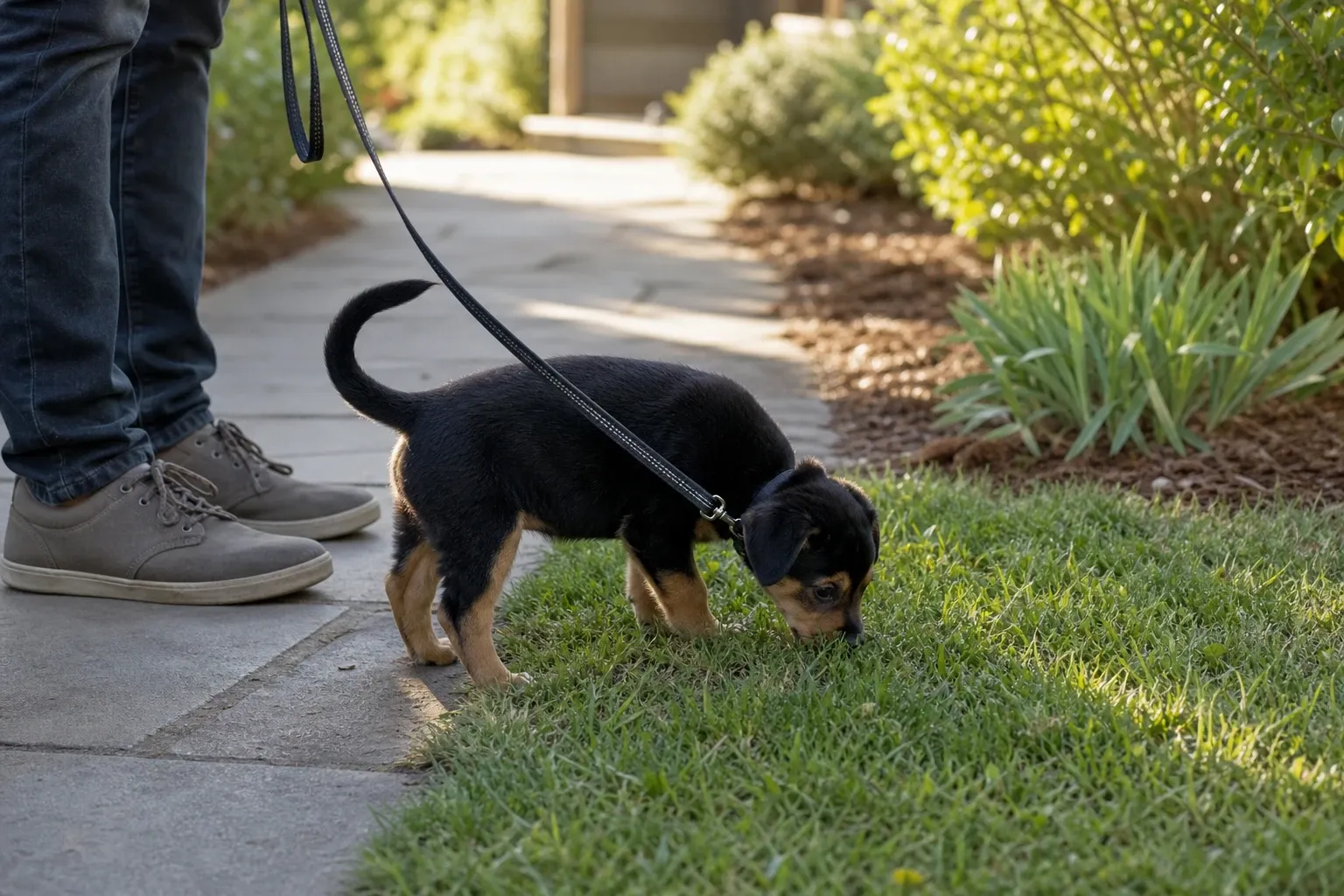
- Pick a designated potty area. Choose one outdoor spot and go there every time. The smell helps your puppy remember the job.
- Go on a leash. A leash keeps your puppy at the spot instead of wandering off to play.
- Be boring. Stand still and let them sniff. Save the fun for after.
- Add a cue word. Say a word like “go potty” softly while they’re going. Over time it becomes a gentle prompt.
- Reward right away. Give praise and treats within a second or two of finishing, right at the spot.
- Use supervision or confinement. When you can’t watch, use a crate or small playroom pen. When you can, keep them in sight and watch for sniffing and circling.
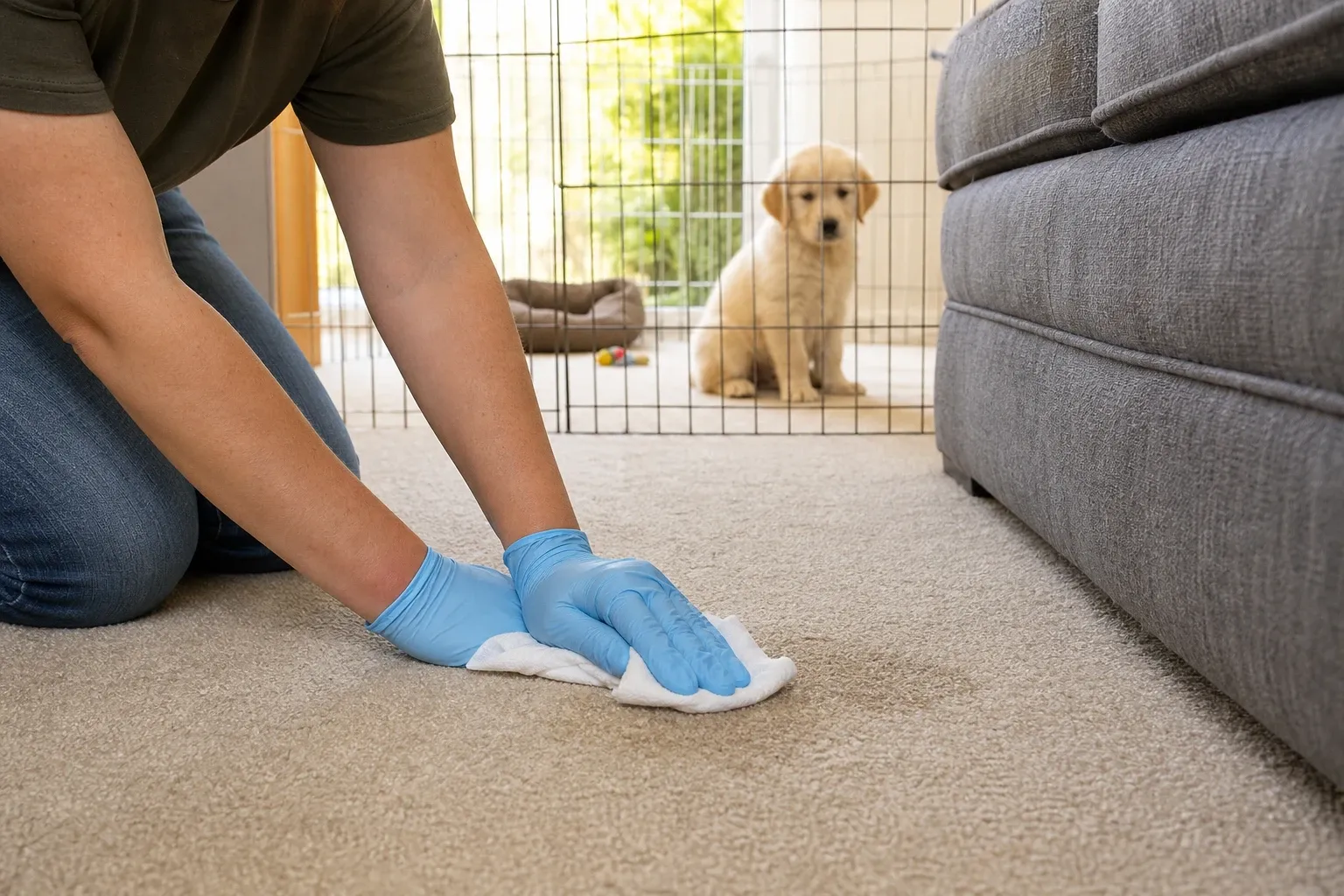
- Handle accidents calmly. Interrupt with a cheerful “outside!” and take them out. Clean with an enzymatic cleaner, which breaks down the smell so they won’t return to it. Never use punishment or rub their nose in it; that teaches them to hide when they go.
One common version of the 10-10-10 rule goes like this. Give your puppy 10 minutes at the spot. If nothing happens, spend 10 minutes back in the crate or under close watch. Then try again for 10 minutes. It stops you waiting outside forever and stops sneaky accidents back indoors.
Puppy pads are an option for high-rise living or long workdays. They can slow the move outdoors, though, because your puppy learns that indoors is fine too.
Is 8 weeks too early, and can a young puppy be left alone?
Eight weeks is a common, sensible age for a puppy to go home, and potty training can start the first day. By then most puppies are weaned and ready to learn from people. A 6 or 7 week old usually does better staying with mother and littermates a bit longer. Those weeks teach bite softness and play manners.
Missing their littermates is normal. Most puppies settle into a new home within days to a couple of weeks with a steady routine, warm bedding and plenty of calm company. They don’t need to “forget” their mother to bond with you.
Can a 7 or 8 week old be left alone for 4 hours? Plainly, that’s too long. A puppy this age can’t hold it that long, and long stretches alone can be stressful. If you work, plan for:
- A family member, neighbour or sitter for midday breaks
- A puppy-proofed pen with a pad in one corner for longer gaps
- Short practice absences that build up slowly
Breed matters less than size and the individual puppy. Toy breeds have smaller bladders and may need more breaks, but any puppy can learn with a steady routine.
What if potty training stalls or goes backwards?
Potty training setbacks are normal and usually mean the puppy got a little more freedom than they were ready for. The fix is to step back: shorter gaps, more supervision and more rewards for going outside.
Regression at 4 to 6 months
Regression at 4 to 6 months often happens because a puppy who seemed trained is now roaming the house, distracted and confident. Picture a 5-month-old who was fine for weeks, then pees behind the sofa. Go back to the 8-to-10-week rhythm for a week or two, then widen the gaps again.
Common causes and fixes
Most potty training stalls trace back to a few everyday causes, each with a simple fix:
- Too much freedom: close doors and use gates or a pen again.
- Missed signals: watch for sniffing, circling or a sudden stop in play.
- Irregular meals: return to set feeding times.
- Leftover smells: re-clean old spots with an enzymatic cleaner.
- Rewards fading: keep rewarding outdoor potties for a while yet.
If your puppy suddenly pees much more often, strains, has blood in the urine or seems unwell, talk to your vet rather than treating it as a training problem.
How long does full house training take?
Full house training usually takes about 4 to 6 months, and some puppies take longer. Some guides say to start at 12 to 16 weeks. Starting at 8 weeks with a gentle routine simply means fewer accidents become habits while you wait.
Use the waiting time outside. While your puppy sniffs after going, practise an easy sit or a short come for a treat. For more ideas, see our guide to dog & puppy training at home.
Signs your puppy is ready for more freedom:
- Several accident-free weeks in their current space
- Heading to the door or showing you when they need to go
- Going quickly once at the potty spot
Add one room at a time. If accidents return, shrink the space again for a while.
When potty training is going smoothly, short games and cues help keep your puppy’s mind busy. Brain Training for Dogs by Adrienne Farricelli is one option: self-paced games and obedience lessons you follow at home. Our Brain Training for Dogs review covers what’s inside and who it suits.
Check the current Brain Training for Dogs course, price and refund terms on the creator’s site.
See what's inside Brain Training for Dogs60-day money-back guarantee
Where does age-based potty training fit in the bigger plan?
Age-based potty training is one piece of a wider house training plan, and the timing chart works best alongside the core method. For the full method, from choosing a spot to fading treats, start with our step-by-step guide to puppy potty training. Toy breeds and very small pups often need extra breaks, so our page on potty training a small puppy covers how size changes the plan. Want a printable routine you can adapt as your puppy grows? Our schedule for potty training a puppy lays one out by the hour. Pick the one that matches where you’re stuck tonight, and set your next potty alarm.
Owners also ask
Should I wake my puppy at night to pee?
For an 8 to 10 week old puppy, setting a gentle alarm about 3 to 4 hours after bedtime can prevent accidents in the crate. As your puppy gets older and starts sleeping longer without whining or accidents, push the alarm later, then drop it once they stay dry through the night.
How long should I wait outside for my puppy to pee?
Around 5 to 10 minutes is usually enough. If your puppy doesn’t go, bring them back in, keep them in a crate or under close watch for about 10 minutes, then try again. Standing quietly at the same spot, without play, helps them focus on the job.
When can a puppy sleep through the night without a potty trip?
Many puppies start sleeping through the night somewhere around 4 to 6 months, though it varies by size and the individual puppy. Small breeds may need night trips a bit longer. Watch for several dry nights in a row before you stop setting an alarm.