Heads up: some links here are affiliate links. If you buy through one we may earn a commission, at no extra cost to you. More
Brain Training for Dogs: A $67 online course (regular price $127) with 21+ brain games across seven levels, obedience lessons, trick videos and a members' forum, with a 60-day refund window.
See what's inside Brain Training for Dogs60-day money-back guarantee
Can I put my puppy in a crate at night?
Yes, crate training a puppy at night is safe and sensible for most puppies, as long as the crate feels like a cosy bed and never a punishment. A crate keeps a curious puppy from wandering, chewing cables or swallowing something they shouldn’t while you sleep.
It also helps with house-training. Most puppies try hard not to soil the spot where they sleep. So a snug crate nudges them to hold on a little and tell you when they need to go.
Many people link this to the den instinct, the natural pull toward a small, sheltered resting spot. You’ll often see it in action: a puppy who wanders off to nap under a chair or a desk is choosing a den.
The golden rule is simple. Never send your puppy to the crate as a telling-off. Every good thing should happen there: treats, chews, cosy naps.
Here’s the night routine in short:
- Play and exercise in the early evening
- Quiet wind-down time
- Water up an hour or two before bed
- A final potty break
- Treat, crate, calm goodnight
- Quiet toilet trips through the night
This plan suits puppies from about 8 weeks, and it works for adult dogs new to a crate too, with fewer night trips.
How do I set up the crate for night: size, placement and bedding?
A good night crate is just big enough for your puppy to stand and turn, sits right beside your bed, and holds only safe, simple bedding. Get these three right and the first nights get much easier.
Crate size: just big enough to stand and turn around
The right crate size lets your puppy stand up, turn around and lie flat, with little spare room. Too much space and they may pee in one corner and sleep in the other.
A wire metal crate with a crate divider is a smart buy for growing puppies. You slide the divider back as your puppy grows, so one crate lasts into adulthood. Fabric travel crates are light, but chewy puppies can rip through them, so they’re better saved for older, calmer dogs.
For example, a Labrador puppy might start with the divider set to a third of an adult-sized crate.
Where to put it: next to your bed at first
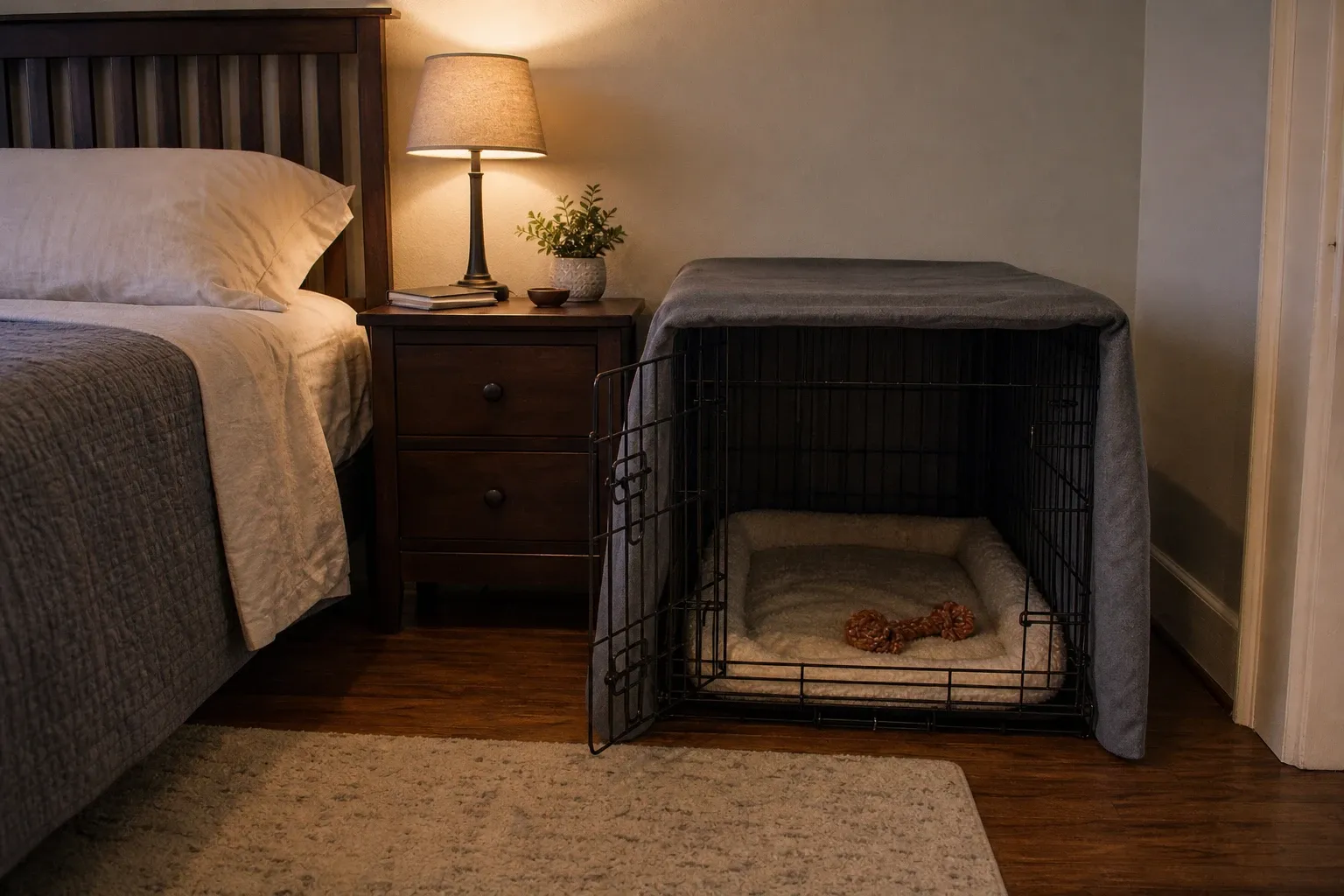
Crate placement near bed is the single biggest help on early nights. Your puppy can hear and smell you, which calms them, and you’ll hear the restless shuffle that means a toilet trip is due.
Put it at arm’s reach so you can dangle a few fingers by the door if needed. Once nights are settled, you can shift the crate a little each few days toward where you want it long term.
Quick tip: Raise the crate onto a sturdy low table for the first week so your puppy sees your face more easily.
What goes inside: pad, blanket, chews and safety
A washable crate pad or blanket and one tough chew are all your puppy needs inside the crate. Keep it simple and safe.
Puppies shred things. Swallowed bits of towel, stuffing or toy can get stuck in the gut, which is called foreign-body ingestion risk, and it can mean an emergency vet trip. If your puppy chews bedding, swap to a thin, tough mat or bare tray until the chewing phase passes.
Good toys or chews in crate are solid rubber toys and chews too big to swallow. Skip squeakers and anything with small parts.
What about a covered crate? A light blanket over the back and sides can help some puppies settle, like closing curtains. Leave the front open for airflow, check the room isn’t too warm, and remove the cover if your puppy pulls it through the bars.
What does the first night of crate training look like?
The first night of crate training a puppy usually means a calm bedtime routine, some crying, and one or more toilet trips. Expect broken sleep and plan for it, and it will feel far less stressful.
The bedtime routine, step by step
A steady bedtime routine tells your puppy that sleep is coming. Do it the same way each night.
- Early evening play. Exercise before bedtime matters: 10 to 15 minutes of tug, fetch or a sniff around the garden burns off energy.
- Wind down. An hour of quiet: a chew, a cuddle, gentle stroking.
- Water up. Lift the water bowl an hour or two before bed.
- Final potty break. Take your puppy out right before bed and wait until they go. Praise and treat.
- Into the crate. Toss a treat in, say a short cue like “bedtime”, and close the door when they step in.
- Calm goodnight. A soft word, lights off, you go to bed too.
If your puppy has an accident outside the crate on the way, just clean up. Our guide to puppy potty training covers day-time toilet habits.
How long will a puppy cry the first night?
Puppy crying on the first night can come in bursts for an hour or more, and it often fades over a few nights to around two weeks. Every puppy is different.
Your puppy has just left their mum, littermates and everything familiar. Crying is a normal stress response, not naughtiness.
Try to tell the cries apart. A sudden whine after a few hours of sleep often means “I need to pee”, so take them out. Protest crying right after you turn the light off is usually “let me out”. For that, stay quiet, maybe rest your hand near the crate, and wait for a pause.
Avoid letting your puppy out mid-protest. If crying opens the door, your puppy learns to cry louder and longer.
How often does a puppy need a toilet break at night?
Most young puppies need overnight potty trips every two to four hours, with gaps growing as their bladder matures. Bladder control by age is a rough guide, so watch your own puppy too.
Bladder limits by age
A common rule of thumb is about one hour per month of age, plus one. It’s a starting point, not a promise.
| Puppy age | Rough night gap | What to try |
|---|---|---|
| 8 weeks | 2 to 3 hours | Set an alarm; 2 to 3 trips a night |
| 10 to 12 weeks | 3 to 4 hours | Stretch the gap by 15 to 30 minutes after dry nights |
| 3 to 4 months | 4 to 5 hours | Often 1 trip a night |
| 4 to 6 months | 5 to 7+ hours | Many puppies sleep through |
| Adult dog | Full night | Last trip before bed, first thing in the morning |
Small breeds can need more trips than big ones at the same age. If your puppy suddenly needs to pee much more often, check in with your vet.
Can a 9-week-old sleep through the night?
A 9-week-old puppy usually can’t hold their bladder through a full night. Set an alarm for about three hours after bedtime and take them out, even if they’re quiet.
After a few dry nights, push the alarm back by 15 to 30 minutes. If you wake to a wet crate, go back to the last time that worked. For instance, if 3 hours was dry but 3.5 wasn’t, stay at 3 for another week.
Doing a quiet night potty trip
A night potty trip should be dull, quick and dark. Pop the lead on, carry or walk your puppy to the toilet spot, and stand still.
When they go, give a quiet “good” and a small treat. Then straight back to the crate with no play, chat or bright lights. Most puppies settle faster when the trip feels like sleepwalking.
Quick tip: Keep shoes, a torch, lead and treats by the door so you’re out in under a minute.
What if my puppy keeps whining or crying in the crate?
Ongoing crate whining usually has a simple cause, such as a full bladder, too much energy or a crate that doesn’t yet feel safe. Work through the basics before changing the plan.
Troubleshooting checklist
Check these first, in this order:
- Toilet: Has it been a few hours since the last trip?
- Energy: Did your puppy get play and a sniff walk in the evening?
- Tiredness: Overtired puppies fight sleep. A longer wind-down can help.
- Temperature: Too warm under a cover, or in a draught?
- Hunger: Was dinner a few hours before bed, not right at bedtime?
- Day practice: Is the crate only used at night?
That last one matters a lot. Feed meals in the crate, hide treats in it, and let your puppy nap there in the day with the door open. A puppy who naps there happily at noon cries less at midnight. Our crate puppy training guide walks through day-time crate games.
When it may be more than normal adjustment
Frantic crying that builds and doesn’t ease may point to deeper distress, sometimes called separation anxiety. Signs include heavy drooling, panting, biting the bars hard, peeing in panic, or hurting themselves trying to escape.
If you see this, stop forcing the crate. Talk to your vet to rule out pain, and look for a qualified reward-based trainer or behaviour professional.
In the meantime, a puppy playpen can be a kinder halfway step. Set it beside your bed with a cosy bed at one end and a pee pad at the other. It gives safe space without the tight walls.
If you’d like structured games for general puppy training in the day, Adrienne Farricelli’s Brain Training for Dogs is a self-paced online course. The maker says it includes game-based modules and a members’ forum. It’s a general training resource, not a fix for night crying. This assessment uses published course information; we have not worked through Brain Training for Dogs with a dog of our own.
What are the 7-7-7 rule, the witching hour and the hardest puppy age?
The 7-7-7 rule, the witching hour and the hardest-age question are three popular ideas that help set fair expectations for a new puppy.
The 7-7-7 rule is an informal guide often used for rescue dogs. It suggests a dog needs about 7 days to decompress, 7 weeks to learn your routine, and 7 months to feel fully at home. It isn’t science. Still, it loosely fits puppies: the first week is the roughest, routines click over the following weeks, and real confidence takes months.
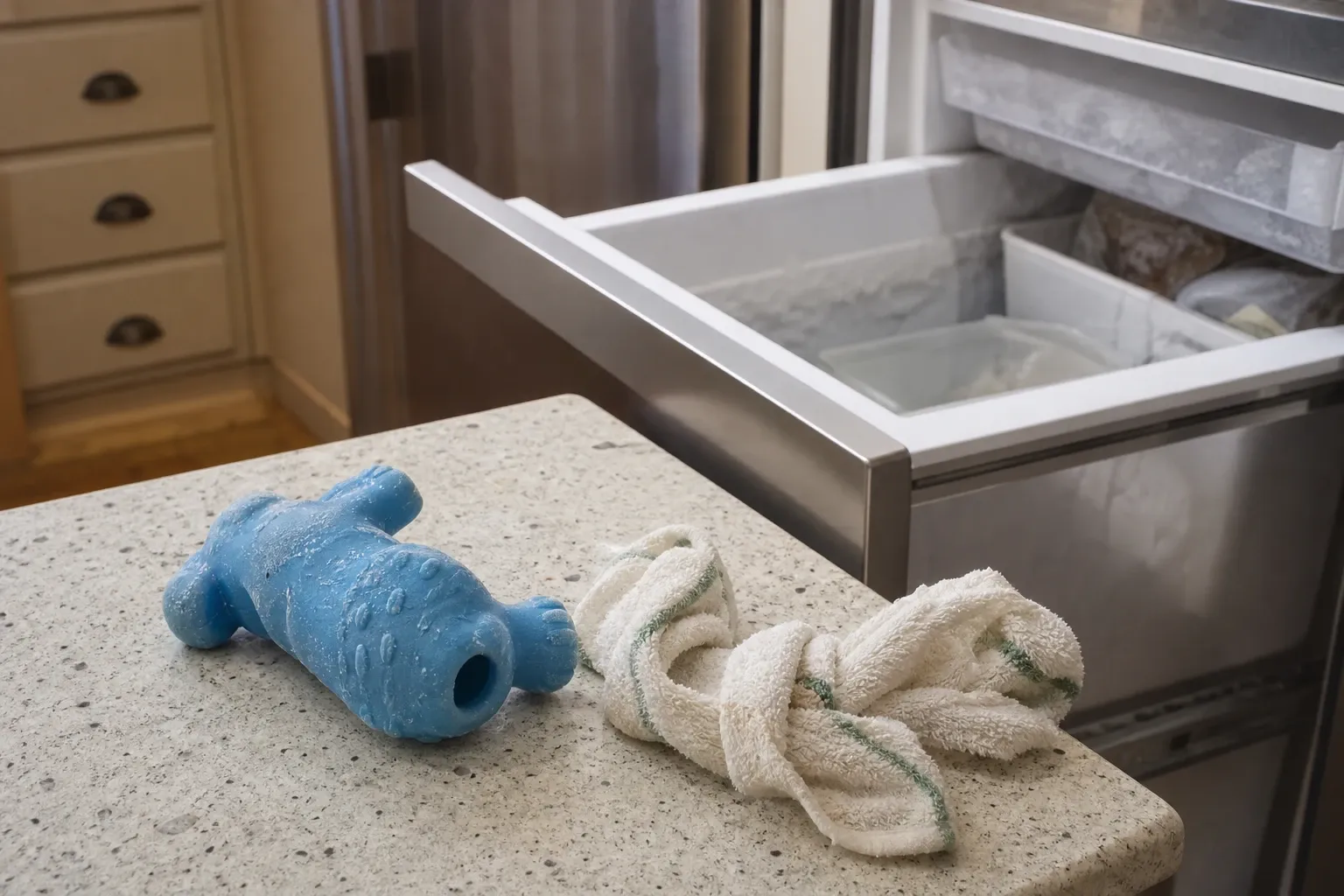
The witching hour is that evening burst of zoomies and sharp biting, usually from overtiredness. To get through it:
- Hand over a chew or a frozen stuffed toy
- Move to a quiet room with low light
- Offer a crate nap with a chew
- Skip wild play that winds them up more
If the nipping is a daily struggle, see our tips on how to stop puppy biting — wait, that’s not on our list here, so just redirect calmly to a toy.
The hardest age is different for sleep and behaviour. Sleep is hardest in the first few weeks home. Behaviour testing often peaks in adolescence, roughly 4 to 8 months, when puppies push limits and seem to forget cues. Short, rewarding sessions carry you through.
When can my puppy sleep outside the crate?
Your puppy is ready to sleep outside the crate when they’ve had several weeks of dry nights, settle easily, and no longer chew household things when left alone. For many dogs that’s well past the teething months.
Use these readiness signs:
- At least 3 to 4 weeks of dry nights in a row
- No chewing of shoes, cables or furniture when unsupervised for short spells
- Settles within a few minutes at bedtime
- Asks to go out rather than having accidents
Test it in steps. First leave the crate door open in a puppy-proofed bedroom. If that goes well for a week or two, add a dog bed outside the crate. Then give more of the room or house over time.
Step back if you see:
- A wet floor in the morning
- Chewed items
- Night wandering or restlessness
A gradual crate transition out takes months, not days. Plenty of owners never finish it, and that’s fine. Many dogs choose the open crate as their bed for life.
How does night crate training fit with the rest of crate training?
Night crate training is one part of a wider crate plan that includes daytime naps, short alone time and crate games. Night routines go more smoothly when the crate is already a happy place by day.
For the full picture, start with Crate Training a Puppy: A Step-by-Step Guide. If your puppy is brand new, our guide to crate training an 8-week-old puppy covers the youngest stage. And for sit, stay, come and more, our dog & puppy training hub is a good next stop.
If you want a structured set of games for daytime training alongside your crate routine, you can look at the course details.
Check the current Brain Training for Dogs course, price and refund terms on the creator’s site.
See what's inside Brain Training for Dogs60-day money-back guarantee
Tonight, focus on the basics: evening play, water up early, a final potty break, the crate by your bed and an alarm set. If your puppy shows panic rather than ordinary protest, pause and talk to your vet.
Owners also ask
Should I take water away from my puppy at night?
Lifting the water bowl an hour or two before bed helps many puppies stay dry overnight. Make sure your puppy drinks well during the day and evening. In hot weather, or if your vet advises it for health reasons, leave water available. Never limit water all day to cut accidents.
Should I wake my puppy to pee at night?
For young puppies, yes. Setting an alarm before your puppy is likely to need a toilet prevents accidents and teaches them that pee happens outside. As dry nights build up, push the alarm later by 15 to 30 minutes until your puppy can sleep through.
What if my puppy sleeps through the night, do I still crate?
Yes, keep crating for now. Sleeping through is great progress, but a loose puppy may still chew, wander or have an accident. Keep the crate routine until your puppy has weeks of dry nights and no unsupervised chewing, then open the door gradually in a puppy-proofed room.