Heads up: some links here are affiliate links. If you buy through one we may earn a commission, at no extra cost to you. More
Brain Training for Dogs: A $67 online course (regular price $127) with 21+ brain games across seven levels, obedience lessons, trick videos and a members' forum, with a 60-day refund window.
See what's inside Brain Training for Dogs60-day money-back guarantee
Are pee pads right for your puppy and home?
Pee pads are right for your puppy when going outside often isn’t practical yet, and they’re a poor fit when you can easily get outdoors. Here’s a simple decision rule: if you can reach a safe potty spot outside within a minute or two, most of the day, skip pads or keep them as a backup only.
When pads make sense
Pee pads make sense for households where frequent outdoor trips are hard for a while. Good fits include:
- Apartment living, especially high floors where a puppy can’t hold it through a lift ride
- Long work hours, when nobody can get home for midday breaks
- A small breed puppy with a tiny bladder that needs very frequent trips
- Young puppies not yet fully vaccinated, if your vet advises keeping them off public ground
- Very bad weather for short stretches
A grass pad is a handy alternative. It’s a tray of real or fake grass, and brands like Fresh Patch sell real-grass versions. The surface feels more like outdoors, which may make the later move outside easier.
For example, a busy couple in a fourth-floor flat with an 8-week-old Yorkie might use a pad in a gated corner of the kitchen for the first month or two.
When pads can slow outdoor training
Pee pads can slow outdoor potty training because a puppy learns that soft things indoors are okay to pee on. Rugs, bath mats and towels can start to look like pads. Pads also add ongoing cost and waste.
If you have a large breed puppy, a garden and someone home most of the day, going straight to outdoor potty training is usually simpler.
How do you get a puppy to pee on a pad? Step by step
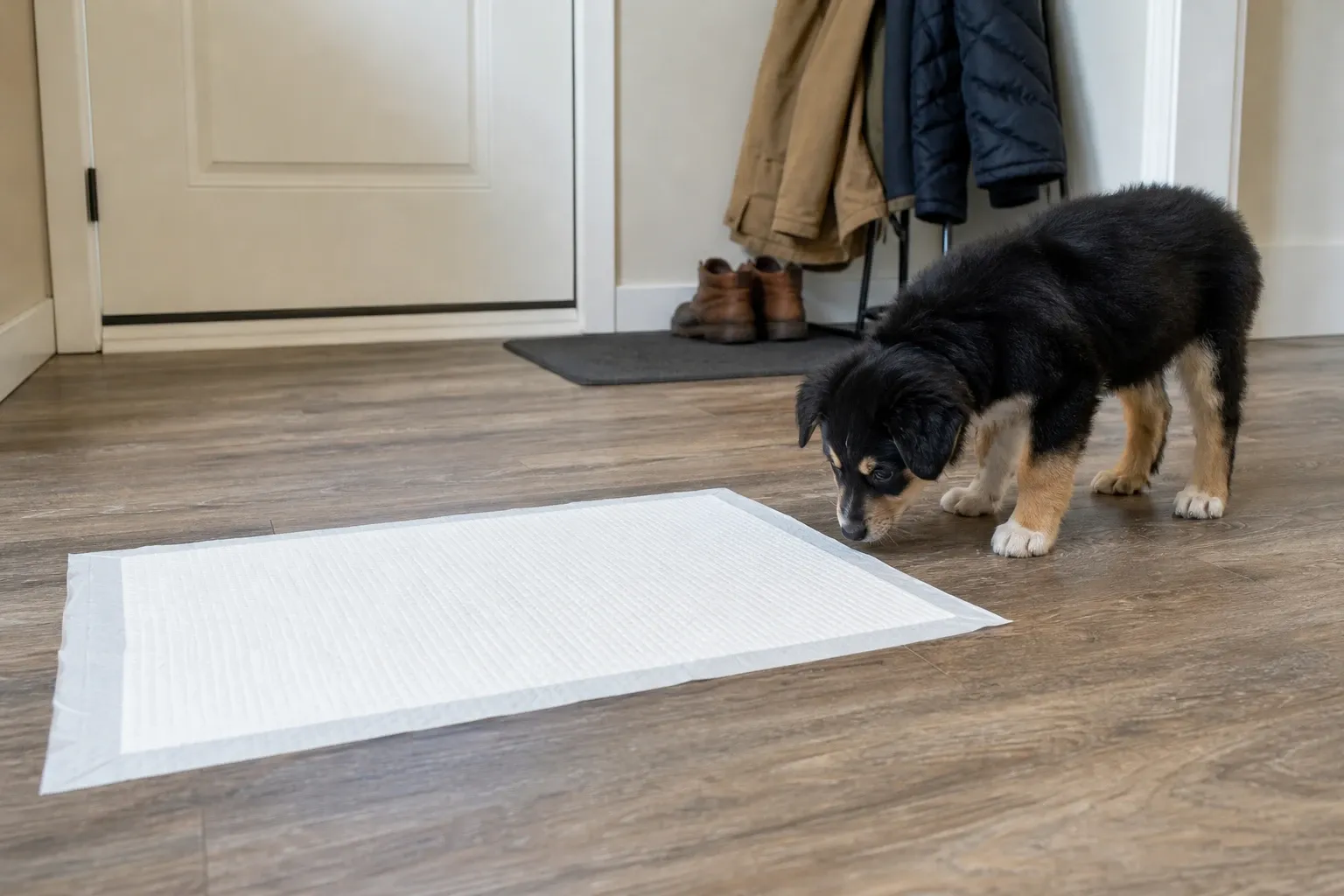
You get a puppy to pee on a pad by making the pad the easiest, most rewarding place to go, over and over. Best for: puppies and small adult dogs starting from scratch.
Step 1: Pick one spot and set up the area
One designated potty spot works far better than pads scattered around the house. Choose a quiet corner away from food and bed. At first, put the pad inside a small pen or gated area so your puppy is never far from it.
Scattered pads teach “go anywhere,” which is the habit you’re trying to avoid.
Step 2: Take the puppy to the pad on a schedule
A bathroom schedule routine means you bring the puppy to the pad before it has a chance to go elsewhere. Go right after waking, eating, drinking and play. Stand quietly and wait a minute or two. Skip games and chatter until it’s done.
Step 3: Reward the moment it finishes
Praise and reinforcement right as your puppy finishes, while it’s still on the pad, is what links the pad to good things. Keep tiny treats near the pad so you’re not running for the kitchen. A calm “good potty” plus a treat is plenty.
Quick tip: Say a short cue such as “go potty” just before it goes. Later you can use the same words outside.
Step 4: Handle accidents calmly
Accidents are part of house training, and punishment only teaches a puppy to hide when it pees. If you catch it mid-pee, calmly scoop it up and set it on the pad. Clean the spot with an enzymatic cleaner, a cleaner that breaks down the smell, so the scent doesn’t invite a repeat.
If your puppy ignores a clean pad, tuck a small scrap of a used pad on top so it smells right.
How often should you take a puppy to the pad, and when do you change it?
Most young puppies need the pad roughly every 1 to 2 hours while awake, plus straight after meals, naps and play. Treat any rule of thumb as a starting point and adjust to your own puppy.
Sample bathroom schedule
A sample puppy bathroom schedule might look like this for a young puppy:
| Time or event | Take to pad? | Notes |
|---|---|---|
| Wake up | Yes, right away | Carry if needed |
| After each meal | Yes, within 5 to 15 minutes | Poop is likely |
| After drinking | Yes | Watch closely |
| After play | Yes | Excitement fills bladders |
| Every 1 to 2 hours awake | Yes | Stretch as it grows |
| Last thing at night | Yes | Keep it calm |
| Overnight | Once, for the youngest puppies | Quiet, no play |
For a fuller day plan, see our schedule for potty training a puppy.
Signs a puppy needs to go
A puppy that needs to go often sniffs the floor, circles, whines, stops playing suddenly or heads for a corner. When you see these, walk it to the pad straight away.
Changing the pad
Change a puppy pad once it’s soaked through or smells strongly, not necessarily after every pee. Some puppies refuse a dirty pad, so change those sooner. Others go more reliably with a little scent left, so you can keep a small used corner on the fresh pad.
How do you move from pads to outdoor potty training?
You move from pads to outdoor potty training in small steps, and only once your puppy uses the pad reliably. Rushing usually means more accidents.
Moving the pad toward the door
Moving the pad toward the door teaches your puppy to head for the exit when it needs to go. Shift it a few feet every few days. If accidents start, move it back a step and wait longer. You can also cut the pad smaller over time.
Taking the first trips outside
Your first outdoor trips can start once your vet says it’s safe, even while pads are still in use. Lay a used pad, or a grass pad, on the grass as a bridge. Use the same cue and the same treats you used indoors. Reward outside the second it finishes.
Going pad-free
Going pad-free works best once your puppy mostly chooses outside. Remove the indoor pad and keep outdoor trips frequent for a while. A puppy that pees by the door where the pad was is telling you to go out sooner.
What if your puppy won’t pee on the pad, or won’t poop?
A puppy that won’t use the pad usually needs a quieter spot, more frequent trips or a smaller space. Small changes often fix it.
Puppy refuses the pad
A puppy that refuses the pad may dislike its location, its texture or a dirty surface. Move it somewhere calm, try a grass pad, and shrink the play area if the puppy keeps going elsewhere.
How to get a puppy to poop
To get a puppy to poop, take it to the spot 5 to 15 minutes after a meal, walk slowly in a small circle and say your cue. Stay calm for a few minutes. If your puppy strains, seems uncomfortable or hasn’t pooped in a while, ask your vet rather than guessing.
How long does pad potty training take?
Pad potty training usually takes weeks to months, not days, and no three-day trick fits every puppy. Many puppies pick up the pad habit within the first few weeks, manage longer gaps by around 4 to 6 months, and go fully pad-free later. Small breeds with tiny bladders often take longer than large breeds. Every puppy moves at its own pace, so steady routine matters more than speed.
Where pad training fits in your puppy’s house training
Pad training is one piece of the bigger job of house training a puppy. Our full guide to puppy potty training covers outdoor routines, crates and setbacks step by step. If you want a wider plan for cues, manners and games, start at our dog & puppy training hub.
Some owners like a structured course for life beyond potty basics. Brain Training for Dogs by Adrienne Farricelli is one option: self-paced games and obedience lessons you follow at home. Our Brain Training for Dogs review covers what’s inside and who it suits. It won’t do potty training for you.
See the current course details and refund terms on the creator’s site.
See what's inside Brain Training for Dogs60-day money-back guarantee
Owners also ask
Can I use pee pads and crate training together?
Yes. Many owners keep the crate for sleep and quiet time and place a pee pad in a small pen attached to it, away from the bed. Puppies usually avoid soiling where they sleep, so the pad gives them a clear alternative. Avoid putting a pad inside the crate itself.
Should I use grass pads instead of regular pads?
Grass pads can be a good choice if you plan to move your puppy outside later, because the surface feels more like a lawn. They cost more and need regular replacing or rinsing. Regular pads are cheaper and easier for very young puppies. Pick whichever your puppy uses reliably.
How many pee pads should I put down at once?
Start with one or two pads side by side in a single spot, so a small puppy has a big enough target. Avoid spreading pads around the home. Once your puppy hits the pad reliably, go back to one pad, then trim it smaller as you move toward the door.